
How Leaders Mistake Arrogance for Confidence and Quietly Shut Down the Execution Engine by Dr. Abiola Salami, Worldclass Performance Strategist
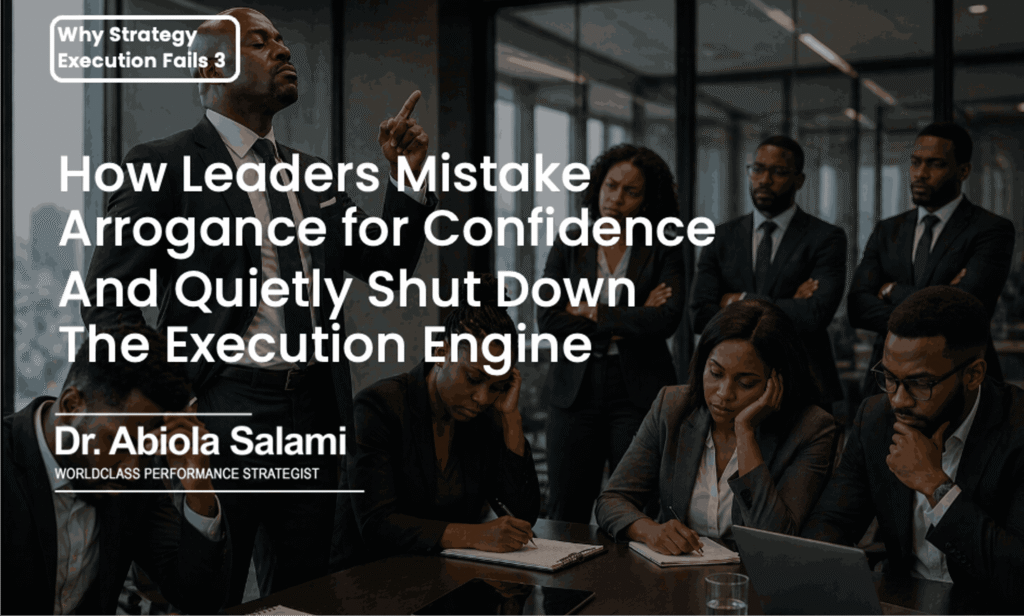
How To Prevent Strategy Execution Failure 3: How Leaders Mistake Arrogance for Confidence and Quietly Shut Down the Execution Engine by Dr. Abiola Salami
In many organizations today, strategy is not the problem. Execution is.
Plans are clear. Goals are defined. Teams are capable. Yet performance remains inconsistent.
Not because leaders lack intelligence. But because many leaders are operating from a dangerous blind spot i.e. They no longer know the difference between confidence and arrogance. And that difference is not personality. It is execution.
The Leadership Miscalculation Nobody Talks About
Confidence is celebrated. Arrogance is rarely admitted. Yet in practice, they often look the same.
Both speak with certainty. Both make decisions quickly. Both command attention. But beneath the surface, they produce completely different outcomes. One accelerates execution. The other quietly destroys it.
Confidence Accelerates Execution
Confident leaders create movement. They invite ideas, encourage challenge and expand thinking. They understand that no single perspective is ever complete. So they ask questions. They listen actively. They create space for others to contribute. They understand that when people feel heard, they think better, contribute more and execute faster. Because confidence builds collective intelligence but arrogance slows execution.
Arrogance looks similar but behaves differently. It kills feedback, shrinks perspectives and creates blind spots. Arrogant leaders interrupt before others finish, dismiss ideas quickly and defend positions instead of exploring them. And over time, something dangerous happens.
People stop contributing. Not because they lack ideas. But because they believe their ideas are not wanted.
Execution Insight: Silence Is a Warning Sign
The moment feedback reduces, execution risk increases because problems go unchallenged, weak ideas move forward and risks are ignored. Consequently, the organization becomes less adaptive and more fragile over time.
When leaders stop listening, teams stop contributing. And when teams stop contributing, they don’t disengage completely. They simply reduce how they show up. Less challenge. Less creativity. Less ownership.
Execution does not collapse instantly. It weakens gradually because people are no longer bringing their full intelligence into the room. And the strongest organizations understand that execution thrives where people are encouraged not just to attend but to contribute; not just to agree but to think and not just to be present but to fully show up.
The Room That Looks Aligned but Is not
Many leaders walk into meetings and see no disagreement, no tension, no resistance. And they conclude:
“We are aligned.” But what if that silence is not alignment? What if it is withdrawal? Quiet teams are often disengaged, cautious and selectively compliant. They are not contributing their best thinking. They are managing the leader. And once that happens, execution becomes shallow.
The Success Trap
Here is where it becomes even more subtle. Many leaders don’t start arrogant. They grow into it. Success reinforces belief. Results build confidence. Recognition increases authority. And gradually, something shifts. The leader becomes used to being right. Then begins expecting to be right. Then stops questioning whether they might be wrong. That is where confidence quietly crosses into arrogance.
The Cost to Execution
At first, performance may not drop. In fact, it may improve. Because arrogant leaders move fast, decide quickly, push hard but over time, the following hidden costs emerge:
- Blind Spots Expand: Without input, leaders see less, decisions become narrow and risk increases.
- Talent Goes Quiet: High performers want to contribute. When ignored, they withdraw or leave. Execution loses its strongest voices.
- Learning Slows Down: Confident leaders stay curious. Arrogant leaders believe they already know. And when learning stops execution becomes outdated.
The Bigger Context: Strategy Execution in Human Environments
Execution is not mechanical. It is human. Human systems depend on trust, voice and psychological safety. When leaders shut down feedback even unintentionally, they damage the very system required for execution. This is why many organizations struggle. They focus on improving strategy but ignore the leadership behaviors shaping execution.
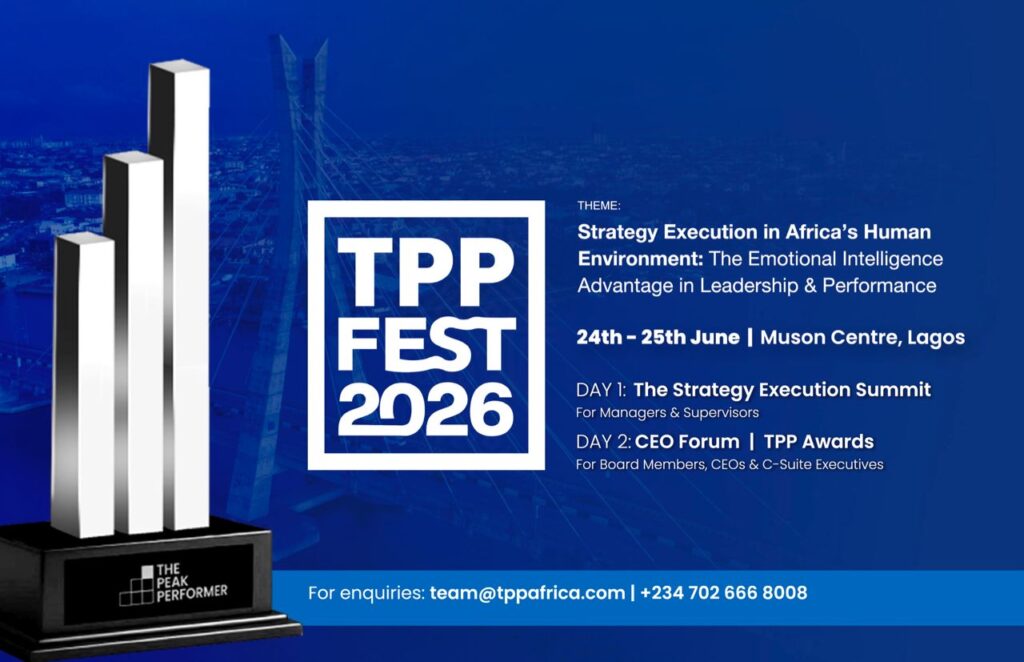
The TPPFEST Framework™ — Restoring Execution Through Leadership Discipline
As we build toward TPP Fest 2026, we must remember that execution excellence requires leaders who can balance confidence with humility. The TPPFEST Framework™ provides that structure.
T — Timely & Decisive Leadership
Confidence enables speed. Arrogance creates false certainty. Great leaders decide quickly but remain open to adjustment because execution requires movement not rigidity.
P — People-Centered Execution
Confident leaders involve people. Arrogant leaders override them. Execution improves when leaders listen actively, invite input and value diverse thinking
P — Performance Accountability Without Fear
Arrogance creates fear and fear creates silence. Confident leaders build open dialogue, honest reporting and shared ownership because performance thrives in trust not intimidation.
F — Focus & Energy Discipline
Arrogance often leads to overconfidence and poor prioritization. Confident leaders remain grounded.
They focus on what matters, conserve energy and avoid unnecessary complexity
E — Emotional Intelligence Under Pressure
This is the real differentiator. Confident leaders regulate emotion, stay curious and respond thoughtfully. Arrogant leaders eact defensively, protect ego and shut down conversation. And that difference shapes execution outcomes.
S — Scalable Systems Over Personality
Execution should not depend on one person’s certainty. Confident leaders build systems. Arrogant leaders centralize control. And centralized control always slows execution.
T — Total Leadership Alignment
Confidence invites alignment. Arrogance forces agreement. And forced agreement is not real alignment. It is compliance.
Looking Ahead: TPP Fest 2026
This entire conversation is about a shift. A new way of thinking about performance. The conversation comes alive TPP Fest 2026 on 24th – 25th June with the theme Strategy Execution in Human Environments:The Emotional Intelligence Advantage in Leadership & Performance to serve two clear verticals – (i) Strategy Executors (i.e. Managers & Supervisors) will be exposed to our proprietary framework on The Magic of Emotional Intelligence for Daily Execution with a focus on Behavior, Communication, Team Climate (ii) Strategy Leaders (i.e. Senior leaders, C-Suite Executives, Company Directors etc) will be exposed to our proprietary framework on Taming the Invisible Toll of Leadership ExpectationsTM with a focus on Decision Quality, Pressure Management and Organizational Energy.
We must remember that the leaders who will win are not the ones who always have answers. They are the ones who are willing to ask better questions. Because in the end, execution does not depend on how much you know. It depends on how well you listen, adapt, and lead through people.
A Practical Leadership Shift
Start with one habit. Replace “I know this will work.” with “What are we missing before we move?”
That single question does three things i.e. invites thinking, surfaces risk and strengthens decisions
And most importantly, it keeps confidence from becoming arrogance.
When people challenge your ideas, do you become curious OR defensive? Because that moment defines your leadership posture. And your leadership posture defines your execution environment.
Final Thought
Confidence builds credibility. Arrogance erodes it. Confidence attracts ideas. Arrogance silences them. Confidence strengthens execution. Arrogance weakens it quietly, gradually, and dangerously. Confidence opens the door for contribution. Arrogance quietly shuts it. And the difference between the two determines whether people hold back or step forward. Because execution does not depend on how much the leader knows. It depends on how many people are willing to bring their best thinking forward.
And that only happens in cultures where people show up.
About Dr. Abiola Salami
Dr. Abiola Salami is the Convener of Dr Abiola Salami International Leadership Bootcamp ; The Peak PerformerTM Festival Made4More Accelerator Program and The New Year Kickoff Summit. He is the Principal Performance Strategist at CHAMP – a full scale professional services firm trusted by high performing business leaders for providing Executive Coaching, Workforce Development & Advisory Services to improve performance. You can reach his team on hello@abiolachamp.com and connect with him @abiolachamp on all social media platforms.
For private coaching, boardroom recalibration, or executive healing strategy, connect email me directly at hello@abiolachamp.com to begin your private Executive Coaching Session.

