
WE HAVE MEASURED PERFORMANCE. NOW, WHAT WILL WE DO WITH THE EVIDENCE? By Dr. Abiola Salami, FNIM, FCIPD (UK), FCIPM, ACIB | Principal, CHAMP Global Leadership Consulting
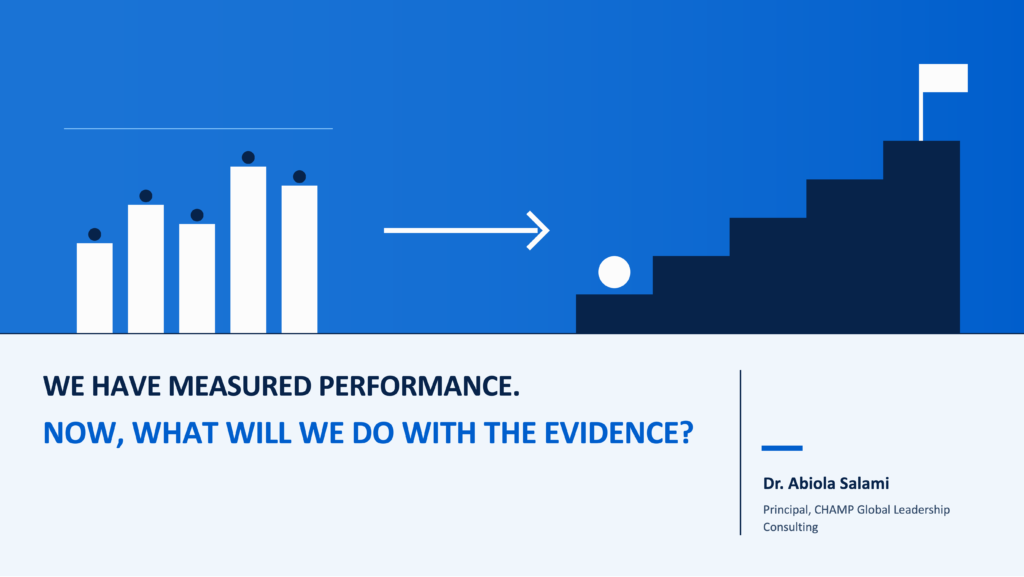
“There is a difference between measuring performance and being prepared to act on what measurement reveals.” – Dr. Abiola Salami
INTRODUCTION
Organisations commission assessments, run employee surveys, review results and prepare strategic reports. Governments publish indicators and monitor programmes. Yet information alone does not produce better decisions. The real test of measurement is what happens afterwards.
What changes in the boardroom when evidence reveals weak leadership capability? What happens when research exposes barriers to women’s progression, or an assessment identifies gaps in governance, execution or succession? What happens when public institutions discover their activities are not producing the outcomes citizens expect?
Measurement should never become an administrative exercise. Its purpose is to improve the decisions, behaviours and systems that determine outcomes. This is the larger conversation emerging from The Peak Performance Summit & Honours 2026 and two complementary initiatives i.e. the No More Shrinking® Full Capacity Report and the Performance Leadership Index.
WHAT WE HAVE CHOSEN TO EXAMINE
The Full Capacity Report asks whether organisations are getting the full contribution of the women they employ. It examines the experiences, conditions and practices that shape women’s progression. Representation figures alone cannot establish whether women have meaningful access to opportunity, strategic responsibility, influence and advancement.
The Performance Leadership Index asks whether organisations have the leadership capabilities and systems to sustain performance. It covers ten dimensions: strategic coherence, execution discipline, accountability, leadership capability, succession, governance, organisational alignment, adaptability, stakeholder confidence and enduring performance.
Together, they examine the capacity within a workforce and the institutional conditions required to convert it into results. The Peak Performer Awards add a further dimension: recognition supported by transparent standards and evidence. None claims to measure everything perfectly, but together they offer a more disciplined basis for asking questions that are often overlooked.
WHAT THIS MEANS FOR THE BOARDROOM
Financial performance, compliance and risk remain essential board concerns, but modern organisations demand a broader view of institutional performance.
A board should not be satisfied merely because management presents a strategy; it must examine whether the strategy is coherent, resourced and supported by execution discipline. A training budget does not prove leadership development. Succession policies do not prove succession readiness. Women in senior positions do not prove the organisation is unlocking women’s full capacity; boards should examine progression, access to strategic assignments and workplace experience.
Above all, boards must ask whether the organisation is becoming stronger or simply larger. Such questions move directors from reviewing management activity to interrogating institutional capability.
WHAT THIS MEANS FOR POLITICS AND PUBLIC LEADERSHIP
The same principle must apply to government. Political leadership is often judged by visibility, announcements, promises and projects inaugurated, but citizens experience government through outcomes. A policy announcement is not a policy outcome. A budget allocation is not development. A completed project does not necessarily deliver its intended public value.
Are public services more accessible? Are schools producing better learning outcomes? Are health systems more reliable? Are infrastructure investments reducing the cost of doing business? Are institutions more responsive and accountable? These are performance questions.
The Performance Leadership Index is not a political scorecard and should not be presented as one. But its principles reinforce the expectation that public leadership be examined through evidence, capability and outcomes. Citizens deserve more than promises; they deserve institutions that deliver measurable public value.
WHAT THIS MEANS FOR THE MARKETPLACE
Reputation can be persuasive, but it should not replace examination. Investors need to understand the quality and sustainability of performance, not just headline earnings. Customers should expect consistency, integrity and value. Employees should be able to see whether stated values are reflected in practice.
Stakeholders need not become performance analysts, but their expectations should become more discerning. A company should be able to explain how it creates value, manages risk, develops people and prepares for the future. It should also be able to show that its performance rests on systems rather than individual heroics.
THE RESPONSIBILITY OF LEADERS
Measurement can expose uncomfortable gaps: between ambition and execution, representation and influence, profitability and productivity, governance structures and governance effectiveness. But evidence does not automatically produce improvement.
Leaders must accept what the evidence reveals. Boards must ask difficult questions. Management must translate findings into priorities, HR leaders must examine workplace systems, and public officials must connect policy intentions to measurable outcomes.
An assessment that identifies a weakness but produces no intervention is incomplete. A report that exposes barriers but informs no action has limited value. A ranking that generates publicity without improvement becomes another exercise in visibility. Success must include what changes after the measurement.
FROM EVIDENCE TO INSTITUTIONAL CHANGE
This work cannot end with a summit, report launch or awards ceremony. The Full Capacity Report’s next step is to translate findings into practical interventions that improve women’s opportunities and contribution. The Performance Leadership Index should encourage institutions to examine their evidence, identify capability gaps and strengthen the systems behind enduring results. The Peak Performer Awards must preserve the credibility of recognition through rigorous, evidence-based standards. These are continuing commitments, not one-day activities.
Measurement alone will not solve Nigeria’s institutional challenges. But without it, decisions rest on assumptions, impressions and incomplete information.
THE QUESTION IS WHAT HAPPENS NEXT
The value of measurement lies not in the score, report, ranking or recognition, but in what leaders do with the evidence. In the boardroom, it should improve oversight. In government, it should strengthen accountability. In the marketplace, it should sharpen expectations. Within organisations, it should unlock people’s capacity and strengthen the systems through which they contribute.
We must become less impressed by what institutions claim and more interested in what they can demonstrate. We must stop treating activity as achievement, visibility as influence and ambition as capability. Measurement only becomes meaningful when it changes decisions and produces better outcomes.
We have measured performance. The next test is whether we have the courage to act on what the evidence tells us.
About Dr. Abiola Salami
Dr. Abiola Salami is a World-Class Performance Strategist, leadership authority and founder of CHAMP Global Leadership Consulting. He is the originator of Performance Leadership™ and the driving force behind No More Shrinking®, platforms dedicated to advancing leadership excellence, human potential and transformative impact. Through his work, he equips leaders and organisations to bridge the gap between investment, capability, execution and measurable outcomes, building the leadership capacity required to achieve extraordinary and sustainable performance. Reach him on hello@abiolachamp.com
NB
If you are a Supervisor, Manager or Team Lead, Take the Manager’s Execution Scorecard Assessment to see where execution may be breaking in your team.
If you are a Senior Executive, Look into the Invisible Toll Mirror to see the toll of the weight you are carrying.
For private coaching, boardroom recalibration, or executive healing strategy, connect email me directly at hello@abiolachamp.com to begin your private Executive Coaching Session.

