
WOMEN ARE IN THE WORKFORCE. BUT ARE ORGANISATIONS GETTING THEIR FULL CAPACITY?. by Dr. Abiola Salami, FNIM, FCIPD (UK), FCIPM, ACIB | Principal, CHAMP Global Leadership Consulting
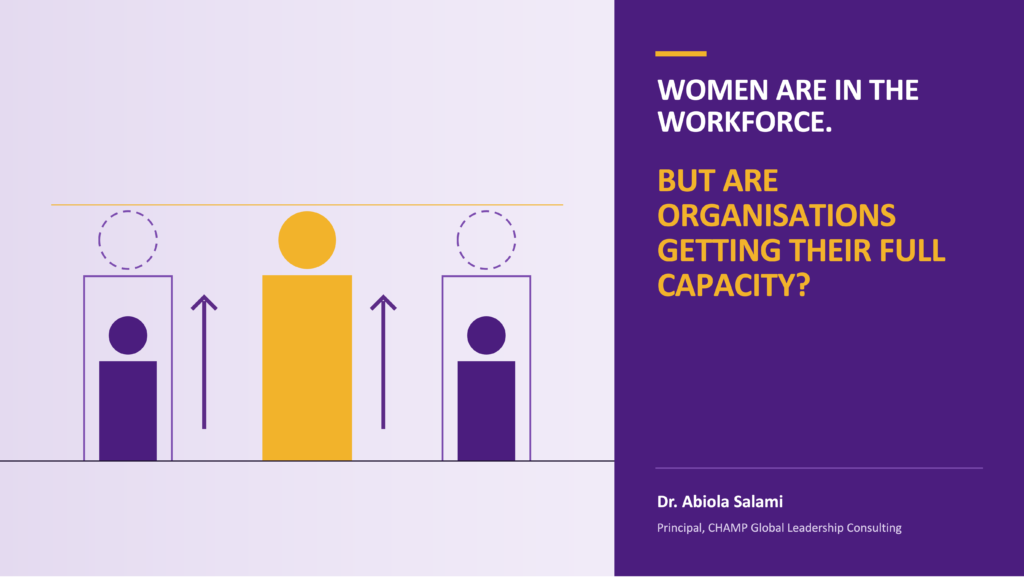
“An organisation can employ women, promote women, celebrate women and still fail to benefit from the full capacity of its female workforce.” – Dr. Abiola Salami
INTRODUCTION
Representation matters, but it does not tell us whether women have meaningful access to opportunity, whether their contributions influence decisions, whether their careers progress at a fair pace or whether the workplace allows them to perform at their full potential.
Too often, conversations about women at work have centred on participation figures, diversity statements, commemorative events and leadership appointments. These are useful indicators, but the more consequential question is whether organisations create the conditions in which women’s capabilities are fully utilised. That is not merely a social concern. It is a performance concern.
PARTICIPATION IS NOT THE SAME AS PROGRESSION
World Bank Gender Data, drawing on ILO modelled estimates, puts Nigeria’s female labour-force participation at 80.7 per cent in 2025, compared with 84.3 per cent for men. Yet participation does not automatically translate into quality employment, decision-making authority or senior leadership.
McKinsey’s 2025 Women in the Workplace analysis covering Nigeria, India and Kenya reported that women held approximately 51 per cent of entry-level roles in Nigeria but around 38 per cent of senior-level positions. It also noted barriers to entering formal employment and a relatively narrow pipeline into the C-suite.
If women are participating in the workforce, what happens as they seek to progress?
One data point cannot explain the entire Nigerian labour market; industries, organisational structures and career pathways differ. But the evidence reinforces the need to examine progression, not simply participation. An organisation may employ many women while its strategic assignments, revenue-generating responsibilities, succession opportunities and most influential positions remain concentrated elsewhere. It may be counting women’s presence without assessing their influence.
THE INVISIBLE STRUCTURES THAT SHAPE PROGRESSION
Career progression is rarely determined by competence alone. It is shaped by access to opportunities, sponsorship, networks, culture, performance evaluation, flexibility, leadership expectations and workplace relationships. Some barriers are formal and visible. Others are embedded in everyday behaviour.
Consider strategic assignments. Who leads a major transformation programme? Who is entrusted with a difficult business unit? Who gains exposure to the board, is sponsored for an international opportunity, or is considered ready for promotion? These decisions shape careers long before a vacancy is advertised.
How leadership potential is interpreted also matters. Organisations sometimes judge readiness through narrow expectations of availability, visibility, personal style or conformity to established leadership behaviour. Left unexamined, these expectations cause capable professionals to be overlooked because they do not fit an inherited image of leadership.
Culture matters too. Employees may formally have equal opportunities while informal behaviours undermine them. Being interrupted, excluded from influential networks, denied credit or expected to prove competence repeatedly can accumulate into significant professional disadvantage. The effect may not appear in any policy document, but it becomes visible in career trajectories.
THE COST OF UNDERUTILISED CAPACITY
When capable women cannot progress, organisations risk losing institutional knowledge, leadership potential, innovation and the return on their investment in recruitment and development. When women leave because they see limited prospects, the organisation incurs replacement costs and loses experience. When they stay but are excluded from meaningful responsibility, it retains talent without fully benefiting from it. And when leadership pipelines are unnecessarily narrow, succession options weaken.
The cost is not always visible in financial statements. It shows up in lower engagement, reduced retention, missed opportunities, weaker decision-making and a leadership bench that does not reflect the organisation’s available talent. The question is not only whether organisations employ enough women, but whether they are getting the best from the women they employ.
THE RESPONSIBILITY OF LEADERSHIP
This cannot be delegated to human resources or diversity committees. It is a leadership responsibility. Chief executives set priorities. Boards shape governance expectations and succession oversight. Line managers shape daily employee experience. Senior leaders decide who receives sponsorship, visibility and consequential assignments.
Organisations must therefore examine their systems rather than rely on individual success stories. Are promotion criteria clear and consistently applied? Is access to strategic assignments equitable? Do performance reviews identify and address bias? Do women have access to influential mentors and sponsors? Do workplace policies support sustained contribution? Do succession plans identify capable women for critical roles?
They must also distinguish symbolic inclusion from substantive influence. A woman in a senior position is significant, but the more important question is whether she has the authority, resources and institutional support to perform effectively.
WHY MEASUREMENT MATTERS
Organisations cannot improve what they have not examined. This is one reason for the No More Shrinking® Full Capacity Report. It moves beyond general statements about women’s empowerment to investigate the workplace experiences, progression conditions and organisational practices that shape women’s capacity; where women encounter barriers, how structures influence advancement, and which leadership behaviours enable or constrain contribution.
The report does not begin from a predetermined conclusion that every organisation discriminates against women, or that every difference in career outcome has a single explanation. Its aim is to investigate, listen, examine evidence and identify patterns organisations can act on.
A credible report must be willing to discover complexity, recognising differences across sectors, career stages, organisational sizes and professional contexts, and distinguishing individual experiences from systemic patterns. Most importantly, it must provide a basis for practical action.
FROM WOMEN’S EMPOWERMENT TO ORGANISATIONAL PERFORMANCE
Women’s advancement is often framed as an issue that primarily benefits women. That framing is incomplete. Unlocking women’s capacity widens an organisation’s access to talent, experience, judgement, innovation and leadership capability, strengthening succession pipelines and improving how it deploys its people.
Women should not have to prove their economic value before being treated fairly; fairness and equal opportunity matter in their own right. But organisations that understand the performance cost of exclusion are more likely to treat capacity utilisation as a strategic priority.
The same logic applies to other groups, including men, younger professionals and people with disabilities, whose contributions may be constrained by organisational structures. Human capacity should not be wasted. But women’s progression deserves specific examination, because general workforce measures can conceal the particular barriers women face.
THE QUESTION EVERY ORGANISATION SHOULD ASK
The next phase of this conversation must be more demanding. We should look beyond photographs, commemorative statements and the number of women on an employee register, and examine who progresses, who exercises influence, who receives strategic opportunities and who is being prepared to lead.
The test of an inclusive organisation is not simply whether women are present. It is whether they can contribute, advance and exercise their capabilities without unnecessary structural or behavioural constraints.
For boards and chief executives, this is an invitation to examine talent systems more honestly. For HR leaders, it is an opportunity to connect workforce research to measurable improvement. For women professionals, it is a call to recognise that their capacity should not be diminished by expectations unrelated to their ability to deliver.
An organisation cannot credibly claim to be people-centred while failing to understand the conditions under which its people perform.
The question is no longer whether women are in the workforce. It is whether the workforce is benefiting from everything women are capable of contributing.
About Dr. Abiola Salami
Dr. Abiola Salami is a World-Class Performance Strategist, leadership authority and founder of CHAMP Global Leadership Consulting. He is the originator of Performance Leadership™ and the driving force behind No More Shrinking®, platforms dedicated to advancing leadership excellence, human potential and transformative impact. Through his work, he equips leaders and organisations to bridge the gap between investment, capability, execution and measurable outcomes, building the leadership capacity required to achieve extraordinary and sustainable performance. Reach him on hello@abiolachamp.comNB
If you are a Supervisor, Manager or Team Lead, Take the Manager’s Execution Scorecard Assessment to see where execution may be breaking in your team.
If you are a Senior Executive, Look into the Invisible Toll Mirror to see the toll of the weight you are carrying.
For private coaching, boardroom recalibration, or executive healing strategy, connect email me directly at hello@abiolachamp.com to begin your private Executive Coaching Session.

