
NIGERIAN @ 66: WHAT KIND OF INTEGRATED MARKETING COMMUNICATION LEADERSHIP & EXPERTISE DOES A NATION TRYING TO GROW TO $1TRILLION ECONOMY NEED? by Dr. Abiola Salami, FNIM, FCIPD (UK), FCIPM, ACIB | Principal, CHAMP Global Leadership Consulting
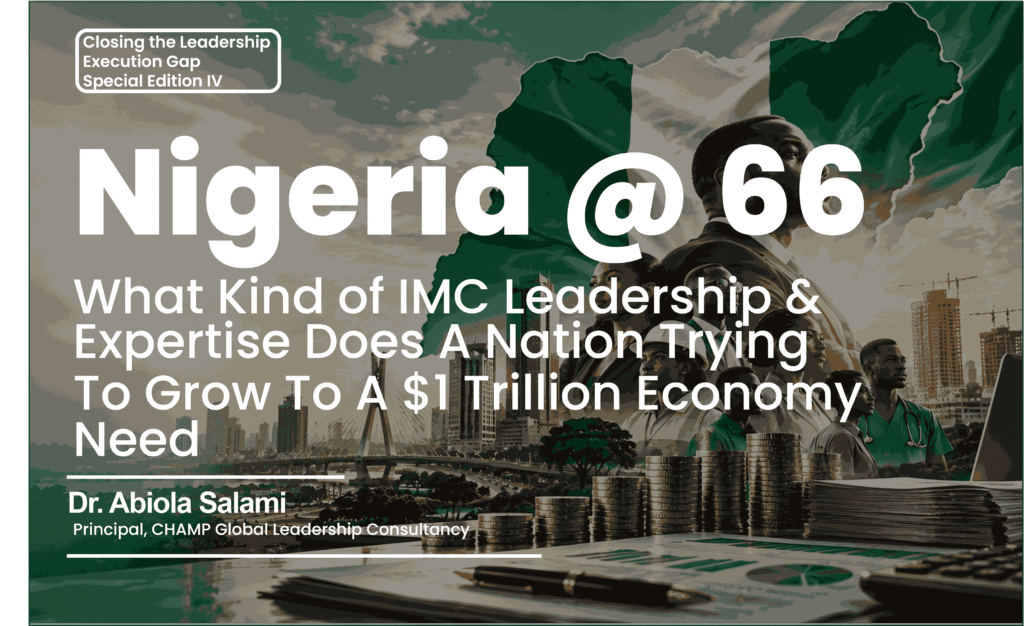
“As Nigeria turns 66, Nigeria’s Integrated Marketing Communications leaders must answer a vital question i.e. What part of the $1 trillion economy will our ability to build trust, create demand and make Nigerian value desirable help produce?” – Dr. Abiola Salami
Introduction
Nigeria is 66.
One of the country’s defining economic ambitions is to build a $1 trillion economy by 2030. The Federal Government’s current development agenda expressly identifies the journey toward a US$1 trillion economy, with investment, enterprise, economic diversification and human-capital development among the drivers.
On Independence Day itself, the national conversation has moved increasingly toward productivity, enterprise, industrial growth, Nigerian businesses selling to the world and converting economic reforms into broadly shared prosperity.
But there is a question the Integrated Marketing Communications industry should be asking i.e. How does a nation communicate its way into a $1 trillion economy?
This is not because communication substitutes for production; it does not.
This is not because great advertising can compensate for bad products, poor infrastructure or weak institutions; it cannot.
But because in a competitive global economy, value that is poorly understood, badly positioned, weakly differentiated or insufficiently trusted will struggle to realise its full economic potential.
Countries compete, companies compete, cities compete, products compete, ideas compete, talent competes, capital competes, and increasingly, narratives compete.
So, if Nigeria wants to build a $1 trillion economy, the country will need more than factories, technology, infrastructure, financial capital and productive people.
It will also need a sophisticated generation of Integrated Marketing Communications leaders capable of helping Nigerian value win attention, trust, preference, markets and ultimately revenue.
That makes IMC more than a communications conversation. It makes it an economic performance conversation.
A $1 Trillion Economy Must Know How to Sell
Consider what the ambition actually requires.
Nigeria will need more businesses to grow, more Nigerian brands will need to compete regionally and globally, more products will need to move from local production into export markets, more investment opportunities will need to attract capital, more Nigerian destinations will need to attract visitors, more innovations will need to win adoption, more SMEs will need to become scalable enterprises, more organisations will need to earn consumer confidence and Nigeria itself will continually compete for investors, tourists, talent, partnerships and global influence.
Almost every one of those outcomes contains a communications challenge where we will start asking, can we make people understand the value? Can we make them believe it? Can we make them prefer it? Can we make them trust it? Can we make them buy it? Can we make them advocate for it? Can we sustain that trust when something goes wrong?
That is where Integrated Marketing Communications becomes significant.
Nigeria Does Not Merely Need More Advertising. It Needs More Demand Creation.
One danger for the profession is to reduce marketing communications to visibility by running the campaign, buying the media, getting the impressions, generating engagement, trending on social media, winning the award and produce the beautiful television commercial.
There is nothing inherently wrong with any of those things; but the question for an economy seeking significant expansion must be What economic behaviour did the communication produce?
Did awareness become consideration? Did consideration become preference? Did preference become purchase? Did communication expand the category? Did it increase adoption? Did it change behaviour? Did it create trust? Did it improve customer lifetime value? Did it open a new market? Did it make a Nigerian product more competitive? Did it attract investment? Did it strengthen reputation? Did it produce measurable commercial value?
In other words Where is the performance?
The future of IMC leadership cannot be measured merely by the amount of communication produced. It must increasingly be measured by the value communication helps unlock.
So What Kind of IMC Leadership Does a $1 Trillion Nigeria Need?
A. We Need Market-Making Communicators
The best marketing communication does not simply fight for market share. Sometimes, it creates markets.
Nigeria needs practitioners who understand unmet needs, emerging behaviours, cultural shifts and economic opportunity well enough to help businesses create new categories of demand.
They must be able to ask Who is currently outside this market? Why? What belief is preventing adoption? What behaviour must change? What friction must disappear? How can communication make the unfamiliar understandable and the complicated desirable?
When millions of consumers adopt digital payments, insurance, financial services, healthcare products, clean energy solutions, locally manufactured goods or new technology, economic activity expands, IMC can help accelerate that adoption.
That is not merely promotion; that is market creation.
B. We Need Reputation and Trust Architects
A $1 trillion economy cannot run sustainably on low trust. Consumers need to trust companies. Investors need to trust institutions. Citizens need credible information. Global partners need confidence in counterparties. Employees need to believe leadership. Communities need to trust businesses operating around them. Brands need to know that reputation can take decades to build and hours to damage.
This means Public Relations cannot remain primarily press release distribution. Corporate Communications cannot merely manage announcements. Reputation management cannot begin when there is a crisis.
The new IMC leader must understand that trust is economic capital; because trust reduces friction. It encourages transactions. It strengthens brands. It attracts investment. It protects institutions during uncertainty.
In a world in which misinformation can travel faster than corporate response, reputation leadership becomes even more strategic.
C. We Need Nigerian Brand Builders With Global Ambition
A $1 trillion Nigeria cannot be an economy where we consume sophisticated global brands but struggle to build enough globally desired Nigerian brands.
We should ask ourselves; How many Nigerian brands can become category leaders across Africa? How many can become globally recognised? How many Nigerian products can command premium pricing because of the strength of the brand behind them?
Brand is not decoration. Brand is not a logo. Brand is not merely celebrity endorsement. At its best, brand is an economic multiplier.
Two products may have comparable functional value, but the one with stronger reputation, distinctiveness, emotional connection and consumer trust can command greater preference and sometimes greater economic value.
Nigeria therefore needs IMC leaders capable of helping local businesses move from
Made in Nigeria → Trusted in Nigeria → Preferred across Africa → Desired globally.
That journey requires world-class brand strategy.
D. We Need Export Storytellers
If Nigerian businesses are going to sell more Nigerian goods and services to the world, as the country’s current economic agenda envisages, then export competitiveness must include narrative competitiveness.
The world must understand what Nigeria produces exceptionally well. From financial technology to entertainment to fashion to food to professional services to creative industries to technology to manufacturing to agriculture to culture.
We need people who can package Nigerian value in language, imagery, experiences and stories that global markets understand.
This does not mean manufacturing an attractive story around poor-quality products; the product must perform. But once the product performs, communication must ensure that the value does not remain invisible.
Nigeria cannot build a globally competitive economy while consistently allowing others to tell our commercial story better than we do.
E. We Need Consumer Intelligence Leaders
Communication must begin long before the creative brief. It begins with understanding human beings.
What do people value? What are they afraid of? What are they trying to become? What pressures shape their choices? What cultural codes influence behaviour? What makes them trust? What makes them switch? What makes them stay?
Nigeria is not one homogeneous consumer market. Income, geography, generation, language, culture, digital access, education and lifestyle create dramatically different consumer realities.
A sophisticated IMC leader must therefore move beyond intuition. We need professionals who combine Culture + Behaviour + Data + Technology + Commercial Intelligence.
The organisations that understand Nigerians most deeply may increasingly become the organisations best equipped to serve them profitably.
F. We Need Data-Literate Creative Leaders
Creativity remains essential; but creativity and measurement can no longer live in separate rooms.
The new communications leader should understand reach and conversion, attention and acquisition, engagement and economics, sentiment and sales, brand equity and commercial outcomes as well as customer experience and retention.
Marketing communications should increasingly be able to demonstrate a conversion chain Investment → Attention → Engagement → Behaviour → Demand → Revenue → Enterprise Value.
I reckon that not every communications outcome can be reduced neatly to a financial metric; that would be simplistic. But neither should complexity become an excuse for avoiding accountability.
The $1 trillion economy needs IMC professionals who can speak both the language of creativity and the language of business performance.
G. We Need Technology-Enabled Communicators
Artificial intelligence is already changing marketing i.e. content production, personalisation, consumer intelligence, media planning, customer engagement, creative development, analytics, search, commerce, reputation monitoring.
The question is no longer whether technology will affect Integrated Marketing Communications. It already is. The leadership question is Who will use it intelligently?
Nigeria needs IMC leaders who understand how to combine machine capability with human judgement. Technology should enable greater speed, relevance, personalisation and insight.
But the competitive advantage will not simply belong to whoever can generate the most content. If everybody can produce more content, then discernment, strategy, original insight, authentic creativity, trust and understanding humans become more valuable.
H. We Need Crisis-Ready Institutional Communicators
As institutions become larger and more visible, scrutiny increases. A company’s response to one operational failure, executive controversy, product problem, employee incident or social issue can rapidly become a reputational event.
Silence can communicate. Delay can communicate. Defensiveness can communicate. Contradiction can communicate.
Nigeria needs senior communication leaders who are involved before crises occur. They should have sufficient institutional standing to challenge leadership, identify reputation risks, prepare response architecture and ensure that what organisations say remains connected to what organisations actually do because communication cannot permanently repair an operational truth.
The strongest reputation strategy will always begin with institutional performance.
I. We Need Ethical Persuaders
As communications capability becomes more powerful, responsibility becomes more important.
AI-generated content, influencer marketing, behavioural targeting, political communication, deepfakes, native advertising, data-driven personalisation, synthetic media; all create opportunities. They also create ethical questions.
The profession must decide what kind of influence it wants to exercise because the objective cannot simply be to persuade people. The more important objective will be about the way to persuade people.
Trust will become one of the most valuable currencies in the communication economy. The leaders who protect it will build institutions that last.
J. We Need IMC Leaders Who Understand the Boardroom
Perhaps the profession’s biggest transition is that the senior IMC leader of the future cannot merely be an expert in communications. He or she must understand enterprise, strategy, economics, customers, competition, risk, technology, eputation, regulation, operations, finance and growth.
The CMO, Communications Director, Agency CEO and Brand Leader should be capable of sitting at the executive table and connecting communication decisions with enterprise outcomes.
The conversation should no longer be:“This is our communication plan.” It should increasingly become “This is the business problem. This is the stakeholder behaviour preventing performance. This is how communication can change that behaviour. This is what we will measure.”
That is a different level of leadership.
And Then There Is Nigeria’s Own Brand
There is one more conversation the profession cannot avoid i.e. What does Nigeria mean to the world?
Every country has a brand whether it deliberately manages it or not. Our music communicates Nigeria. Our films communicate Nigeria. Our athletes communicate Nigeria. Our entrepreneurs communicate Nigeria. Our diaspora communicates Nigeria. Our companies communicate Nigeria. Our political institutions communicate Nigeria. Our airports communicate Nigeria. Our customer service communicates Nigeria. Our digital conversations communicate Nigeria. And our national performance communicates Nigeria.
This is why nation branding cannot simply be a slogan or campaign. The strongest national brand is eventually the reputation created by repeated national experience.
Communication can amplify reality. It can contextualise reality. It can correct misunderstanding. It can elevate overlooked success. But communication cannot indefinitely substitute for reality.
That means Nigerian IMC leaders should not merely ask How do we make Nigeria look better? The more useful question is What authentic Nigerian value deserves to be better understood, better positioned and better experienced by the world?
That is a much more credible foundation for national reputation.
From Communication Activity to Economic Performance
Perhaps this is the Independence Day challenge to the profession. Nigeria does not simply need more campaigns.
We need communication that creates markets, increases trust, grows brands, attracts investment, expands adoption, strengthens institutions, helps Nigerian enterprises cross borders, turns creativity into commercial value, helps worthy Nigerian products earn preference and makes Nigerian businesses globally competitive.
In other words, Nigeria needs Integrated Marketing Communications that performs.
At 66, as the country pursues the ambition of becoming a $1 trillion economy, the Integrated Marketing Communications profession should see itself not on the margins of that ambition but somewhere inside its economic engine.
Because economies grow partly by producing more value but they also grow when that value finds markets. When markets understand it. When customers trust it. When people choose it When investors believe in it. When the world is willing to pay for it.
This leaves Nigeria’s Integrated Marketing Communications leaders with perhaps the most important question of all i.e. What part of the $1 trillion economy will our ability to build trust, create demand and make Nigerian value desirable help produce?
This question is bigger than advertising, bigger than PR, bigger than media and bigger than marketing. It is the challenge of converting Nigerian value into Nigerian economic performance. And at 66, that is a challenge the profession should be ready to own.
That is the performance test. And that is the conversation we need to have..
About Dr. Abiola Salami
Dr. Abiola Salami is the Principal Performance Strategist at CHAMP – a full scale professional services firm trusted by high performing business leaders for providing Executive Coaching, Workforce Development & Advisory Services to improve performance. He is the Convener of Dr Abiola Salami International Leadership Bootcamp ; The Peak PerformerTM Festival Made4More Accelerator Program and The New Year Kickoff Summit. You can reach his team on hello@abiolachamp.com and connect with him @abiolachamp on all social media platforms.
NB
If you are a Supervisor, Manager or Team Lead, Take the Manager’s Execution Scorecard Assessment to see where execution may be breaking in your team.
If you are a Senior Executive, Look into the Invisible Toll Mirror to see the toll of the weight you are carrying.
For private coaching, boardroom recalibration, or executive healing strategy, connect email me directly at hello@abiolachamp.com to begin your private Executive Coaching Session.

