
Leadership Capacity Erosion: Why Capable Leaders Gradually Become Less Effective by Dr. Abiola Salami, Principal, CHAMP Global Leadership Consultancy
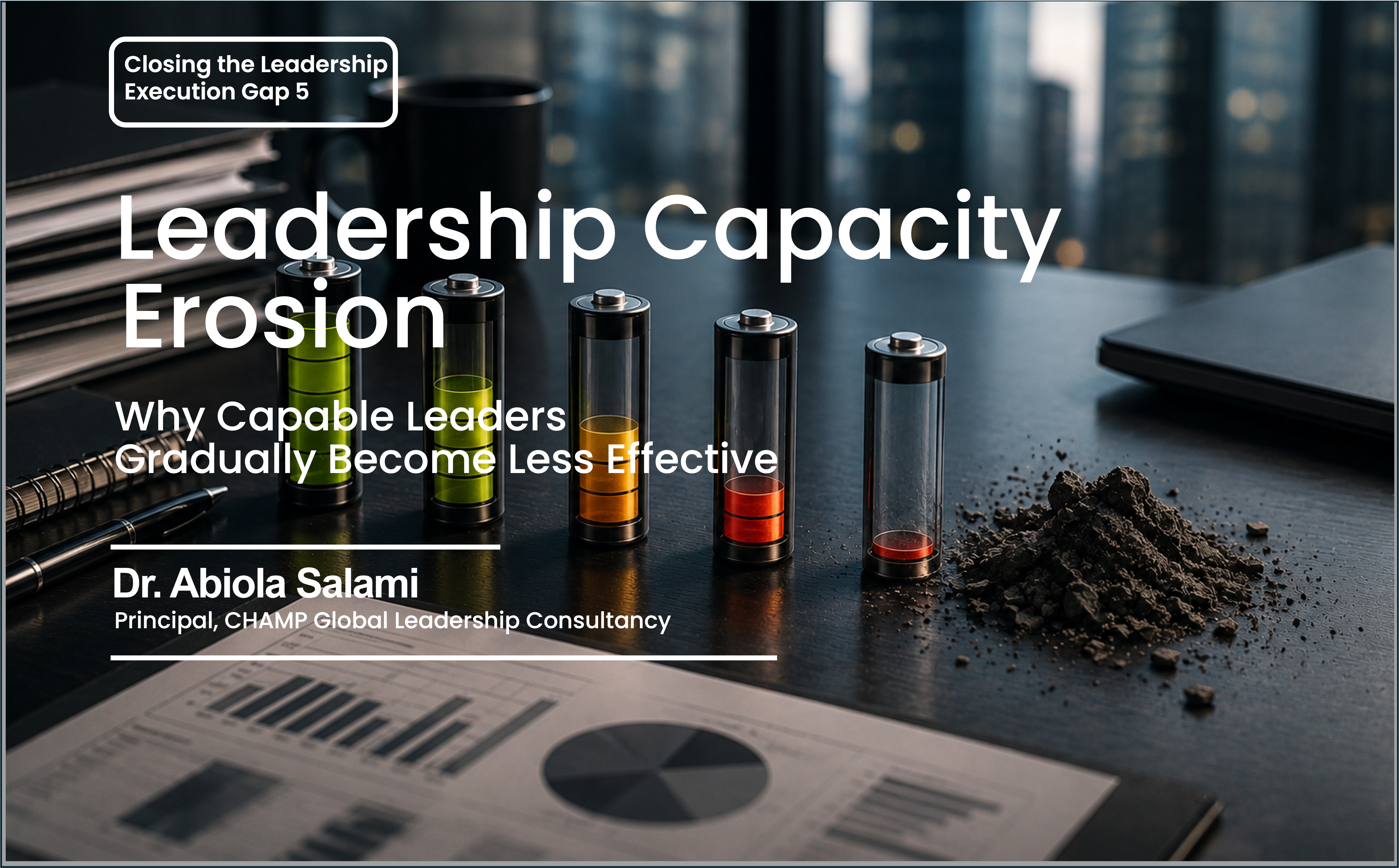
“Leadership rarely fails because capacity suddenly disappears. More often, capacity erodes quietly until yesterday’s strengths can no longer sustain today’s responsibilities.”– Dr. Abiola Salami
One of the greatest assumptions in leadership is that experience naturally produces greater effectiveness. There is the belief that the longer people lead, the more capable they become. The more senior they become, the wiser their decisions. The greater their influence, the stronger their performance.
I agree that experience matters. Yet observation suggests a more complicated reality.
Many leaders do not become less effective because they lose competence. They become less effective because they gradually lose capacity. Let’s pay attention to this signficant distinction.
Competence concerns what leaders know. Capacity concerns what leaders can consistently sustain.
Leadership does not merely demand intelligence. It demands sustained emotional regulation. Clear judgment under pressure. Relational resilience. Mental presence. Physical energy and Identity stability.
Over time, these capacities are continually consumed by leadership itself.
The gradual depletion of these leadership resources is what I describe as Leadership Capacity Erosion.
Unlike incompetence, it rarely announces itself. The leader still appears capable. Still speaks confidently. Still occupies the office. Still attends the meetings. Yet something fundamental has begun changing. Of course it is not the leader’s capability, it is the leader’s capacity.
The Misunderstanding About Leadership Failure
When organisations observe declining leadership performance, they often assume capability has diminished. The leader needs more training, more information, more coaching or more technical development.
These interventions may be valuable but what I have observed is that organizations frequently overlook a deeper reality.
And here is the reality. Many struggling leaders already know what should be done. They simply no longer possess the internal capacity to consistently do it. Knowledge has remains but capacity has quietly declined.
This explains why experienced leaders sometimes begin avoiding conversations they once handled confidently. Why emotionally intelligent leaders become increasingly reactive. Why decisive leaders become hesitant. Why visionary leaders become operationally trapped.
The problem is not always competence. Sometimes the problem is erosion.
Understanding Leadership Capacity Erosion
Leadership Capacity Erosion is the gradual reduction of a leader’s ability to consistently think clearly, relate effectively, regulate emotions, sustain energy and lead purposefully under increasing organisational demands.
Unlike burnout, Leadership Capacity Erosion rarely represents one dramatic event.
It accumulates with one difficult quarter, one organisational crisis, one restructuring, one unresolved conflict, one personal sacrifice, one disappointment, one expectation after another.
Leadership continues but capacity quietly adjusts. Eventually, leaders begin operating below the level their responsibilities require. The organisation sees reduced effectiveness. The leader often experiences only increasing exhaustion.
The Invisible Nature of Erosion
The danger of erosion is that it rarely attracts immediate attention. Mountains do not disappear overnight. Coastlines recede gradually. Buildings weaken long before collapse becomes visible. Leadership follows the same pattern.
Few leaders recognise the precise moment when emotional resilience begins declining. When curiosity gives way to routine. When empathy becomes impatience. When listening becomes interruption. When courage becomes caution.
The transformation is rarely intentional. It is cumulative. Leadership Capacity Erosion therefore deserves attention not because leaders suddenly become ineffective, but because effectiveness quietly becomes more difficult to sustain.
The Five Invisible Expressions
Leadership Capacity Erosion rarely appears in one form. It expresses itself through multiple dimensions of leadership performance and I published these invisible expressions in my book title Taming the invisible Toll of Leadership Expectations.
Sometimes Leadership Capacity Erosion appears as Cognitive Overload, where constant decision-making reduces clarity and strategic thinking. Sometimes as Emotional Drain, where sustained pressure weakens emotional regulation and relational effectiveness. Sometimes as Relational Strain, where leadership responsibilities slowly distance leaders from the very relationships that once strengthened them. Sometimes as Physical Depletion, where exhaustion gradually becomes accepted as the normal cost of responsibility. Sometimes as Identity Fracture, where leaders quietly lose connection with the person they once believed themselves to be.
These are not isolated leadership challenges. They are interconnected expressions of one deeper reality i.e. Leadership Capacity Erosion.
The Organisational Consequence
Leadership capacity rarely belongs to leaders alone. Teams experience it, Culture reflects it and Execution absorbs it.
When leadership capacity declines, organisational capacity eventually follows. Decisions slow, Innovation weakens, Trust becomes fragile, Communication loses clarity and Execution becomes inconsistent. People often conclude that culture has changed. Or perhaps leadership capacity changed first.
Rethinking the Conversation
Leadership development has traditionally focused on expanding competence. The future may require equal attention to preserving capacity. Because leadership is not only about acquiring more; it is about sustaining enough. Enough clarity to think. Enough courage to confront. Enough empathy to connect. Enough resilience to continue. Enough identity to remain authentic despite expectation.
Without sustained capacity, even extraordinary competence eventually becomes difficult to express.
Closing Reflection
Organisations often invest heavily in developing leadership capability. Far fewer invest time understanding leadership capacity. Capability determines what leaders are able to do. Capacity determines how long they can continue doing it. Leadership rarely disappears in one dramatic moment. It slowly erodes beneath the invisible weight of responsibility. Until organisations recognise Leadership Capacity Erosion, they may continue asking why capable leaders become less effective, while overlooking the quiet process that has been reducing their ability to lead all along.
About Dr. Abiola Salami
Dr. Abiola Salami is the Principal Performance Strategist at CHAMP – a full scale professional services firm trusted by high performing business leaders for providing Executive Coaching, Workforce Development & Advisory Services to improve performance. He is the Convener of Dr Abiola Salami International Leadership Bootcamp ; The Peak PerformerTM Festival Made4More Accelerator Program and The New Year Kickoff Summit. You can reach his team on hello@abiolachamp.com and connect with him @abiolachamp on all social media platforms.
NB
If you are a Supervisor, Manager or Team Lead, Take the Manager’s Execution Scorecard Assessment to see where execution may be breaking in your team.
If you are a Senior Executive, Look into the Invisible Toll Mirror to see the toll of the weight you are carrying.
About Dr. Abiola Salami
Dr. Abiola Salami is the Principal Performance Strategist at CHAMP – a full scale professional services firm trusted by high performing business leaders for providing Executive Coaching, Workforce Development & Advisory Services to improve performance. He is the Convener of Dr Abiola Salami International Leadership Bootcamp ; The Peak PerformerTM Festival Made4More Accelerator Program and The New Year Kickoff Summit. You can reach his team on hello@abiolachamp.com and connect with him @abiolachamp on all social media platforms..
For private coaching, boardroom recalibration, or executive healing strategy, connect email me directly at hello@abiolachamp.com to begin your private Executive Coaching Session.

