
Performance Debt: The Hidden Cost of Leadership Decisions Deferred by Dr. Abiola Salami, Principal, CHAMP Global Leadership Consultancy
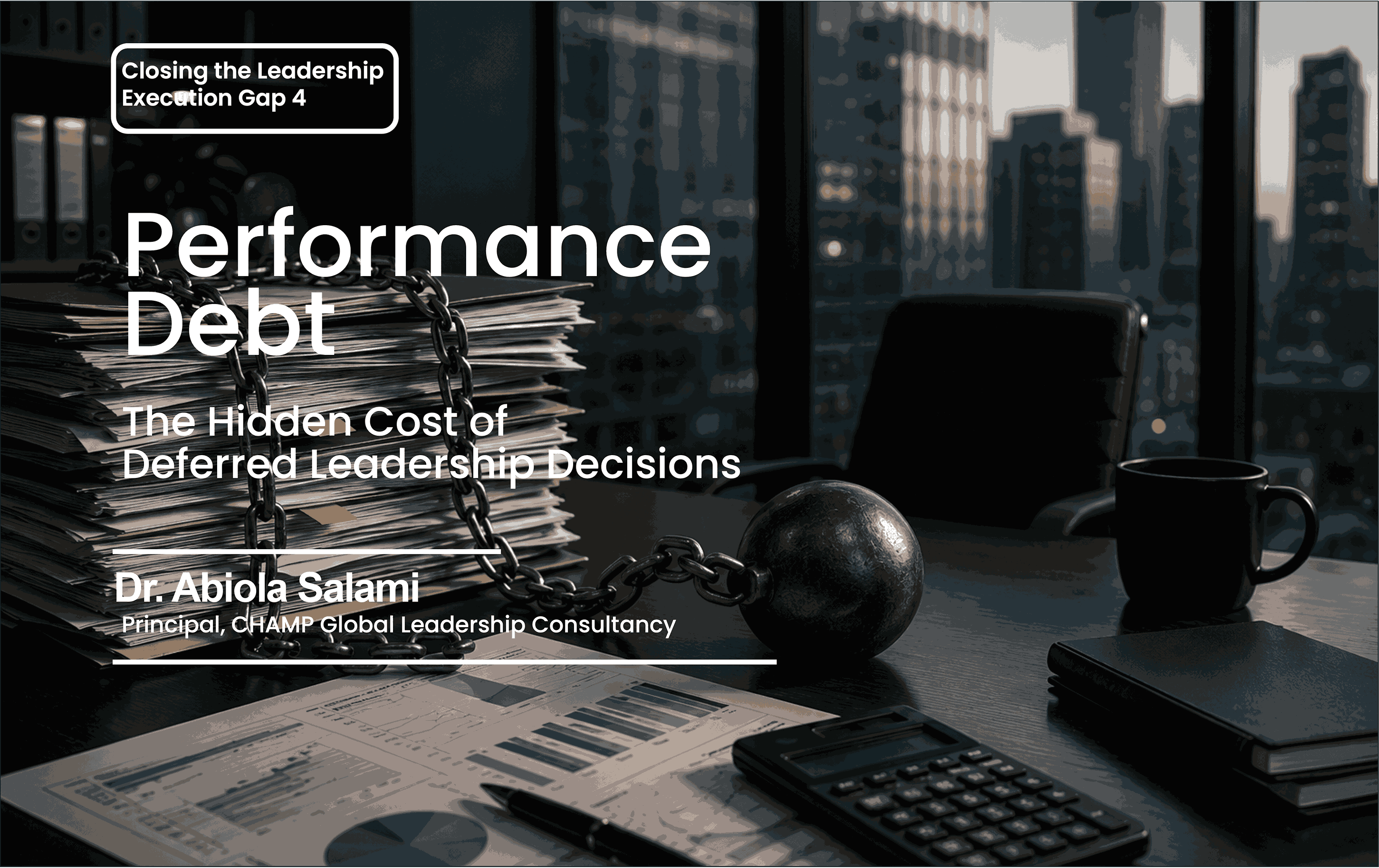
“Organisations rarely pay the full price of poor leadership immediately. Like financial debt, the cost compounds over time.” – Dr. Abiola Salami
No responsible organisation deliberately accumulates financial debt without understanding its consequences. Boards monitor liabilities. Finance teams manage cash flow. Executives carefully assess borrowing because they understand a simple principle. Debt never remains static. Interest accumulates. The longer repayment is delayed, the more expensive the obligation becomes.
Curiously, many organisations apply this discipline to finance but ignore it completely in leadership. Difficult conversations are postponed. Poor performance is tolerated. Critical decisions remain unresolved. Misalignment is left unattended. Trust slowly deteriorates. Accountability weakens.
Leaders reassure themselves that these issues can be addressed later. When later eventually arrives. the organisation discovers that the problem is now significantly larger than it originally appeared.
What changed? Time.
Time rarely solves neglected leadership problems. It compounds them. This gradual accumulation is what I describe as Performance Debt. Like financial debt, it grows quietly. Like financial debt, it appears manageable in the beginning. And like financial debt, it eventually begins limiting the organisation’s future long before leaders recognise its true cost.
The Misunderstanding About Organisational Performance
Many organisations believe performance declines because of major mistakes such as failed strategy, an economic downturn, a disruptive competitor or a public crisis. These events certainly matter. Yet they often expose problems that have existed for much longer.
Organisational decline is frequently less about dramatic events than accumulated neglect. A difficult employee is ignored because “this is not the right time.” A manager avoids confronting repeated underperformance. An executive delays restructuring because “things may improve.” A team continues operating without clarity because everyone appears busy.
Individually, each decision appears reasonable. Collectively, they become expensive; maybe not immediately but eventually. This delay is precisely what makes Performance Debt so dangerous.
Understanding Performance Debt
Performance Debt is the accumulated future cost created when leaders repeatedly postpone the conversations, decisions and actions required to sustain organisational performance.
Unlike operational setbacks, Performance Debt rarely announces itself. It accumulates silently with every avoided conversation becoming unpaid principal. Every tolerated behaviour attracts interest. Every unresolved conflict increases the balance. Every postponed decision extends repayment. Eventually, organisations discover that yesterday’s small leadership compromises have become today’s complex organisational challenges.
Performance Debt is therefore not created by one poor decision. It is created by repeated deferral.
The Interest Is Paid Through Culture
Financial debt reduces financial flexibility. Performance Debt reduces organisational capacity. As the debt grows, organisations begin experiencing symptoms that appear unrelated. Decision-making slows, trust weakens, ownership declines, initiative disappears, innovation becomes cautious, meetings increase and alignment decreases.
Leaders become increasingly busy while organisations become progressively less productive.
The temptation is to treat each symptom separately with more meetings, new reporting systems, another performance review, and perhaps, another restructuring exercise.
Yet these interventions often resemble making minimum payments on a growing financial obligation where the underlying debt remains.
Eventually, culture begins paying the interest. People stop raising concerns because previous concerns raised produced no action. Managers stop challenging poor performance because inconsistency has become normal. Employees lower personal standards because organisational standards have already shifted. Performance Debt has now moved beyond leadership decisions. It has entered organisational behaviour.
The Cost of Delayed Leadership
Leadership often celebrates patience. Patience is valuable but delay is different. The inability to distinguish between patience and postponement quietly increases organisational debt.
Leaders delay feedback to preserve relationships. They postpone accountability to maintain harmony. They defer difficult conversations because immediate priorities appear more urgent.
Ironically, these attempts to avoid discomfort usually create greater discomfort later. Because the conversation becomes harder, the behaviour becomes stronger, the consequences become broader and the emotional cost becomes heavier. Leadership therefore does not become easier through avoidance. It becomes more expensive.
Why High Performers Sometimes Carry the Largest Debt
Performance Debt is not limited to struggling organisations. Successful organisations often accumulate it more quickly. Past success creates confidence. Confidence encourages tolerance. Tolerance slowly weakens discipline. The organisation begins believing its history can compensate for present neglect. Outstanding results provide temporary cover.
Underneath the visible success, unresolved leadership obligations continue accumulating. When external conditions eventually change, the organisation discovers that it has been operating on borrowed performance. The debt has simply become visible.
The Invisible Balance Sheet
Every organisation maintains two balance sheets. The financial balance sheet receives rigorous attention across the organization but the leadership balance sheet rarely receives any attention even when HR calls it out.
Yet every postponed conversation, every unresolved conflict, every tolerated underperformance, every unclear expectation, every abandoned commitment and every inconsistency adds another entry into the debit side.
Unlike financial accounting, these liabilities do not appear in annual reports. They appear in culture. They appear in execution. They appear in trust. They appear in performance. And eventually, they appear in results.
By then, leaders often mistake accumulated debt for sudden decline. It is neither sudden nor accidental. It has simply matured.
Beyond Performance Management
Performance Debt challenges a longstanding assumption. Many organisations believe performance is primarily managed through systems i.e. measurement, targets, dashboards and reviews. These mechanisms matter.
But systems rarely compensate for accumulated leadership neglect. Performance is sustained less by monitoring than by leadership behaviours consistently reinforced over time.
The greatest organisational liabilities are often behavioural rather than financial. Unfortunately, behavioural liabilities rarely receive behavioural accounting.
Performance Debt encourages leaders to recognise that every unresolved leadership obligation remains outstanding until deliberately addressed. Ignoring it does not eliminate the debt. It merely postpones repayment while increasing the cost.
.
Towards a Different Conversation
Perhaps leadership should no longer ask “How is performance today?” A more revealing question might be “What leadership obligations have we been carrying unpaid?”
The answer may reveal far more about the organisation’s future than this quarter’s performance report. Because organisations rarely become overwhelmed by one major failure. More often, they become overwhelmed by years of accumulated obligations that leadership believed could safely wait.
Performance Debt reminds us that organisational decline often begins long before financial indicators reveal it. It begins whenever leadership mistakes delay for discipline and avoidance for stability.
Closing Reflection
Financial debt compounds because interest never sleeps. Performance Debt compounds because organisational behaviour never stops adapting. Every leadership decision postponed today quietly shapes tomorrow’s culture. Every conversation avoided today becomes tomorrow’s complexity. Every standard tolerated today becomes tomorrow’s expectation. Organisations rarely collapse under the weight of one catastrophic decision. More often, they struggle beneath the accumulated burden of leadership obligations left unpaid for far too long. That accumulated burden is Performance Debt
About Dr. Abiola Salami
Dr. Abiola Salami is the Principal Performance Strategist at CHAMP – a full scale professional services firm trusted by high performing business leaders for providing Executive Coaching, Workforce Development & Advisory Services to improve performance. He is the Convener of Dr Abiola Salami International Leadership Bootcamp ; The Peak PerformerTM Festival Made4More Accelerator Program and The New Year Kickoff Summit. You can reach his team on hello@abiolachamp.com and connect with him @abiolachamp on all social media platforms.
NB
If you are a Supervisor, Manager or Team Lead, Take the Manager’s Execution Scorecard Assessment to see where execution may be breaking in your team.
If you are a Senior Executive, Look into the Invisible Toll Mirror to see the toll of the weight you are carrying.
About Dr. Abiola Salami
Dr. Abiola Salami is the Principal Performance Strategist at CHAMP – a full scale professional services firm trusted by high performing business leaders for providing Executive Coaching, Workforce Development & Advisory Services to improve performance. He is the Convener of Dr Abiola Salami International Leadership Bootcamp ; The Peak PerformerTM Festival Made4More Accelerator Program and The New Year Kickoff Summit. You can reach his team on hello@abiolachamp.com and connect with him @abiolachamp on all social media platforms..
For private coaching, boardroom recalibration, or executive healing strategy, connect email me directly at hello@abiolachamp.com to begin your private Executive Coaching Session.

