
Execution Drift: Why Organisations Rarely Lose Performance Overnight by Dr. Abiola Salami, Principal, CHAMP Global Leadership Consultancy
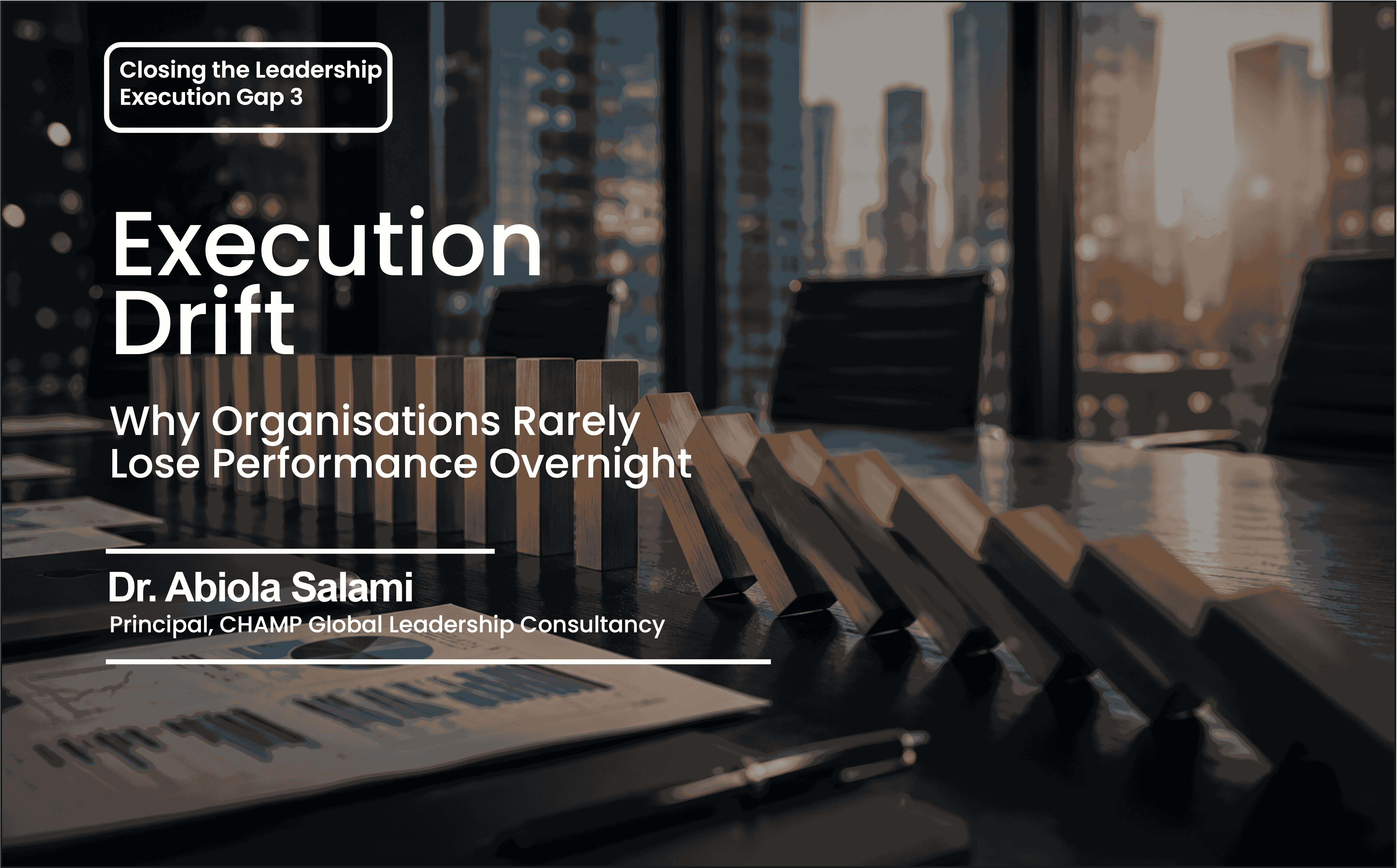
“Organisations hardly abandon execution deliberately. They drift away from it gradually, one compromise at a time.” – Dr. Abiola Salami
Most organisational failures are investigated only after they become visible. After targets are missed, projects stall, customers complain, revenue declines, culture deteriorates and talent leaves. Only then do organisations begin searching for explanations.
The usual suspects quickly emerge i.e. the economy, competition, technology, government policy, resources, market conditions etc. While these factors undoubtedly influence organisational performance, they often conceal a more uncomfortable reality.
Most organisations do not lose execution suddenly. They lose it gradually. Performance rarely collapses because of one catastrophic decision. It deteriorates through a series of small compromises that individually appear harmless but collectively become destructive. This gradual erosion is what I describe as Execution Drift.
Execution Drift explains why organisations that once executed with discipline slowly become organisations where deadlines become negotiable, accountability becomes selective, urgency becomes inconsistent and excellence quietly gives way to acceptable mediocrity. It is not an event. It is a progression. And because it happens slowly, it often escapes attention until recovery becomes significantly more difficult.
The Myth of Sudden Decline
Organisations frequently describe declining performance as though it appeared unexpectedly.
“We don’t know what happened.” “Things used to work.” “People are no longer committed.” “Our culture has changed.”
Yet organisational performance rarely changes without warning.
The warning signs were almost always present. They simply appeared too insignificant to attract attention. One deadline quietly slips. A difficult conversation is postponed. A performance issue is tolerated. An unnecessary meeting replaces a necessary decision. A leader avoids confronting misalignment. An employee stops speaking honestly. A commitment becomes optional. None of these moments appears capable of changing organisational performance.
Yet together they begin altering organisational standards. Execution does not disappear. It drifts.
Understanding Execution Drift
Execution Drift is the gradual decline in organisational execution caused by the repeated normalisation of small behavioural compromises that collectively weaken performance. Its danger lies in its invisibility.
Unlike financial crises, public scandals or operational failures, Execution Drift rarely announces itself dramatically. It enters organisations politely, quietly, reasonably and almost logically.
The first compromise feels temporary. The second feels understandable. The third feels unavoidable. Eventually, compromise becomes culture. What once demanded immediate attention now receives polite reminders. What once required accountability now receives explanations. What once produced urgency now produces meetings. Without realising it, organisations slowly redefine what acceptable performance looks like.
Performance Does Not Collapse. Standards Do.
Many leaders assume declining performance begins with declining effort. More often, it begins with declining standards. People naturally adapt to the standards leadership consistently reinforces. I am not talking about the standards written in policy documents or those displayed on office walls. I am referring to the standards leaders repeatedly tolerate.
When missed commitments attract little consequence, standards shift. When poor preparation becomes routine, standards shift. When mediocre thinking receives enthusiastic approval, standards shift. When difficult conversations remain avoided, standards shift. When excuses become more acceptable than ownership, standards shift.
When standards shift, performance eventually follows. Organisations therefore do not suddenly produce poorer results. They gradually produce different expectations. Execution Drift is fundamentally a shift in organisational tolerance.
Leadership Is the Primary Current
Like a river, organisations naturally move in the direction of the strongest current. That current is leadership. Employees rarely wake up intending to lower standards. They simply respond to the environment leadership consistently creates.
Where leaders insist on clarity, ambiguity decreases. Where leaders demonstrate accountability, ownership expands. Where leaders tolerate confusion, confusion multiplies. Where leaders reward convenience over courage, avoidance becomes organisational behaviour. Execution Drift is therefore not merely an operational phenomenon. It is a leadership reality. People rarely drift beyond the boundaries leadership quietly permits.
The Invisible Cost of Small Compromises
Perhaps the greatest danger of Execution Drift is that every compromise appears insignificant in isolation.
One postponed conversation, just one. One delayed decision, just one. One unchallenged behaviour, just one. One exception, just one. One ignored commitment, just one. One unnecessary meeting, just one. None appears capable of changing organisational destiny. Yet organisations are rarely shaped by dramatic moments alone. They are shaped by repeated moments.
Culture itself is accumulated behaviour. Trust is accumulated behaviour. Accountability is accumulated behaviour. Execution is accumulated behaviour. So is decline. Execution Drift reminds us that organisations do not become high-performing through isolated acts of excellence. Neither do they become average through isolated acts of failure. Both emerge from repetition.
Why High-Performing Organisations Are Most Vulnerable
Ironically, successful organisations often become especially susceptible to Execution Drift. Past success creates confidence. Confidence sometimes creates complacency. Processes become familiar. Relationships become comfortable. Results become expected. Standards begin relying more on historical reputation than present discipline.
Eventually, yesterday’s excellence becomes today’s excuse. “We’ve always done it this way.” “We’ve always delivered.” “We’ll catch up.”
The organisation continues appearing successful while quietly consuming the momentum that created its success. By the time declining performance becomes measurable, Execution Drift has often been developing for months or even years.
A Leadership Problem Disguised as an Operational Problem
Execution Drift is frequently diagnosed as an operational issue. Leaders respond by introducing new software, new reporting systems, new performance dashboards, new restructuring exercises, new strategy sessions and any new intervention they can come up with.
These interventions may improve visibility. They rarely address the underlying drift. Because Execution Drift is not fundamentally the absence of systems. It is the gradual weakening of leadership behaviours that once sustained organisational discipline. Without addressing those behaviours, organisations simply digitise decline.
Towards a Different Understanding of Organisational Decline
Perhaps organisations should stop asking “What caused our execution failure?” A more useful question may be “When did we begin accepting behaviours that made execution failure inevitable?”
The answer rarely points to one dramatic event. It points to hundreds of ordinary moments. Moments where standards quietly shifted, where conversations were postponed, where expectations softened and where leadership hesitated. Consequently, performance slowly adjusted itself to the new normal.
Execution Drift invites leaders to reconsider organisational decline not as sudden collapse, but as gradual movement away from disciplined execution. Understanding that movement may become one of the most important responsibilities of Performance Leadership.
Closing Reflection
Organisations rarely lose excellence in one dramatic moment. They surrender it one tolerated compromise at a time. Execution does not usually disappear because people stop caring. It disappears because organisations slowly redefine what they are willing to accept. Performance is rarely destroyed overnight. It drifts. And until leaders recognise the quiet current pulling their organisations away from disciplined execution, they may continue searching for dramatic explanations while overlooking the ordinary behaviours that quietly reshape organisational destiny. That quiet current is Execution Drift.
About Dr. Abiola Salami
Dr. Abiola Salami is the Principal Performance Strategist at CHAMP – a full scale professional services firm trusted by high performing business leaders for providing Executive Coaching, Workforce Development & Advisory Services to improve performance. He is the Convener of Dr Abiola Salami International Leadership Bootcamp ; The Peak PerformerTM Festival Made4More Accelerator Program and The New Year Kickoff Summit. You can reach his team on hello@abiolachamp.com and connect with him @abiolachamp on all social media platforms.
NB
If you are a Supervisor, Manager or Team Lead, Take the Manager’s Execution Scorecard Assessment to see where execution may be breaking in your team.
If you are a Senior Executive, Look into the Invisible Toll Mirror to see the toll of the weight you are carrying.
About Dr. Abiola Salami
Dr. Abiola Salami is the Principal Performance Strategist at CHAMP – a full scale professional services firm trusted by high performing business leaders for providing Executive Coaching, Workforce Development & Advisory Services to improve performance. He is the Convener of Dr Abiola Salami International Leadership Bootcamp ; The Peak PerformerTM Festival Made4More Accelerator Program and The New Year Kickoff Summit. You can reach his team on hello@abiolachamp.com and connect with him @abiolachamp on all social media platforms..
For private coaching, boardroom recalibration, or executive healing strategy, connect email me directly at hello@abiolachamp.com to begin your private Executive Coaching Session.

