
NIGERIAN BANKS HAVE MORE CAPITAL. WILL NIGERIAN BUSINESSES GET MORE CREDIT? by Dr. Abiola Salami, Principal, CHAMP Global Leadership Consultancy
“ Nigeria does not need banks to become development agencies. It needs them to become exceptionally effective banks. But exceptionally effective banking should ultimately make productive capital move more intelligently through the economy.” – Dr. Abiola Salami
Introduction
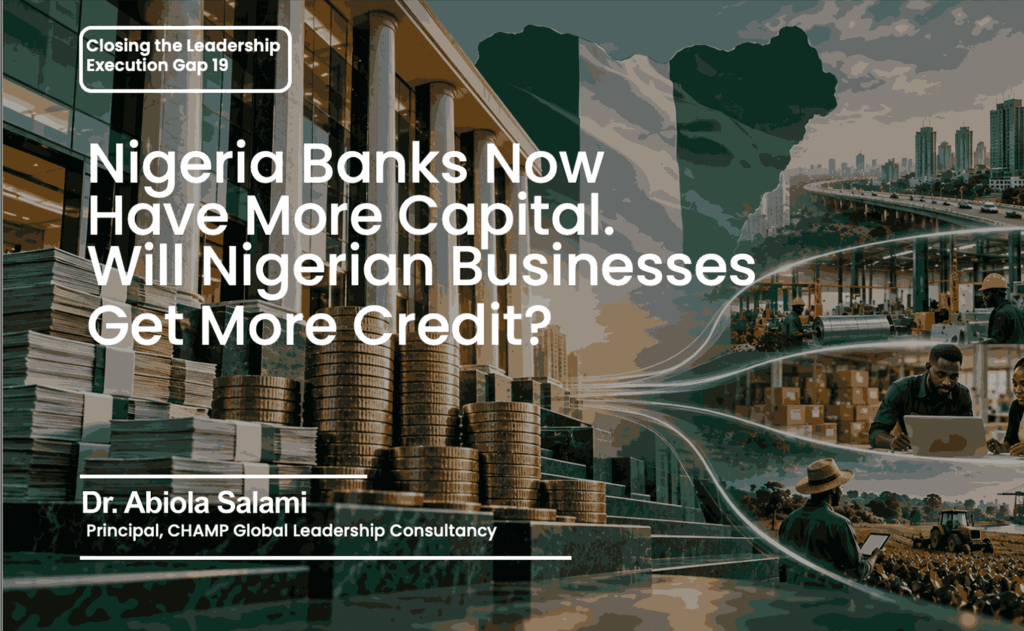
Nigeria has recapitalised its banks. Now comes the more difficult question. What happens to the capital?
The Central Bank of Nigeria did not embark on the latest recapitalisation programme simply so Nigerian banks could display larger numbers on their balance sheets. The policy had a broader economic logic. Stronger capital buffers should make banks more resilient, but they should also increase their capacity to perform one of banking’s most important economic functions i.e financial intermediation.
In simple terms, banks help move money from where it is available to where it can be productively deployed. That makes the relationship between bank capital and productive credit one of the most significant performance relationships in the Nigerian economy.
Recapitalisation Must Create Capacity
Under the new requirements, international commercial banks were required to reach minimum paid-up capital of ₦500 billion, national banks ₦200 billion and regional banks ₦50 billion.
The CBN said the programme was intended not only to strengthen resilience but also to better position banks to lend to critical sectors of the economy.
The IMF’s 2026 Article IV consultation subsequently described the recapitalisation programme as successfully completed, with most institutions meeting revised requirements.
So a new question naturally follows. If banks now possess greater capital capacity, will Nigeria experience greater credit capacity?
Credit Is Growing. But the Real Question Is Where It Goes.
CBN monetary statistics put credit to the private sector at approximately ₦83.43 trillion in July 2026, compared with about ₦83.26 trillion in June. The scale sounds impressive; but aggregate credit alone does not tell us whether financial intermediation is doing what the economy needs.
We must ask about allocation.
What proportion supports productive investment rather than short-term consumption?
How much reaches businesses capable of expanding capacity? How much supports manufacturing, Agriculture and agro-processing, Energy, Logistics, Healthcare, Technology, Exports, Small and medium-sized businesses? And at what cost?
Those questions matter because credit only becomes economically transformative when it enables productive activity that might otherwise not occur.
There Is a Structural Tension
Nigeria’s banking system is operating in a difficult environment.
The CBN’s September Monetary Policy Committee meeting reset the Monetary Policy Rate to 23 per cent and retained a 45 per cent Cash Reserve Requirement for deposit money banks.
At the same time, the IMF noted that banks’ holdings of government securities stood at about 22 per cent of total assets and warned that these holdings, combined with the high CRR and other structural constraints, were crowding out private-sector credit. This creates an important economic tension.
Banks have a responsibility to lend responsibly. But they also have choices about where capital is deployed.
When lending to productive businesses is perceived as difficult, risky and expensive while alternative assets offer attractive risk-adjusted returns, rational institutions respond to those incentives.
That means the credit problem cannot be placed entirely at the feet of banks.
Government borrowing matters. Monetary conditions matter. The quality of businesses seeking credit matters. Credit information matters. Contract enforcement matters. Infrastructure matters. The predictability of the operating environment matters. The quality of financial statements matters. Risk management matters. This is a system problem. And system problems require system solutions.
More Lending Is Not Enough
There is another danger in the conversation. We should not reduce financial intermediation to simply “banks must lend more”.
More bad loans will not build Nigeria. Poor underwriting will not build Nigeria. Politically directed credit will not build Nigeria. Capital destroyed through poorly structured lending does not create development. What Nigeria requires is better intermediation.
Banks that understand productive sectors deeply enough to distinguish risk from opportunity, better data, better credit assessment, more sophisticated value-chain financing, appropriate collateral structures, longer-duration instruments where the economics justify them, stronger partnerships with development-finance institutions, better support for exporter and more innovative financing for businesses that have cash flows but insufficient traditional collateral. That is where recapitalisation should meet innovation.
SMEs Reveal the Performance Gap
Many entrepreneurs do not require charity. They require appropriately structured capital.
A business may have customers, demand and expansion potential but still be unable to finance inventory, machinery, distribution, technology or new locations.
When thousands of viable businesses experience the same constraint, we are no longer discussing individual corporate inconvenience. We are discussing national productive capacity.
A financial system that can efficiently identify, price and finance productive opportunity creates leverage for the entire economy. One naira sitting passively on a balance sheet is capital. One naira deployed intelligently into productive enterprise can become machinery, inventory, salaries, exports, taxes, household income and additional economic activity.
That is the conversion we should care about.
The Performance Leadership Question
This month’s Performance Leadership Brief™ asks Nigerian Banks Have Recapitalized. Can the Banks Now Recapitalize Nigeria?
The distinction is deliberate because Bank recapitalisation is an institutional event but Recapitalising Nigeria would be an economic outcome.
The first is measured by capital raised. The second would be visible in stronger businesses, deeper productive credit, more investment, expanded capacity and increased economic opportunity.
Performance Leadership™ asks whether resources are being converted into sustainable outcomes.
That same logic should now be applied to Nigerian banking. Capital is not performance. Capital creates capacity for performance. The test is what leadership does with that capacity.
The Next Banking Conversation
For several years, much of the Nigerian banking conversation has centred on capital adequacy, profitability, digital transformation, regulatory compliance and shareholder value.
All these are important; but the post-recapitalisation conversation should become broader and provide answers to the following 10 questions:
- Which banks are building the strongest productive-finance capabilities?
- Which institutions understand the sectors that will power Nigeria’s next decade?
- Which are developing new models for financing credible SMEs?
- Which are helping domestic companies become regional businesses?
- Which are building financing structures for exports?
- Which are converting stronger balance sheets into stronger economic ecosystems?
- Which banks are financing infrastructure and productive assets with appropriately structured, longer-term capital?
- Which are using technology and data to expand responsible credit without weakening underwriting standards?
- Which are demonstrably improving the reliability, security and trust of the customer experience?
- Which are showing measurable evidence that their capital allocation is contributing to employment, enterprise growth, exports and broader economic productivity?
These are Performance Leadership questions.
Nigeria does not need banks to become development agencies. It needs them to become exceptionally effective banks. But exceptionally effective banking should ultimately make productive capital move more intelligently through the economy.
That is why recapitalisation cannot be the end of the story. It is the beginning of a bigger test.
Nigeria has strengthened the capital of its banks. Now we must collaborate with those banks to help strengthen the capital base of Nigeria itself.
About Dr. Abiola Salami
Dr. Abiola Salami is the Principal Performance Strategist at CHAMP – a full scale professional services firm trusted by high performing business leaders for providing Executive Coaching, Workforce Development & Advisory Services to improve performance. He is the Convener of Dr Abiola Salami International Leadership Bootcamp ; The Peak PerformerTM Festival Made4More Accelerator Program and The New Year Kickoff Summit. You can reach his team on hello@abiolachamp.com and connect with him @abiolachamp on all social media platforms.
NB
If you are a Supervisor, Manager or Team Lead, Take the Manager’s Execution Scorecard Assessment to see where execution may be breaking in your team.
If you are a Senior Executive, Look into the Invisible Toll Mirror to see the toll of the weight you are carrying.
For private coaching, boardroom recalibration, or executive healing strategy, connect email me directly at hello@abiolachamp.com to begin your private Executive Coaching Session.

