
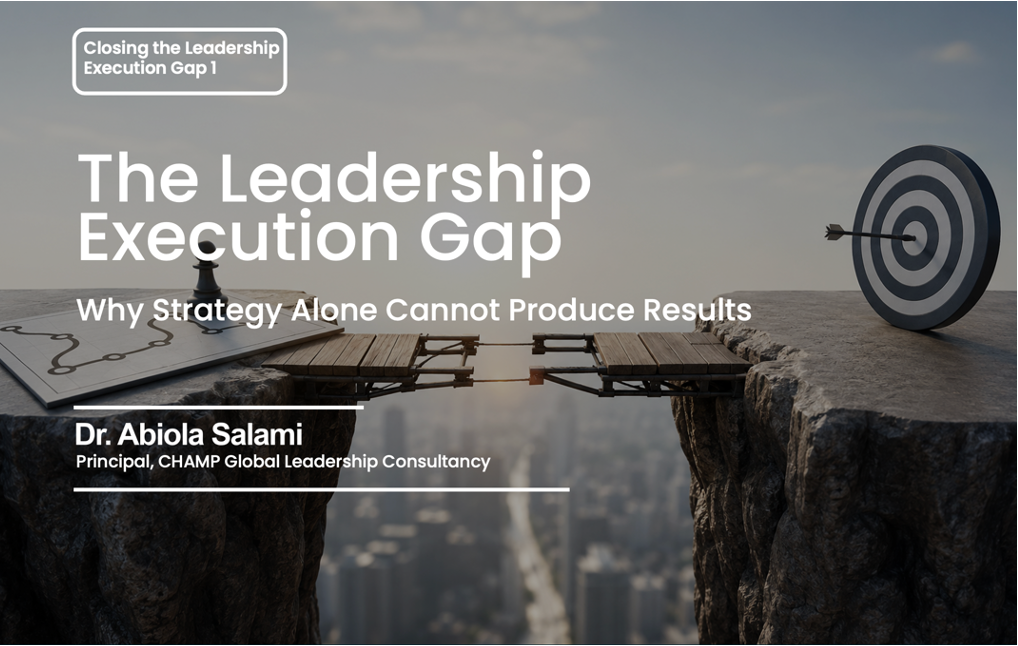
The Leadership Execution Gap: Why Strategy Alone Cannot Produce Results by Dr. Abiola Salami, Principal, CHAMP Global Leadership Consultancy
“Strategy is not executed by organisations. It is executed by people; and people experience leadership before they deliver performance.” – Dr. Abiola Salami
For decades, organisations have invested heavily in strategic planning. Executive retreats have become more sophisticated. Consultants have developed increasingly robust frameworks. Digital dashboards have made performance more visible than ever before. Annual strategy sessions continue to consume significant organisational resources, while leadership teams spend countless hours refining objectives, priorities and key performance indicators.
Yet one uncomfortable reality remains. Strategy continues to fail at execution. This persistent failure has often been blamed on poor planning, changing market conditions, inadequate resources or weak organisational systems.
While these factors undoubtedly matter, they distract attention from a more fundamental issue. The greatest obstacle to execution is rarely strategy itself. It is leadership.
More specifically, it is what I describe as the Leadership Execution Gap i.e. the often invisible space between what leaders intend and what people consistently deliver. This gap explains why brilliant strategies produce mediocre results, why talented organisations underperform despite possessing capable people, and why execution remains one of the most misunderstood disciplines in modern management.
The Leadership Execution Gap deserves greater attention because strategy does not move from boardroom to marketplace on its own. It travels through human beings. Every interpretation, every conversation, every decision, every priority and every action passes through leaders before it reaches customers, citizens or stakeholders. By the time strategy becomes execution, it has already become a human experience.
The Great Management Illusion
Many organisations continue to believe that better strategy automatically leads to better performance. Consequently, when execution falters, they respond by revisiting the strategy by wither organizing another retreat, emgaging another consultant, initiating another restructuring exercise or deploying another technology platform.
Yet the strategy itself is often not the problem.
In my experience working with executives, boards and leadership teams across sectors, I found that organisations rarely fail because they lack ambition. Neither do they fail because they are incapable of producing impressive strategic documents.
They fail because somewhere between executive intention and frontline action, momentum quietly disappears. Managers interpret priorities differently. Communication becomes inconsistent. Accountability weakens. Pressure alters behaviour. Fear suppresses truth. Meetings replace movement. Eventually, organisations begin asking a familiar question Why is nobody executing? When the better question is What happened to the leadership between the strategy and the execution? That question reveals the Leadership Execution Gap.
Understanding the Leadership Execution Gap
The Leadership Execution Gap is the distance between strategic intention and consistent organisational performance created by leadership behaviours that unintentionally weaken execution. It is not created by a single decision nor is it caused by one incompetent leader. It emerges gradually through hundreds of seemingly insignificant interactions.
Every unclear instruction widens the gap. Every avoided conversation widens the gap. Every delayed decision widens the gap. Every inconsistency widens the gap. Every emotionally reactive response widens the gap. Every failure to align people widens the gap. Every compromise on accountability widens the gap.
Eventually, the organisation finds itself with an excellent strategy but disappointing results. The strategy did not fail. Leadership gradually disconnected the strategy from execution.
Execution Is a Human Process
Organisations often describe execution as an operational challenge. It is more accurately a behavioural challenge. People rarely execute what they do not understand. They seldom sustain what they do not believe. They rarely own what they were never invited to shape. And they almost never outperform the leadership environment they experience every day. This is why execution cannot be delegated solely to project management offices, operational teams or middle management.
Execution begins long before implementation. It begins with leadership. Leaders create the emotional climate within which execution either accelerates or deteriorates. When trust exists, people speak honestly. When clarity exists, people move confidently. When accountability exists, people maintain standards. When psychological safety exists, problems surface early. When emotional maturity exists, pressure strengthens rather than destabilises performance.
Execution is therefore not merely a function of organisational systems. It is the cumulative outcome of leadership behaviour repeated consistently over time.
Why Managers Matter More Than Organisations Admit
Perhaps no group influences execution more profoundly than managers. Senior executives define strategic direction. Frontline employees deliver operational outcomes. Managers connect the two.
Managers translate strategic ambition into daily priorities. They convert organisational goals into team behaviour. They clarify expectations. They resolve ambiguity. They reinforce accountability. They shape culture through everyday conversations.
In many organisations, however, managers are promoted primarily because they excelled as individual contributors. Technical competence earns promotion. Leadership capability is assumed. Execution suffers. The consequence is profound.
Many organisations possess capable managers who have never been intentionally developed as execution leaders. They supervise activity. They coordinate tasks. They monitor deadlines. But they have never been equipped to create alignment, sustain ownership, manage pressure or cultivate execution discipline. Hence, the Leadership Execution Gap widens accordingly.
Africa’s Leadership Opportunity
Although the Leadership Execution Gap is a global phenomenon, Africa presents a particularly significant opportunity to redefine the conversation. Across the continent, governments, corporations, development institutions and entrepreneurial ventures continue to produce bold visions for transformation.
What determines whether these ambitions become measurable outcomes is rarely the quality of the vision itself. It is the quality of leadership execution. Africa does not lack intelligence. Africa does not lack ideas. Africa does not lack ambition. What Africa increasingly requires are leaders capable of consistently translating vision into disciplined execution through people.
That challenge cannot be solved by strategy alone. It requires a new generation of performance leaders.
Towards a New Discipline
Leadership has traditionally been studied through the lenses of influence, vision, charisma, service, adaptability and transformation. Each perspective contributes valuable insight. Yet organisations ultimately exist to produce results. This raises an important question. What if leadership should also be evaluated by its ability to consistently convert intention into measurable performance? That question points towards an emerging discipline I describe as Performance Leadership.
Performance Leadership extends beyond inspiring people. It concerns creating the conditions under which people consistently deliver meaningful results despite uncertainty, complexity and pressure. The Leadership Execution Gap represents one of its foundational concepts. Understanding the gap is the first step. Closing it will require an entirely different conversation. That is the conversation we intend to explore in all through the 3rd quarter of 2026.
Closing Reflection
Most organisations do not suffer from a shortage of strategy. They suffer from a shortage of leadership capable of carrying strategy faithfully from intention to execution. Until leadership becomes recognised not merely as the art of influence but as the discipline of consistently converting vision into measurable performance, organisations will continue to confuse planning with progress. The future will not belong to organisations with the best strategies. It will belong to organisations whose leaders know how to close the Leadership Execution Gap.
NB
If you are a Supervisor, Manager or Team Lead, Take the Manager’s Execution Scorecard Assessment to see where execution may be breaking in your team.
If you are a Senior Executive, Look into the Invisible Toll Mirror to see the toll of the weight you are carrying.
About Dr. Abiola Salami
Dr. Abiola Salami is the Convener of Dr Abiola Salami International Leadership Bootcamp ; The Peak PerformerTM Festival Made4More Accelerator Program and The New Year Kickoff Summit. He is the Principal Performance Strategist at CHAMP – a full scale professional services firm trusted by high performing business leaders for providing Executive Coaching, Workforce Development & Advisory Services to improve performance. You can reach his team on hello@abiolachamp.com and connect with him @abiolachamp on all social media platforms.
For private coaching, boardroom recalibration, or executive healing strategy, connect email me directly at hello@abiolachamp.com to begin your private Executive Coaching Session.

