
By Dr. Abiola Salami, Worldclass Performance Strategist
Introduction
There is a culture quietly destroying performance across organizations.
You will not find it in company values. It is not written in any employee handbook. No leader ever announces it. Yet everyone recognizes it. It is what I call The Culture of Pretending.
It is the moment an organization stops dealing with reality and starts managing appearances. The dashboards look impressive. The reports sound optimistic. The presentations are polished. But beneath the surface? Deadlines are slipping. Customers are losing patience. Teams are stretched thin. Execution is quietly breaking down. And instead of confronting the truth, the organization develops a dangerous new capability: The ability to pretend everything is fine.
The Meeting Where Truth Arrives Too Late
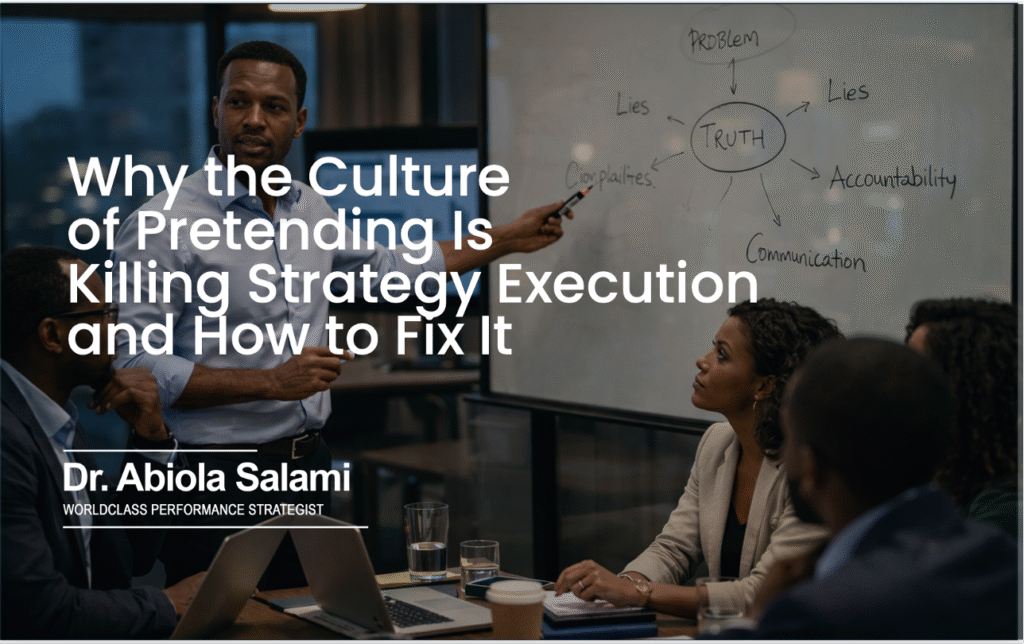
You’ve seen this before. A leadership meeting begins. Slides are presented. Metrics look “encouraging.” Language is measured. Tone is confident. “Are we on track?” the leader asks.
Heads nod and one after the other, people begin to say: “We’re making progress.” “The team is committed.” “Nothing significant to worry about.”
The meeting ends well, professional, orderly and controlled but something interesting happens immediately after. In the hallway, in the elevator, and in the quiet corners of the office, the truth returns. “We’re already behind.” “If the client sees this, we’re exposed.” “The team has mentally checked out.”
And just like that, reality reappears. But once again, too late to influence the decision that mattered.
When Professionalism Becomes Performance
At some point, professionalism crosses a line. It stops being about clarity and accountability and becomes a performance. People no longer communicate to reveal reality. They communicate to manage perception. Problems become “minor setbacks.” Failures become “learning curves.” Confusion becomes “alignment in progress.” Language becomes sophisticated but truth becomes diluted. And slowly, the organization develops a communication style that sounds intelligent while systematically avoiding what is real.
The Organizational Mask
Once pretending becomes normalized, masks emerge. There is the Employee Mask of “I’m fine.” The Manager Mask of “My team is on track.” The Executive Mask of “We are strategically aligned.” Everyone looks composed. Everyone sounds confident. But privately, many are thinking the same thing: “This is not working.”
Yet the culture makes that sentence dangerous to say out loud. So silence becomes safety and pretending becomes policy.
Where It Really Begins
This culture is not born from incompetence. It is born from fear – fear of disappointing leadership, fear of being blamed, fear of losing influence and fear of being labeled “the problem”.
Over time, people learn an unspoken rule that Good news is safe but bad news is expensive. So they adapt. Not by fixing problems but by managing how problems appear.
The Leadership Blind Spot
There uncomfortable truth is many leaders unknowingly create this culture. They say they want honesty but their reactions tell a different story. When bad news enters the room, the tone shifts, questions sharpen, tension rises, the messenger becomes the focus and everyone watching learns something powerful: “This is not a safe place for the truth.”
So next time, the truth is softened, filtered, delayed and becomes completely absent. Until one day, reality doesn’t need a report anymore. It announces itself as a crisis.
The Hidden Cost of Pretending
The damage is never immediate. Here are 3 reason that makes it dangerous.
A. Problems Grow in Silence
Small issues that could have been fixed early become expensive failures because pretending delays intervention and in execution, time is the most unforgiving cost driver.
B. Leaders Lose Sight of Reality
Decisions are only as good as the information behind them. When reality is filtered, polished, and repackaged, leaders begin making strategic decisions based on edited truth and edited truth always produces flawed execution.
C. Trust Quietly Erodes
Employees see the gap between what is said and what is lived. They stop believing updates. They stop trusting leadership language. They disengage emotionally first, then operationally and when trust leaves the room execution follows.
The Conversation Most Organizations Avoid
Most organizations already know this problem exists. They just don’t have a space to confront it honestly. Thtas space is not boardrooms, during performance reviews or quarterly meetings; because those spaces are still governed by the same rules of pretending.
What Happens When Leaders Finally Drop the Mask
Something powerful happens when leaders step into a different kind of room. A room where the conversation continues after the slides, where execution challenges are discussed without reputational risk. Where emotional pressure is not ignored but examined and where leadership is not performed but unpacked.
Because the truth is, strategy does not fail on paper; it fails with people and until leaders learn how to navigate pressure, emotion, fear, and perception, execution will continue to break quietly, consistently, and expensively.
A Quiet Shift Is Coming
In June, a select group of senior leaders across West Africa will convene to examine a critical gap in organizational performance i.e. strategy execution within human environments. This is not a forum for rehearsed presentations or surface-level insights.
It is a space where the real blockers of execution are no longer disguised as “alignment issues” or “capacity gaps” but confronted for what they truly are human realities in strategy execution. It is a space for the unfiltered conversations that rarely make it into boardrooms because until leaders address what is actually happening beneath the reports, strategy will continue to underperform its potential.
Final Thought
The Culture of Pretending does not collapse overnight. It fades the moment truth becomes safe again and that shift does not start with strategy documents. It starts with leaders who are willing to see clearly, hear honestly and respond intelligently under pressure. Because in the end, execution is not just a strategy problem.
It is an emotional intelligence problem in disguise.
About Dr. Abiola Salami
Dr. Abiola Salami is the Convener of Dr Abiola Salami International Leadership Bootcamp ; The Peak PerformerTM Festival Made4More Accelerator Program and The New Year Kickoff Summit. He is the Principal Performance Strategist at CHAMP – a full scale professional services firm trusted by high performing business leaders for providing Executive Coaching, Workforce Development & Advisory Services to improve performance. You can reach his team on hello@abiolachamp.com and connect with him @abiolachamp on all social media platforms.
For private coaching, boardroom recalibration, or executive healing strategy, connect email me directly at hello@abiolachamp.com to begin your private Executive Coaching Session.

