
By The Peak Performer Africa Media
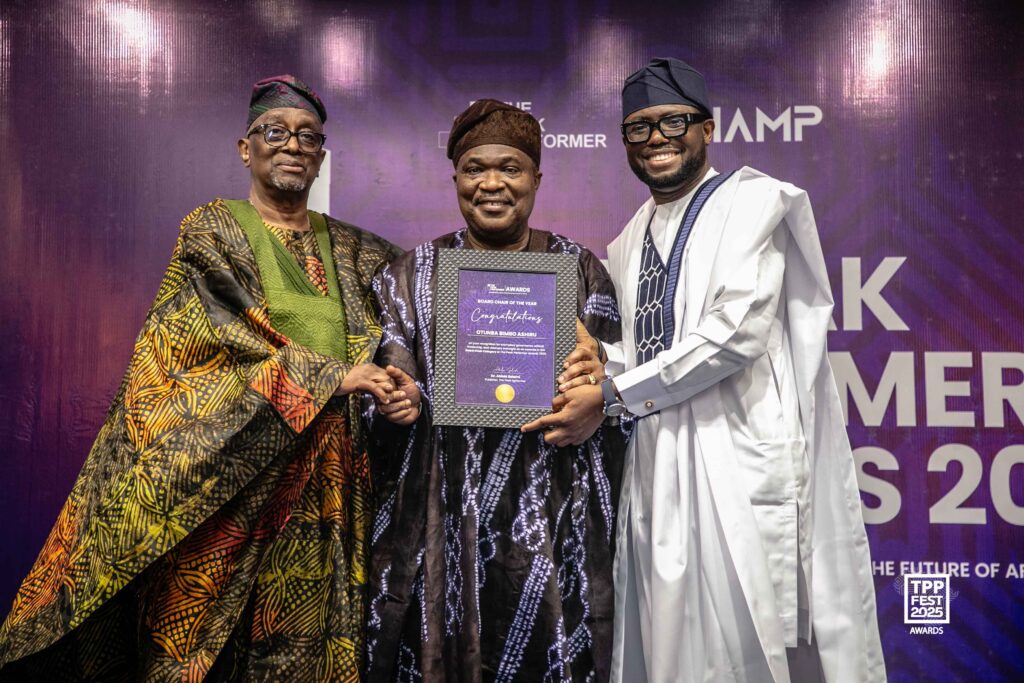
From governance reform and investment diversification to asset renewal and record financial results, Otunba Bimbo Ashiru’s four-year tenure offers a case study in the leadership required to turn institutional potential into measurable performance.
Introduction
When Otunba Bimbo Ashiru assumed the chairmanship of Odu’a Investment Company Limited in June 2022, he inherited a responsibility that extended beyond managing a corporate portfolio. Odu’a was an institution built on the economic aspirations of Nigeria’s South-West, owned collectively by the governments of Lagos, Ogun, Oyo, Osun, Ondo and Ekiti states.
Its significance lay not only in its assets, but in the founding ambition it represented: that regional capital, properly managed, could sustain businesses, create employment and contribute to economic development across generations.
Four years later, as Ashiru’s chairmanship concluded in June 2026, the company’s reported financial results, renewed strategic direction and strengthened institutional framework offered important evidence of the journey undertaken during his tenure.
His legacy is therefore worth examining through a question central to effective leadership: What happens when an institution begins to convert its inherited potential into measurable performance?
A Mandate Bigger than the Chairmanship
Ashiru’s appointment was announced in June 2022, following approval by Odu’a’s six shareholder states. A banker and strategic management professional, he brought experience from the private sector and public service, including his previous role as Ogun State Commissioner for Commerce and Industry.
The challenge at Odu’a required more than a change of leadership at the top. It called for a stronger relationship between ownership, governance, management and commercial performance.
One of the defining features of the period was the emphasis on professional governance and reduced political interference in day-to-day operations. In November 2023, Ogun State Governor Dapo Abiodun publicly commended the Odu’a board and management for their efforts to reposition the conglomerate.
According to a report published by Odu’a Investment Company, Abiodun praised the board’s “creativity, direction, sincerity of purpose, and commitment to your mandates,” adding that the organisation had been “walking the talk” on its responsibility to support accelerated regional economic growth.
The governor also highlighted the shareholder states’ decision to favour professionally qualified directors and management rather than treating the organisation as an extension of political office.
That endorsement pointed to an important governance principle: public ownership and professional management need not be competing ideas. A state-owned investment institution can remain accountable to its shareholders while allowing qualified professionals the space to make commercially sound decisions.
The distinction matters. Governance is not merely about who sits on a board; it is about the quality of decisions, the discipline with which those decisions are implemented and the institutional safeguards that make performance sustainable.
Repositioning an institution through strategy
During Ashiru’s tenure, Odu’a continued implementing its Sweat, Revive and Create strategic framework, commonly known as SRC 1.0. The framework predated his chairmanship, having been initiated in 2021, but its implementation was accelerated during his time as chairman and reached its stated conclusion in 2025.
The programme focused on revitalising legacy businesses, optimising assets, diversifying investments and improving the Group’s commercial orientation.
This distinction is important in assessing leadership fairly. Strategies are rarely created or executed by one individual alone. Boards provide direction and oversight; management translates priorities into operational plans; employees and business partners execute them. The chairman’s contribution lies in helping establish the conditions in which these parts work together.
For Odu’a, that meant moving beyond the passive ownership of valuable assets towards a more deliberate approach to investment, portfolio management and value creation.
The work was visible across several areas of the Group’s portfolio, including real estate, hospitality, agriculture and energy.
From legacy assets to productive investments
Odu’a’s historic assets carry both commercial value and emotional significance for the South-West. Yet heritage alone cannot guarantee relevance or profitability. Assets must be maintained, modernised and positioned to meet contemporary market needs.
The redevelopment of Premier Hotel, Ibadan, became one of the most visible symbols of the Group’s renewal. The project sought to modernise the historic hospitality property and reposition it for a more competitive market.
The Group also advanced property development initiatives, including residential projects, while pursuing opportunities in energy and agribusiness. Its entry into upstream oil exploration through the BITA Marginal Field licence represented an effort to diversify its investment exposure.
In agriculture, the establishment and development of the South West Agricultural Company, SWAgCo, reflected an ambition to connect the region’s agricultural resources with more organised commercial activity.
These initiatives differ in scale, maturity and risk. They should not be treated as if every announced project has already delivered its intended economic impact. Their significance, however, lies in the strategic direction: making legacy assets and regional resources work harder as productive investments.
That is an important part of institutional performance. It is not enough to possess valuable properties, business interests or natural resources. The test is whether leadership can create the governance, investment discipline and commercial partnerships required to unlock their value.
What the financial record reveals
The numbers provide another perspective on the transformation.
According to The Guardian’s report on Odu’a’s 2024 financial year, the Group’s operating revenue rose from ₦3.95 billion in 2023 to ₦7.15 billion in 2024—an increase of approximately 81 per cent.
The same report recorded total comprehensive income of ₦82.26 billion, compared with ₦9.23 billion in 2023. However, the report attributed much of that increase to fair-value gains on financial assets. Profit before tax excluding those gains was ₦1.78 billion, down from ₦2.38 billion in 2023.
That qualification matters. Comprehensive income, operating revenue and cash-backed operating profitability are different measures. A credible account of institutional performance must distinguish between them rather than allowing a striking headline figure to tell the entire story.
The next year brought a significant reported milestone. In its account of Odu’a’s 44th Annual General Meeting, BusinessDay reported that the Group recorded a profit before tax of ₦23.58 billion for the 2025 financial year. It also reported that Agusto & Co. upgraded the company’s credit rating from A+ to Aa-.
These developments suggest a stronger financial and institutional position at the close of Ashiru’s chairmanship. The credit-rating upgrade, in particular, provides an additional signal of how an external rating agency assessed the Group’s credit profile.
The appropriate conclusion is not that one chairman alone produced every result. Rather, the reported outcomes provide evidence of the organisation’s trajectory during his tenure and the collective work of its board, management and operating businesses.
Recognition from the Presidency and regional leaders
The public record contains more than corporate announcements. It also documents recognition from senior political leaders who engaged with Ashiru and Odu’a during the period.
In September 2024, Vice-President Kashim Shettima received the Odu’a board at the Presidential Villa. According to the Group’s published account of the meeting, Shettima commended its sustainability and business initiatives, identifying agriculture, the digital economy and micro, small and medium-sized enterprises as important to Nigeria’s economic development and youth empowerment.
He also pointed to the South-West’s endowment of agricultural land, human capital and natural resources as a source of national economic potential.
The significance of that engagement was the alignment between Odu’a’s investment ambitions and broader national development priorities. It was not an endorsement of every project or a certification of every outcome, but recognition of the sectors in which the Group was seeking to participate.
Lagos State Governor Babajide Sanwo-Olu also publicly acknowledged the repositioning effort. During a meeting with the Odu’a board in October 2024, he described the Group as one that “brings memories to the South-west” and said: “We are proud of what you have done.”
Sanwo-Olu expressed confidence that Odu’a could compete with international companies and pledged his government’s support for the Group’s ambitions. He also called for stronger collaboration among the South-West governors to support Odu’a’s development and preserve its legacy for future generations.
These comments underscore the regional significance of the institution. Odu’a is not simply a company seeking improved financial returns; it is a shared investment vehicle whose performance has implications for six shareholder states.
At the federal level, President Bola Ahmed Tinubu’s December 2025 birthday message to Ashiru described him as a “bridge builder” and an advocate of economic development. The President also acknowledged Ashiru’s contributions to the growth and development of businesses and the Nigerian business community.
Earlier, when Ashiru was appointed chairman in 2022, former President Muhammadu Buhari described his emergence as a vote of confidence in his professional record and urged him to justify the confidence placed in him.
Taken together, these statements establish a record of recognition from the Presidency and regional leadership. The more consequential question, however, remains how such confidence translates into institutional results—and whether those results can endure beyond the tenure of any individual leader.
The Most Important Legacy is What Happens Next
Ashiru’s chairmanship ended in June 2026, when Odu’a announced Dr. Tajudeen Tola Kasali as his successor. The transition provides an important test of the institutional continuity that effective leadership should seek to establish.
According to BusinessDay, the next strategic framework, SRC 2.0, was developed under Ashiru’s chairmanship and began implementation in January 2026. It sets out an ambitious growth agenda through 2030, including targets for total assets, Group revenue and cash-backed profit before tax.
The successor’s responsibility is to translate those ambitions into sustained performance. That will require continued governance discipline, effective capital allocation, stronger operating businesses and a clear relationship between strategic priorities and measurable results.
Ashiru remains on the board until 2028, according to the company’s reported transition arrangements. That continuity offers an opportunity to preserve institutional knowledge while allowing the incoming chairman to exercise his own leadership mandate.
Ultimately, the strongest measure of Ashiru’s legacy will not be the number of projects announced or the praise received during his tenure. It will be the extent to which the institution is better positioned to generate sustainable returns, create economic opportunities and fulfil its regional purpose.
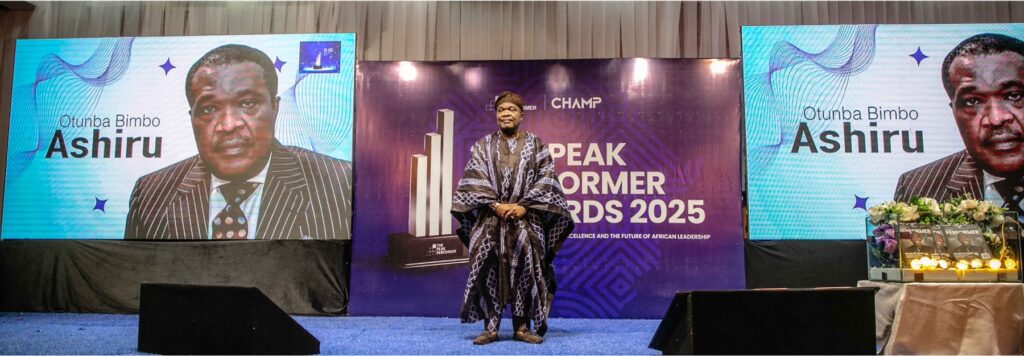
A spotlight on leadership that converts potential into performance
This is the context in which Otunba Bimbo Ashiru’s tenure will receive a spotlight at the The Peak Performer Awards 2026, featuring the Performance Leadership Honours™, on Friday, 20 November 2026, at MUSON Centre, Onikan, Lagos by 6pm.
The spotlight is an opportunity to examine a consequential leadership question i.e. how does an institution with a long history, a complex ownership structure and significant regional expectations reposition itself for a more competitive future?
Ashiru’s experience at Odu’a offers several lessons. Professional governance matters. Strategic intent must be translated into execution. Legacy assets must be renewed. Financial performance must be measured with care. And leadership transitions should preserve institutional capability rather than create dependence on personalities.
These lessons extend well beyond Odu’a. They are relevant to public institutions, family-owned businesses, state-owned enterprises and large corporations seeking to convert potential into durable results.
As Nigeria considers how to improve the performance of its institutions, the Odu’a experience offers a useful case for discussion; not because every challenge has been resolved, but because the reported progress provides evidence of what deliberate repositioning can achieve and a foundation against which future performance can be judged.
A leadership legacy is ultimately measured not only by what changes during a leader’s tenure, but by what an institution becomes capable of sustaining after that leader has moved on.
The Peak Performance Awards 2026 spotlight on Otunba Bimbo Ashiru forms part of the broader Performance Leadership Honours™, which recognises leadership contributions and institutional progress through the lens of governance, execution, accountability and enduring performance.

