
NIGERIAN @ 66: WHAT KIND OF HR LEADERS DOES A NATION TRYING TO GROW TO $1TRILLION ECONOMY NEED? by Dr. Abiola Salami, FNIM, FCIPD (UK), FCIPM, ACIB | Principal, CHAMP Global Leadership Consulting
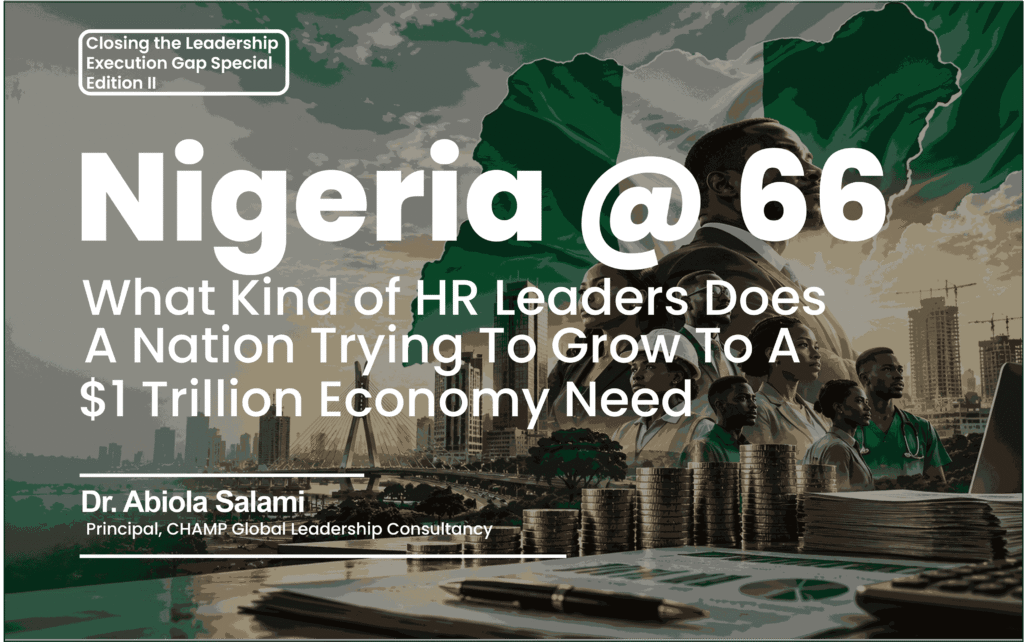
“As Nigeria turns 66, if Nigeria genuinely becomes a $1 trillion economy, then one of the most significant questions HR leaders must be prepared to answer is ‘What part of that trillion dollars will the people systems we lead make possible?” – Dr. Abiola Salami
Introduction
At 66, Nigeria is asking an important economic question. How do we build a $1 trillion economy?
The Federal Government has set a stated ambition of building a US$1 trillion economy by 2030, with enterprise, investment, economic diversification and human capital development among the pillars identified for achieving it.
Much of the conversation will understandably focus on capital.
How much are we investing? How much oil are we producing? How much infrastructure are we building? How much foreign direct investment are we attracting? How much are businesses producing?
But there is another question that deserves equal attention i.e. What kind of people will produce this $1 trillion economy? And perhaps an even more uncomfortable question is Who is building those people?
This is because economies do not become productive simply because governments announce targets. People produce, people innovate, people manage factories, people build businesses, people serve customers, people operate technology, people make decisions, people execute strategy and people lead institutions.
Ultimately, every economic ambition becomes a people-performance question and that puts Human Resources right in the middle of Nigeria’s economic conversation.
HR Can No Longer Be Merely an Organisational Support Function
For decades, Human Resources has fought for a seat at the table. Perhaps the next stage is not simply getting a seat. It is proving what HR contributes when it gets there.
A nation attempting to build a $1 trillion economy cannot afford HR functions whose primary measures of success remain training hours, employee engagement surveys, recruitment numbers, appraisal completion rates and headcount reports. Those things matter but they are inputs and activities.
The bigger question is What changed because HR was there? Did productivity improve?
Did managerial capability improve? Did execution become faster? Did customer experience improve? Did innovation increase? Did leadership pipelines become stronger? Did regrettable talent loss decline? Did the organisation become more competitive? Did investment in people translate into measurable performance?
This shift Nigerian HR leadership now requires is from managing people activity to architecting people performance.
Nigeria Does Not Have a Population Advantage Until It Has a Productivity Advantage
We frequently describe Nigeria’s large and youthful population as an economic advantage.
Potentially, it is; but population alone does not create prosperity. Only productive population create prosperity.
The World Bank’s 2026 Human Capital Report reinforces this distinction. Its Human Capital Index Plus examines how health, education and on-the-job learning affect people’s lifetime productivity and earnings. For Nigeria, the Bank reports an education-pillar score of 64, below the lower-middle-income-country median of 88.
That should matter deeply to HR leaders because the capability gap does not disappear when someone receives an employment letter. Organisations inherit the strengths and weaknesses of the wider education and skills ecosystem.
The question therefore becomes whether companies simply complain about the quality of available talent or deliberately create systems that convert available talent into productive capability.
A $1 trillion economy will require HR leaders who understand that human capital is not an HR issue; it is an economic asset.
So What Kind of HR Leaders Does Nigeria Need?
A. Nigeria needs Productivity Architects.
HR leaders must understand the economics of the organisations they serve. They should be able to sit with the CEO, CFO, COO and business leaders and discuss revenue per employee, productivity, workforce cost, capacity utilisation, skills economics, managerial effectiveness and organisational performance.
They must understand how people create value. The question can no longer simply be, How many employees do we have? It must become What performance is this workforce producing?
B. Nigeria needs Capability Builders.
Training must no longer be confused with capability. An employee attending five programmes does not necessarily mean that employee can perform five things better.
The future HR leader must build a clear conversion chain i.e.
Investment → Learning → Capability → Behaviour → Execution → Performance.
If that chain breaks, HR must know where it broke. That changes Learning and Development from an events business into a performance intervention.
C. Nigeria needs Manager Builders.
One of the most important economic assets inside any institution is the quality of its managers.
Employees experience organisations largely through managers. Strategy reaches employees through managers. Culture is translated through managers. Performance is supervised through managers. Talent is retained or lost through managers.
A nation attempting rapid economic expansion cannot afford millions of employees being managed by people who were promoted because they were technically competent but were never deliberately prepared to lead people.
Building better managers may therefore be one of HR’s highest-leverage contributions to national productivity..
D. Nigeria needs Performance-System Designers.
The best employees eventually adapt to the system around them.
Put talented people inside systems that tolerate poor execution, reward politics, ignore underperformance and confuse activity with achievement, and eventually the system wins. This is why organisations cannot recruit their way out of a performance-system problem.
HR leaders must become architects of clarity, accountability, consequence and performance ownership. People should know what performance means. Managers should know what they are accountable for. High performance should have consequences.
Persistent underperformance should have consequences. Promotion should mean something. Leadership should model the standards the organisation claims to value.
E. Nigeria needs Workforce Strategists.
The $1 trillion economy will not be built using yesterday’s skills architecture. Artificial intelligence, automation, data, digital platforms and emerging technologies will continue changing what organisations need from people.
The Federal Government itself has linked its economic ambition to technical skills, productivity, innovation and the development of a youthful digital workforce.
The sophisticated HR leader must therefore be asking the following 8 questions i.e. What skills will our organisation need three years from now? Which current roles will disappear? Which will change? Which capabilities must we build internally? What should we buy from the labour market? Where can technology augment human performance? Where must employees be reskilled? And what should the organisation stop hiring for entirely? That is workforce strategy.
F. Nigeria needs Leadership Pipeline Architects.
Institutions do not become enduring because they have one exceptional CEO. They become enduring because leadership capability survives individual leaders.
Nigeria has too many organisations where succession remains an emergency conversation. The next generation of HR leaders must build institutions where leadership identification, development, exposure, mobility and succession are systematic.
Every critical role should provoke the question If this person leaves tomorrow, what happens to performance?
Where the answer is organisational instability, there is a leadership-system problem.
G. Nigeria needs People-Data Leaders.
HR cannot demand strategic relevance while remaining uncomfortable with measurement. Every significant investment in people should eventually confront the question Where is the performance?
We can’t attribute every outcome exclusively to HR. Human performance is more complex than that. But HR must become significantly better at connecting workforce decisions with business consequences.
Which teams consistently outperform? What distinguishes their managers? Which capabilities correlate with customer outcomes? What predicts high-performer exits? Where is workforce cost rising faster than productivity? Which development interventions actually change performance? What roles create disproportionate enterprise value?
The future HR leader must be as comfortable with evidence as with empathy.
But There Is an Even Bigger Role
Perhaps the most important shift is that Nigeria needs HR leaders who think beyond their organisations.
If companies continue competing aggressively for the same small pool of ready-made talent without helping expand the national capability pool, we simply keep recycling scarcity. Large employers, professional institutions, universities, governments and industry associations need deeper collaboration around employability, apprenticeships, professional standards, leadership development and emerging skills.
HR leaders should increasingly influence this ecosystem. Imagine Nigeria’s largest employers collectively becoming factories for human capability. Imagine graduates entering organisations and becoming dramatically more productive within three years. Imagine companies becoming recognised not only for how much profit they make, but for the quality of leaders, managers, professionals, innovators and entrepreneurs they produce.
That would be human capital compounding and countries grow when human capability compounds.
The New HR Question
For too long, the conversation has been How much are we spending on our people? That is no longer enough. The stronger question is What performance are we getting from our investment in people?
Nigeria’s $1 trillion ambition will require capital. It will require infrastructure, policy, technology and enterprise. But every one of those things still depends on human beings capable of converting resources into results. That is why HR leadership matters far beyond HR departments.
At 66, Nigeria does not merely need more HR professionals. We need a new generation of Performance HR Leaders i.e. leaders capable of converting talent into capability, capability into execution, execution into productivity and productivity into enterprise performance.
Because ultimately, Nigeria’s greatest economic opportunity is not simply the size of its population. It is what that population can competently, productively and consistently produce.
And if Nigeria truly intends to become a $1 trillion economy, then one of the most significant questions HR leaders must be prepared to answer is What part of that trillion dollars will the people systems we lead make possible?
That is the new mandate. And at 66, it is the mandate Nigeria can no longer afford to treat as merely an HR conversation.
That is the performance test. And that is the conversation we need to have..
About Dr. Abiola Salami
Dr. Abiola Salami is the Principal Performance Strategist at CHAMP – a full scale professional services firm trusted by high performing business leaders for providing Executive Coaching, Workforce Development & Advisory Services to improve performance. He is the Convener of Dr Abiola Salami International Leadership Bootcamp ; The Peak PerformerTM Festival Made4More Accelerator Program and The New Year Kickoff Summit. You can reach his team on hello@abiolachamp.com and connect with him @abiolachamp on all social media platforms.
NB
If you are a Supervisor, Manager or Team Lead, Take the Manager’s Execution Scorecard Assessment to see where execution may be breaking in your team.
If you are a Senior Executive, Look into the Invisible Toll Mirror to see the toll of the weight you are carrying.
For private coaching, boardroom recalibration, or executive healing strategy, connect email me directly at hello@abiolachamp.com to begin your private Executive Coaching Session.

