
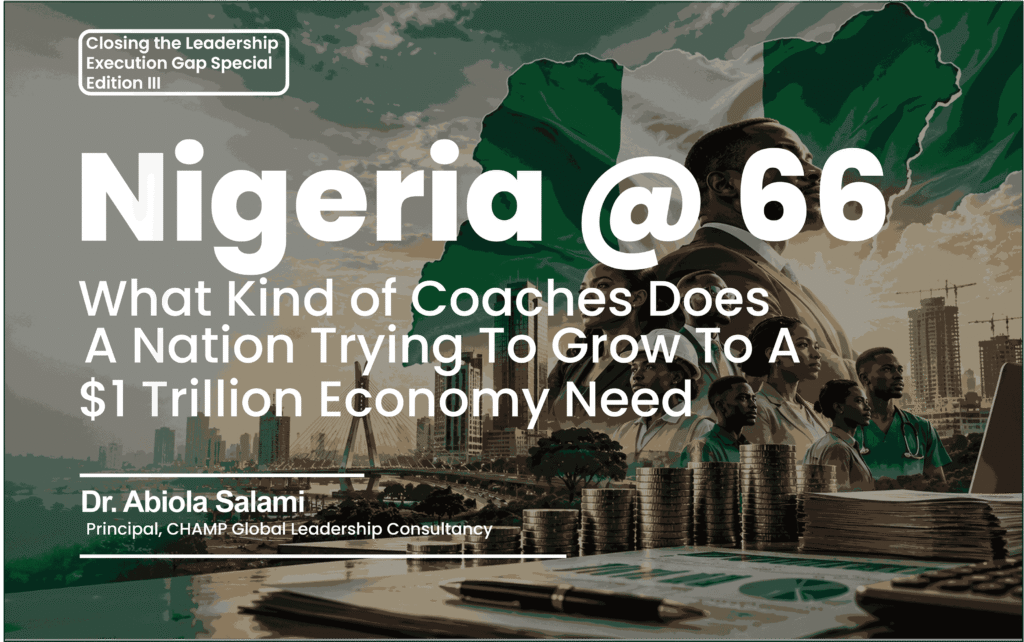
NIGERIAN @ 66: WHAT KIND OF COACHING PRACTITIONERS DOES A NATION TRYING TO GROW TO $1TRILLION ECONOMY NEED? by Dr. Abiola Salami, FNIM, FCIPD (UK), FCIPM, ACIB | Principal, CHAMP Global Leadership Consulting
“As Nigeria turns 66, perhaps this is the question every serious coaching practitioner should ask; If Nigeria genuinely becomes a $1 trillion economy, what evidence will there be that my profession and my practice helped build the leadership capacity that made it possible?” – Dr. Abiola Salami
Introduction
Nigeria is 66.
As we mark another Independence anniversary, there will understandably be conversations about where we have come from, what has gone wrong, what has improved and what kind of country we want to become.
But there is another conversation we need to have. What kind of people will be required to build the Nigeria we keep talking about?
And, more specifically for those of us in the coaching profession, What kind of coaching practitioners does a nation attempting to build a $1 trillion economy actually need?
The Federal Government has set an ambition of building a $1 trillion economy by 2030. In February 2026, the Federal Ministry of Finance said achieving that scale would require sustained annual GDP growth of roughly 10–12%, while describing the present economy at approximately $375 billion.
Yet the IMF projects real GDP growth of about 4.1% for Nigeria in 2026.
Whatever view one takes of the headline $1 trillion target, the underlying challenge is unmistakable: Nigeria has an enormous performance gap to close.
Capital must become productive investment, policy must become execution, talent must become capability, enterprise must become scale, leadership must become institutional performance and aspiration must become results. That is why the conversation about coaching must change.
A $1 Trillion Economy Is Also a Human Performance Project
We understandably discuss economic transformation in terms of infrastructure, power, technology, fiscal policy, foreign investment, trade, industrialisation and access to capital. All of these matter enormously.
Coaching cannot replace good economic policy. It cannot generate electricity, repair roads, reform regulation or substitute for functioning institutions.
But behind every policy, business, institution, investment decision and execution system are human beings.
Someone has to make the decision. Someone has to lead the team. Someone has to navigate uncertainty. Someone has to confront poor performance. Someone has to change an entrenched behaviour. Someone has to build the organisation capable of converting opportunity into value. Someone has to execute.
The World Bank reports that Nigeria’s macroeconomic position has strengthened, but also warns that current growth remains insufficient to create enough productive jobs or materially reduce poverty. Its emphasis is increasingly on private investment, productivity, human capital and job creation.
That should matter to the coaching profession.
Because if Nigeria must dramatically improve productivity, leadership quality, entrepreneurial capacity and institutional execution, then coaching practitioners should be asking Are we developing people who can actually make systems perform?
Nigeria Does Not Need More Motivational Coaching
There is nothing wrong with motivation.
People sometimes need encouragement. They need confidence. They need someone to help them see possibilities they have stopped seeing.
But a country attempting a transformation of this magnitude needs more than encouragement.
Nigeria cannot be coached into a $1 trillion economy by affirmation. We will not inspire our way around weak execution. We cannot positive-think our way out of poor productivity.
A chief executive who feels better but still cannot translate strategy into execution has not solved the organisation’s problem.
A public-sector leader who has greater self-awareness but cannot improve institutional delivery has not yet created public value.
An entrepreneur who has discovered their purpose but cannot build processes, manage people, understand numbers, acquire customers or scale responsibly still has a performance problem.
The coaching profession therefore has to graduate from asking only “How does the client feel?” to also asking “What changed?”
What decision became better? What behaviour changed? What capability improved?
What execution accelerated? What performance constraint was removed? What measurable outcome followed?
That is the journey from coaching activity to coaching impact.
A. We Need Practitioners Who Understand Strategy
The coach of the next Nigerian economy cannot be disconnected from the commercial and institutional realities facing the client.
A senior executive does not operate in an abstract personal-development laboratory. She operates inside a strategy. There are customers, competitors, regulators, shareholders, employees, technology disruptions, capital constraints, performance targets, political economy, market shifts and board expectations.
Effective coaching at that level requires the ability to understand context; not to become the client’s consultant or prescribe every answer, but to ask questions intelligent enough to interrogate the decisions that matter.
If Nigeria wants stronger companies, more productive institutions and globally competitive enterprises, we need coaching practitioners who understand how leadership connects with strategy and how strategy connects with performance.
B. We Need Practitioners Obsessed With Execution
Nigeria has never suffered from a shortage of ideas.
Impressive plans are regularly created across government, corporations, entrepreneurship and civil society.
The recurring challenge is conversion of Intent into Action into Execution into Outcomes.
That conversion problem must become an important territory for coaching.
The executive coach of the future must be comfortable asking these 7 questions:
- What exactly did you commit to doing?
- What has happened since our last conversation?
- What is preventing execution?
- Is the problem capability, courage, clarity, discipline, politics, resources or accountability?
- What difficult conversation are you avoiding?
- What decision have you postponed?
- What evidence will show that progress has occurred?
Coaching cannot become another place where leaders learn sophisticated language for explaining why nothing changed. It should become one of the environments where commitments become visible and accountability becomes unavoidable.
C. We Need Coaches Who Can Work With Systems, Not Just Individuals
One of the limitations of traditional development thinking is the tendency to locate performance problems entirely within the individual; but people operate inside systems.
You can coach a manager to delegate, while the organisation punishes every mistake made by subordinates.
You can coach an executive to innovate, while the governance structure makes experimentation almost impossible.
You can coach employees to take ownership, while every meaningful decision still requires seven layers of approval.
You can coach for performance inside a system designed to reward activity rather than outcomes.
Eventually, the system wins.
The next generation of coaching practitioners must therefore become much more sophisticated about organisational context. They must understand culture, incentives, decision rights, accountability, power, governance, performance management and organisational design.
Because sometimes the appropriate coaching insight is not “You need to change.”
Sometimes it is “The system around you must change if the new behaviour is expected to survive.”
D. We Need Practitioners Who Can Coach Enterprise Builders
A $1 trillion Nigerian economy cannot be built by government alone.
The Federal Ministry of Finance itself has said the ambition depends substantially on investors, entrepreneurs, skills and private-sector productivity.
That creates another assignment for the coaching profession.
We need coaches capable of helping founders make the transition from hustlers to enterprise builders. From personality-dependent businesses to institutions. From revenue obsession to sustainable value creation. From doing everything themselves to building teams. From informal decision-making to governance. From local survival to regional and global competitiveness.
Thousands of Nigerian businesses do not necessarily fail because their founders lack ambition. Many fail because ambition outgrows managerial capability. The person capable of starting a ₦10 million business may need fundamentally different leadership capabilities to run a ₦1 billion organisation.
That transition is coachable and it matters to national economic performance.
E. We Need Coaches Who Can Develop Leaders, Not Dependents
There is a danger within every helping profession i.e. becoming so important to the client that the client becomes dependent on the practitioner.
That should not be the ambition of coaching.
The true test of great coaching is not how frequently the client needs the coach. It is whether the client progressively develops greater capacity to think, decide, confront reality, learn, adapt and perform.
Nigeria needs leaders with internal operating systems strong enough to function under pressure. Leaders who can question their assumptions, receive uncomfortable feedback, make difficult decisions, take responsibility, recover from setbacks, manage competing interests, learn faster than their environment changes and build other leaders.
Coaching at its best should multiply that capacity.
F. We Need Evidence-Led Practitioners
If coaching wants a serious seat in Nigeria’s boardrooms, it must become increasingly comfortable with evidence.
I reckon that not every coaching outcome can be reduced to a spreadsheet. But neither should the profession hide behind the complexity of human development to avoid questions about impact.
Where appropriate, we should be able to connect coaching interventions with observable shifts in leadership behaviour, decision effectiveness, team performance, employee outcomes, execution milestones and organisational results.
The question should increasingly become What was different because coaching happened?
This is particularly important when organisations are investing significant resources in leadership development. Training hours are not performance, number of coaching sessions is not performance and participant satisfaction is not performance.
The conversion chain isb Investment → Capability → Behaviour → Execution → Performance.
The future credibility of coaching will increasingly depend on our ability to demonstrate that conversion.
G. We Need Ethical Practitioners
The greater the influence of coaching becomes, the more seriously practitioners must take professional boundaries.
Coaching gives practitioners unusual access to people’s ambitions, fears, relationships, weaknesses, decisions and organisational realities. That access creates responsibility.
Nigeria does not need celebrity coaches who know how to market themselves but cannot be trusted with confidential information.
We need practitioners who understand ethics. Who know the limits of their competence. Who can distinguish coaching from therapy, consulting, mentoring and counselling. Who will make referrals when an issue exceeds their professional capability. Who will not exploit vulnerability. Who will not manufacture testimonials, credentials or impact.
Because trust is not merely a professional virtue. It is professional infrastructure.
We Need Coaches Who Think Beyond the Client
Perhaps this is the greatest shift required.
Every serious coaching engagement has at least three levels of impact. There is the person. There is the institution in which that person operates. And there is the society that eventually experiences the consequences of how that institution performs.
When a CEO becomes a better leader, thousands of employees may experience the difference. When an entrepreneur successfully scales, jobs can be created. When a public servant improves execution, citizens may experience better services. When a senior banker makes better capital-allocation decisions, productive enterprises may gain access to financing. When a leader builds successors, an institution becomes less dependent on one individual.
The unit of impact may begin with one person; but it should not necessarily end there.
That is why I believe coaching practitioners must begin to see themselves differently.
We are not merely in the business of helping people become better versions of themselves.
At our highest level of contribution, we are helping people develop the capabilities required to build better-performing organisations, enterprises and institutions; and those institutions collectively determine how a nation performs.
Nigeria @ 66: The Challenge to the Profession
At 66, Nigeria’s next chapter will not be written by ambition alone.
It will be written by capability, by the quality of leadership inside our businesses, by the productivity of our people, by the courage of entrepreneurs, by the effectiveness of our institutions, by the quality of decisions made in rooms most Nigerians will never enter.
And, ultimately, by our collective ability to convert potential into performance.
This is where the coaching profession must locate its national relevance.
Nigeria does not simply need more coaches. Nigeria needs coaching practitioners capable of strengthening the people who must strengthen the institutions that must strengthen the economy.
We need practitioners who understand strategy, practitioners who demand execution, ractitioners who understand systems, practitioners who develop enterprise builders, practitioners who measure what changes, practitioners who protect professional integrity and, practitioners who understand that personal transformation is powerful but institutional performance is what ultimately changes societies.
As Nigeria turns 66, perhaps this is the question every serious coaching practitioner should ask; If Nigeria genuinely becomes a $1 trillion economy, what evidence will there be that my profession and my practice helped build the leadership capacity that made it possible?
Because a nation seeking extraordinary economic performance cannot afford an ordinary coaching profession.
That is the performance test. And that is the conversation we need to have..
About Dr. Abiola Salami
Dr. Abiola Salami is the Principal Performance Strategist at CHAMP – a full scale professional services firm trusted by high performing business leaders for providing Executive Coaching, Workforce Development & Advisory Services to improve performance. He is the Convener of Dr Abiola Salami International Leadership Bootcamp ; The Peak PerformerTM Festival Made4More Accelerator Program and The New Year Kickoff Summit. You can reach his team on hello@abiolachamp.com and connect with him @abiolachamp on all social media platforms.
NB
If you are a Supervisor, Manager or Team Lead, Take the Manager’s Execution Scorecard Assessment to see where execution may be breaking in your team.
If you are a Senior Executive, Look into the Invisible Toll Mirror to see the toll of the weight you are carrying.
For private coaching, boardroom recalibration, or executive healing strategy, connect email me directly at hello@abiolachamp.com to begin your private Executive Coaching Session.

