
From Reform to Growth: What Nigeria must Do Differently by Dr. Abiola Salami, Principal, CHAMP Global Leadership Consultancy
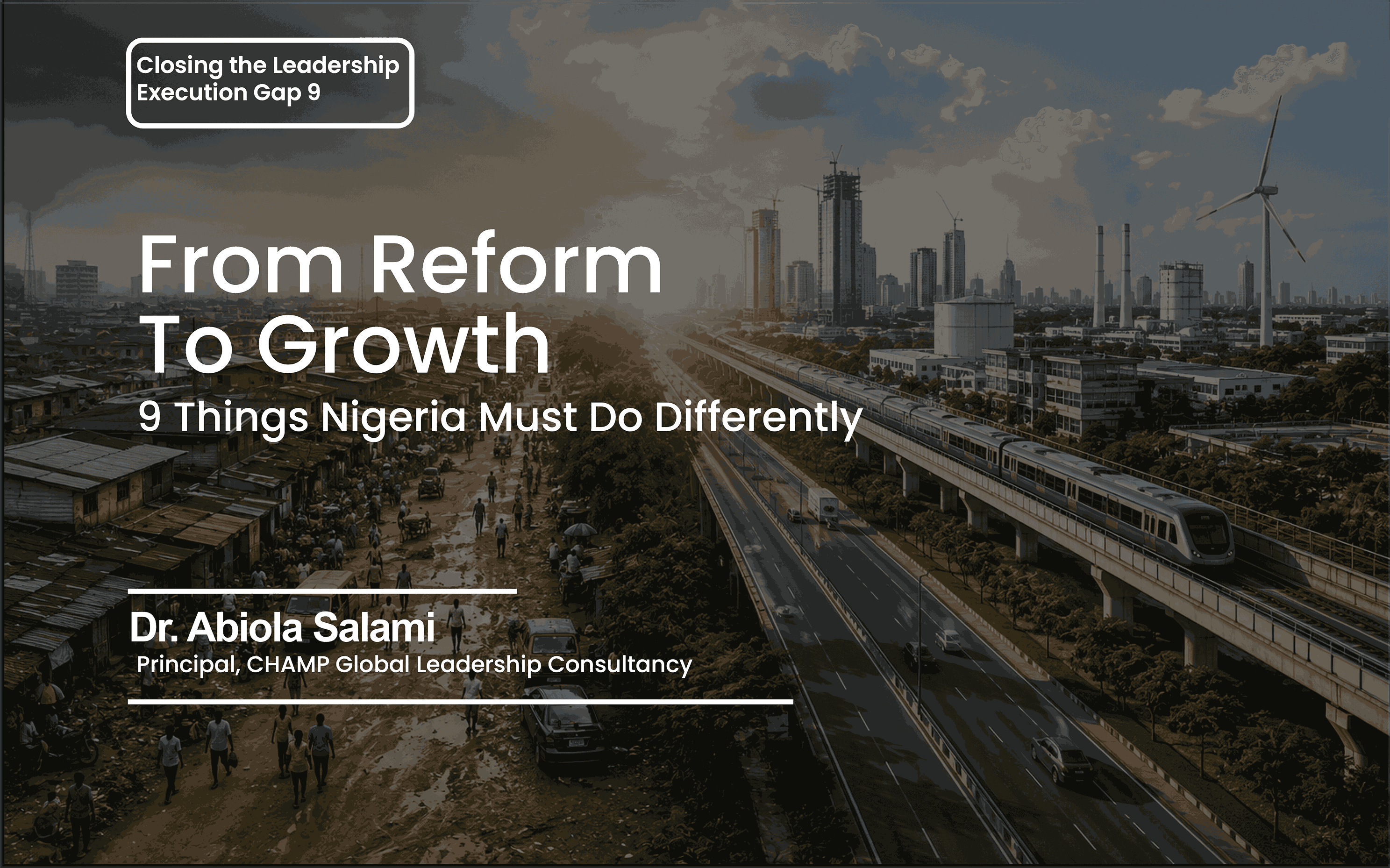
“Reforms are great. How can we ensure Nigeria is growing fast enough, productively enough and inclusively enough to transform the lives of Nigerians?” – Dr. Abiola Salami
Introduction
Nigeria has begun the difficult work of reform. But reform is not the destination. Neither is macroeconomic stability.
The destination is a country where more people have productive work, fewer families live in poverty, businesses can grow, the middle class expands, communities become safer and citizens can see the connection between difficult economic decisions and improvements in their lives.
That is the performance test.
In Issue 001 of the Performance Leadership Brief™ — The National Performance Edition, I asked: Nigeria has paid the price of reform. Where is the performance?
A well respected senior business leader who read the Brief subsequently challenged me to take the argument further. His proposition was that Nigeria needs growth substantially above current levels (i.e. potentially more than 8% annually, sustained over a decade) if we are serious about employment creation, poverty reduction and building a significantly larger middle class.
Although 8% may not be an economic magic number, the underlying argument is compelling. Nigeria needs to grow much faster, for much longer and much more inclusively.
The IMF projects growth of about 4.1% in 2026. Yet its 2026 assessment also estimates poverty at 63% using the national poverty line and reports that 27 million Nigerians faced food insecurity in late 2025. The World Bank estimates that about 3.5 million Nigerians enter the labour force annually.
So the question is no longer simply whether Nigeria is growing. Is Nigeria growing fast enough, productively enough and inclusively enough to transform Nigerian lives?
That demands a different growth strategy and here are my recommendations:
1. Move From Stabilisation to Production
The first phase of reform understandably focused on correcting major macroeconomic distortions. Fuel subsidy reform, exchange-rate reform and tighter monetary policy imposed significant adjustment costs on households and businesses, even as they addressed longstanding structural problems.
However, countries do not become prosperous by stabilising indefinitely. They become prosperous by producing. The next phase must therefore seek to answer the following 4 questions (a) What can Nigeria produce competitively? (b) What can we process instead of exporting raw? (c) Which industries can employ people at scale? (d) Where can Nigerian businesses compete regionally and globally?
Nigeria cannot sustainably consume its way to transformational growth. It must produce, invest, innovate and export its way there.
2. Make the Private Sector the Growth Engine
With millions entering the labour force annually, Nigeria’s employment challenge cannot principally be solved by expanding government payrolls. The scale demands an economy where businesses are created, existing businesses scale and private capital continually enters productive activity. That modifies electricity, affordable finance, logistics, infrastructure, security and regulatory predictability from merely business complaints to growth issues.
Every unnecessary constraint that makes a productive Nigerian enterprise more expensive to operate ultimately constrains national growth. Government creates the enabling environment. But productive enterprises must ultimately create much of the investment, innovation and employment required for transformation.
3. Don’t Forget the Businesses That Paid for Reform
Citizens were not the only ones who absorbed the reform shock. Businesses did too; particularly micro and small enterprises.
Following subsidy removal, higher fuel costs travelled through transportation, distribution, power generation and operating expenses. For a large corporation, an energy shock may become another cost-optimisation challenge. For the barber running a generator, tailor, food vendor, welder, small retailer or neighbourhood manufacturer, it can threaten the economics of the entire business.
This matters because MSMEs account for most Nigerian businesses and a substantial share of employment and economic activity. If Nigeria wants transformational growth, microenterprise cannot be treated merely as a poverty-alleviation conversation. It is part of the growth architecture.
The question should therefore be What are we doing to make the millions of small businesses that survived the reform shock more productive than they were before it? Finance matters. So do electricity, markets, digital infrastructure, transportation, skills and access to customers.
4. Follow the Reform Money
Perhaps one of the least interrogated questions in the reform debate is simple – Where is the money going? The fiscal consequences of reform extend beyond the Federal Government.
NBS data show how significantly aggregate Federation Account flows changed around the reform period. In April 2023, before subsidy removal, states collectively received ₦232.13 billion and local governments ₦171.26 billion from that month’s FAAC disbursement. By July 2024, the corresponding amounts were ₦461.98 billion and ₦337.02 billion respectively.
These figures fluctuate and cannot all be attributed to subsidy removal; exchange gains, VAT, statutory revenue and other components matter. But increased fiscal flows make performance accountability more important.
The question at every level of government should become You are receiving more. What are Nigerians getting more of? Is it better primary healthcare, better schools, better roads, better security, better agricultural infrastructure, better water, better markets or better local enterprise support?
The performance equation should be:
ADDITIONAL REVENUE → PRODUCTIVE INVESTMENT → MEASURABLE OUTCOMES.
Citizens should increasingly be able to trace one to the other.
5. Make States and Local Governments Growth Engines
Nigeria will not achieve transformational growth from Abuja alone.
Growth happens somewhere. A farmer operates in a local government. A factory sits in a state. A truck moves along actual roads. An entrepreneur encounters regulations somewhere.
If greater resources are flowing through the federation, subnational governments must increasingly be judged by the economic capacity those resources create.
Every state should be able to answer these 5 questions (a) Which sectors will we make competitive? (b) What infrastructure bottlenecks will we remove? (c) What investments will we attract? (d) How will we raise productivity? (e) How many businesses will we enable to scale?
At local government level, the question becomes even more immediate What changed in this community because government had more resources?
Fiscal federalism must meet performance accountability.
6. Treat Infrastructure as a Productivity System
Nigeria also needs to change how it measures infrastructure.
A road is not successful merely because it was commissioned. A power project is not successful because capacity was installed. A rail line is not successful because trains started moving.
What did the investment do to productivity? Did it reduce logistics costs? Shorten travel time? Allow manufacturers to produce more efficiently? Connect businesses to markets? Unlock private investment?
Transformational growth requires infrastructure selected, executed and evaluated according to its economic multiplier, not merely its visibility.
7. Build Institutions That Can Execute
This may ultimately be Nigeria’s greatest challenge.
We have produced economic plans, industrial policies, agricultural programmes, intervention funds and infrastructure strategies before. Too often, the missing link has been between intention and execution.
This is why the inaugural Performance Leadership Brief™ introduced the Reform-to-Performance Gap™ i.e. the distance between implementing reform and producing the economic, institutional and social outcomes that justify the sacrifice.
I describe the broader journey through the Performance Leadership Value Chain™:
REFORM → POLICY → STRATEGY → INSTITUTIONS → EXECUTION → PERFORMANCE → PROSPERITY & PUBLIC TRUST.
There is no shortcut from policy to prosperity. Nigeria needs institutions that coordinate, measure, learn, make timely decisions and hold people accountable for outcomes. We need, in effect, an execution revolution.
8. Make Jobs, Incomes and Poverty Reduction Performance Measures
GDP growth matters. But GDP cannot be the final performance measure.
If output rises while households remain economically distressed, something is missing in the transmission mechanism.
We must therefore ask 6 questions regarding our growth. (a) How many productive jobs did it create? (b) What happened to real household incomes? (c) How many businesses moved from micro to small, small to medium and medium to large? (d) What happened to productivity? (e) Is poverty declining? (f) Is the middle class expanding?
These should become national performance indicators, not footnotes beneath GDP.
9. Connect Growth to Security
Finally, Nigeria cannot separate its growth ambition from security.
Poverty or unemployment does not automatically cause crime. Crime and insecurity have multiple drivers, including organised criminal networks, weak law enforcement, conflict, governance failures and ineffective justice systems. But economic opportunity and security are not unrelated.
Millions of young people without credible economic pathways create vulnerabilities no serious country should ignore. At the same time, insecurity destroys livelihoods, discourages investment and suppresses production.
A farmer must be able to farm. A trader must travel. A business must invest. A young Nigerian must see legitimate pathways to advancement.
Growth, opportunity, policing, justice and security must therefore function as parts of the same national performance system.
Conclusion – The Hardest Part of 8% Is Not 8%
Nigeria has experienced periods of rapid growth before. That history should make us more ambitious and more careful. The hardest part is not touching 8%. It is sustaining strong growth, making it productivity-driven and employment-intensive, spreading it geographically and ensuring that it reaches households.
That is why today’s ambition must go beyond reproducing yesterday’s GDP numbers. Nigeria has asked citizens and businesses to absorb extraordinary economic adjustment. Leadership must now commit to converting sacrifice into results.
That responsibility belongs to the Federal Government, states, local governments, regulators, public institutions, business leaders and investors.
The Nigerian who paid more for transportation because subsidy was removed should eventually experience the dividend of reform. The microbusiness that absorbed higher costs should encounter a more productive operating environment. The community whose government receives greater fiscal resources should be able to identify what changed.
Reform must produce execution. Execution must produce growth. Growth must produce productive jobs and rising incomes. And prosperity, combined with effective institutions, justice and security, must contribute to a safer and more stable society.
The question is therefore bigger than whether Nigeria can grow at 8%. Can we build the leadership, institutions and execution capability to sustain transformational growth and ensure that the resources created by reform, from Abuja to states and local governments, become outcomes Nigerians can actually see and feel?
Ultimately, the success of reform will not be determined by how much money government saves or receives. It will be determined by what becomes better because of it.
About Dr. Abiola Salami
Dr. Abiola Salami is the Convener of Dr Abiola Salami International Leadership Bootcamp ; The Peak PerformerTM Festival Made4More Accelerator Program and The New Year Kickoff Summit. He is the Principal Performance Strategist at CHAMP – a full scale professional services firm trusted by high performing business leaders for providing Executive Coaching, Workforce Development & Advisory Services to improve performance. You can reach his team on hello@abiolachamp.com and connect with him @abiolachamp on all social media platforms.
For private coaching, boardroom recalibration, or executive healing strategy, connect email me directly at hello@abiolachamp.com to begin your private Executive Coaching Session.
NB
If you are a Supervisor, Manager or Team Lead, Take the Manager’s Execution Scorecard Assessment to see where execution may be breaking in your team.
If you are a Senior Executive, Look into the Invisible Toll Mirror to see the toll of the weight you are carrying.

