
Nigeria’s Next Crisis Is Not Policy. It Is Execution by Dr. Abiola Salami, Principal, CHAMP Global Leadership Consultancy
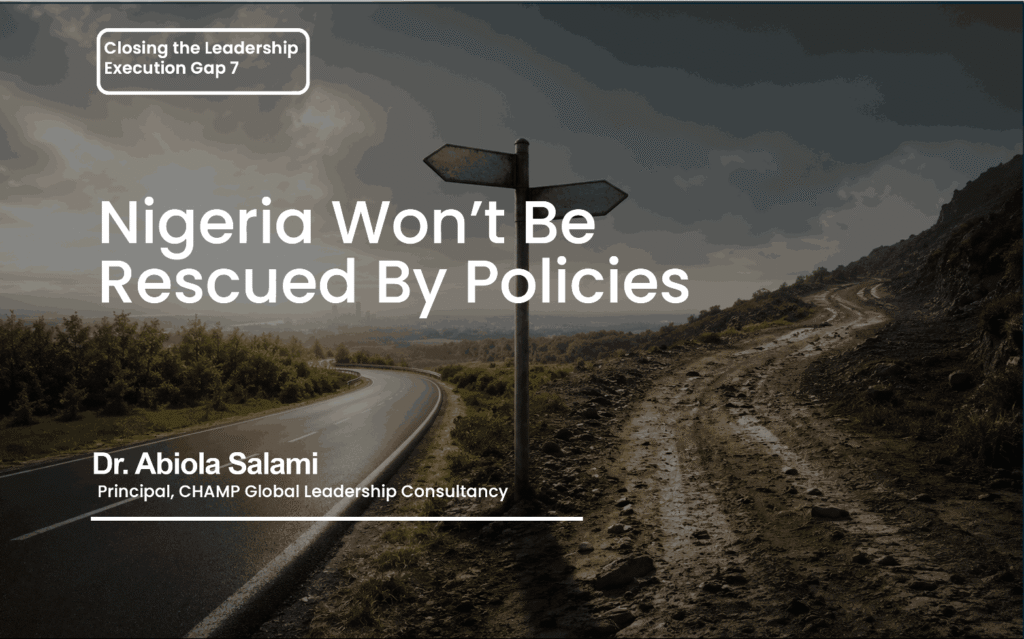
“Policies tell us what will be done. Performance tells us what changed because it was done. Nigeria needs much more of the second.” – Dr. Abiola Salami
What we have repeatedly lacked is the institutional capability to convert ambition into measurable results.
And that may now be one of the biggest risks to Nigeria’s economic future.
In Issue 001 of the Performance Leadership Brief™ — The National Performance Edition, I argued that Nigeria has entered a new phase of its economic journey. After three years of difficult reforms, the defining challenge is shifting from making the right policy decisions to converting those decisions into measurable national performance.
The evidence makes that distinction important.
Nigeria’s economy grew by 3.87 per cent in 2025 and by 3.89 per cent in the first quarter of 2026. The IMF projects growth of approximately 4.1 per cent in 2026. Gross international reserves have strengthened, the foreign exchange market has become more orderly, and inflation has moderated, with headline inflation at 15.91 per cent in June 2026, according to the National Bureau of Statistics.
These are meaningful developments.
Yet the same Brief highlights another reality. Poverty and food insecurity remain significant. Financing remains expensive, with the Central Bank’s Monetary Policy Rate at 26.5 per cent in July. Businesses continue to confront constrained consumer demand, while the Federal Government has acknowledged that much of the fiscal gains anticipated from recent reforms have been absorbed by debt servicing and higher public expenditure rather than immediately translating into visible development outcomes.
The question, therefore, is no longer simply whether Nigeria is making the right policy choices. It is whether our institutions can convert those choices into results. That is an execution question.
One of the most dangerous assumptions in leadership is that making the right decision automatically produces the right result. It does not. A policy is an intention and performance is an outcome. Between the two sits the machinery of execution.
Consider what must happen for an economic reform to improve the life of an ordinary Nigerian.
Reform must create better incentives. Those incentives must stimulate investment. Investment must increase productive capacity. Productivity must enable businesses to expand. Expansion must create jobs. Jobs must generate incomes. Rising incomes must ultimately improve household prosperity.
None of this happens automatically. At every point in that chain, somebody must execute. Institutions must coordinate. Leaders must decide. Resources must be allocated. Responsibilities must be clear. Progress must be measured. Problems must be corrected.
When those capabilities are weak, even excellent policies can produce disappointing outcomes. This is why Nigeria’s next crisis may not be a shortage of policy. It may be a shortage of execution capability.
When Strategy Becomes Activity
Corporate Nigeria should pay attention because this problem is not confined to government. Every year, organisations hold strategy retreats. The presentations are impressive. Growth, digital transformation, market leadership, customer experience, innovation, operational excellence and people development.
The language is rarely the problem. Sometimes, the strategy itself is not even the problem. The real test begins on Monday morning. Who owns each strategic priority? What decisions must be taken? What resources have been committed? Which functions must collaborate? What behaviours must change? What milestones must be achieved? What happens when performance falls behind? And who is ultimately accountable for the result?
When these questions are unanswered, strategy gradually becomes activity. Meetings are held. Reports are written. Presentations are delivered. Budgets are spent. Yet the organisation remains remarkably similar.
This is one of the central distinctions in Performance Leadership™ that activity tells us what was done. Performance tells us what changed because it was done. Nigeria needs much more of the second.
The Hidden Execution Gap
In the inaugural Performance Leadership Brief™, I introduced the Reform-to-Performance Gap™ i.e. the distance between implementing a reform and delivering the measurable economic, institutional and social outcomes that justify the sacrifices required to achieve it.
Underneath that gap sits something deeper. An execution gap.
Nigeria can make the correct policy decision and still produce an inadequate outcome if the institutions responsible for translating that decision into results cannot execute effectively.
Execution, in this context, is not merely implementation. It is the institutional capability to align leadership, coordinate across agencies, make timely decisions, allocate resources effectively, establish accountability, measure outcomes and continuously improve delivery.
That leads to what I call the Performance Leadership Diagnosis™ i.e. Nigeria’s greatest constraint is increasingly not the absence of reform. It is the capability to execute consistently.
That diagnosis should change how we evaluate leadership. A Minister should not ultimately be judged by the number of policies announced. A Ministry should not be judged by the number of programmes launched. A budget should not be celebrated merely because money was appropriated or released. A CEO should not be applauded simply because a new strategy has been unveiled.
The question must increasingly become What measurable outcome did it produce?
We Must Stop Building Hero-Dependent Institutions
There is another execution problem we rarely discuss. Too many institutions perform only when exceptional individuals are in charge. A dynamic CEO arrives and an organisation comes alive. A reform-minded Minister takes office and a Ministry suddenly begins to move. A strong agency head transforms performance. Then the individual leaves and performance deteriorates. That is not institutional capability. That is dependence on hero leadership.
Exceptional leaders matter. But sustainable performance requires institutions capable of performing beyond the tenure of exceptional individuals.
Every Board and public institution should therefore ask a difficult question – If today’s leader disappeared tomorrow, would the system continue to perform?
If the answer is no, we have not yet built an institution capable of sustained performance. Governance, succession, leadership development, institutional memory, accountability and execution disciplines therefore matter enormously. The highest responsibility of leadership is not merely to deliver results today. It is to build an institution capable of repeatedly delivering results tomorrow.
Change the Questions
Nigeria has demonstrated considerable courage in undertaking difficult reforms.
The next phase requires a different discipline. We must move from asking What policy did we announce?
to What outcome did we deliver? From asking How much did we spend? to asking What value did that expenditure create? From asking What programme did we launch? to asking What measurable problem did it solve? From asking Who was responsible for the activity? to Who is accountable for the outcome?
These questions belong in the Federal Executive Council and State Executive Councils. They belong in Ministries, Departments and Agencies. They belong in Boardrooms and Executive Management meetings. Because the execution crisis is not confined to government. It exists anywhere ambition consistently exceeds results.
In Issue 001 of the Performance Leadership Brief™, I posed a question that deserves wider national consideration: If Nigeria introduced no new reforms over the next twelve months, but executed the current reforms exceptionally well, how different would the country’s performance look by this time next year?
Perhaps our next breakthrough will not come from another brilliant policy. Perhaps it will come from becoming exceptionally good at delivering the policies and strategies we already have.
Because ultimately, policy is only a promise of possibility. Execution is what converts that possibility into performance. And performance is what citizens, customers, employees, shareholders and investors ultimately experience.
ABOUT DR. ABIOLA SALAMI
Dr. Abiola Salami is the Principal Performance Strategist at CHAMP – a full scale professional services firm trusted by high performing business leaders for providing Executive Coaching, Workforce Development & Advisory Services to improve performance. He is the Convener of Dr Abiola Salami International Leadership Bootcamp The Peak PerformerTM Festival Made4More Accelerator Program and The New Year Kickoff Summit. You can reach his team on hello@abiolachamp.com and connect with him @abiolachamp on all social media platforms.
FREE ASSESSMENTS
If you are a Supervisor, Manager or Team Lead, Take the Manager’s Execution Scorecard Assessment to see where execution may be breaking in your team.
If you are a Senior Executive, Look into the Invisible Toll Mirror to see the toll of the weight you are carrying.
For private coaching, boardroom recalibration, or executive healing strategy, connect email me directly at hello@abiolachamp.com to begin your private Executive Coaching Session.

