
Nigeria Has Paid the Price of Reform. Where Is the Performance? by Dr. Abiola Salami, Principal, CHAMP Global Leadership Consultancy
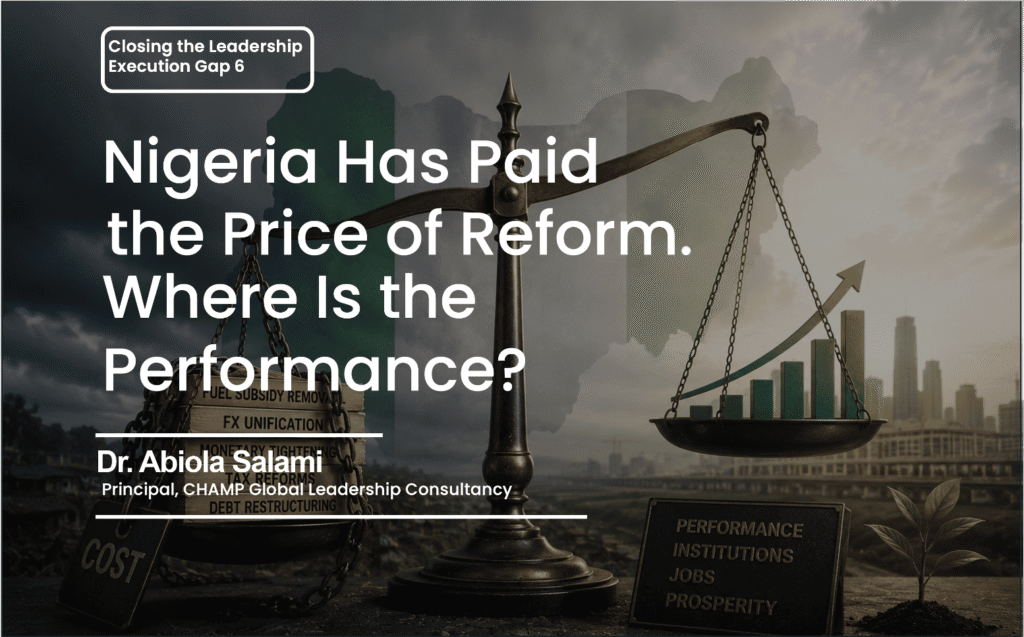
Nigeria is no longer debating whether economic reform was necessary. That debate is over.
The fuel subsidy had become fiscally unsustainable. The foreign exchange market required fundamental restructuring. Fiscal imbalances demanded correction. Difficult decisions were inevitable if the economy was to regain stability and credibility.
The more important question today is no longer whether reform was necessary. It is whether Nigeria is beginning to convert those difficult reforms into measurable national performance.
That question should concern every Board Chair, Chief Executive Officer, investor, legislator and policymaker because nations are not transformed when policies are announced. They are transformed when those policies consistently improve the lives of citizens, strengthen businesses, increase productivity, attract investment and build confidence in the future. This is where Nigeria now stands.
After three years of painful but necessary adjustments, the country has entered a new phase of its economic journey one where the defining challenge is no longer policy reform, but institutional execution. The evidence tells a fascinating story.
According to the National Bureau of Statistics, Nigeria’s economy grew by 3.87 per cent in 2025 and by 3.89 per cent in the first quarter of 2026. The International Monetary Fund projects overall growth of approximately 4.1 per cent this year. Gross international reserves have strengthened significantly, while net international reserves have improved even more dramatically. The foreign exchange market has become considerably more orderly than it was three years ago. Inflation, although still elevated, has moderated following the rebasing of the Consumer Price Index, and international institutions now acknowledge that Nigeria’s reform programme has strengthened macroeconomic stability and restored a measure of policy credibility.
These are not cosmetic improvements. They are meaningful indicators that the economy’s foundations are becoming stronger.
For investors, they signal improving resilience. For businesses, they provide greater policy certainty. For government, they demonstrate that difficult decisions are beginning to stabilise the macroeconomic environment.
Yet there is another story unfolding at exactly the same time.
Businesses continue to grapple with elevated financing costs as tight monetary policy keeps borrowing expensive. Consumer demand remains fragile. Many organisations are postponing investment decisions while waiting for stronger purchasing power to return. Households continue to struggle with the high cost of living, while food affordability remains a daily concern for millions of Nigerians.
Perhaps the most revealing development came from the Federal Government itself.
In July this year, government acknowledged that much of the fiscal gains expected from fuel subsidy removal and foreign exchange reforms had been absorbed by debt-servicing obligations and increased public expenditure rather than translating directly into visible development outcomes.
That admission is significant. It changes the conversation.
The question is no longer whether reforms created fiscal space. The more important question is whether that fiscal space is being converted into measurable national performance.
This is why the public debate has become increasingly polarised. One school argues that the reforms have failed because many Nigerians are yet to experience meaningful relief. Another insists that the reforms have succeeded because macroeconomic indicators continue to improve.
The evidence supports neither extreme. It supports a more balanced conclusion.
Nigeria is telling two economic stories at the same time. One story is reflected in macroeconomic data. The other is reflected in the everyday experience of businesses and households. Both stories are true. Neither story is complete on its own.
Over the years, I have come to believe that one of the greatest mistakes leaders make is assuming that reform automatically produces results. It does not. Policies create possibilities but institutions create outcomes.
This is why I describe Nigeria’s current challenge as the Reform-to-Performance Gap i.e. the distance between implementing a reform and delivering the measurable economic, institutional and social outcomes that justify the sacrifices required to achieve it.
Every reform creates expectations. Citizens expect a better quality of life. Businesses expect greater certainty. Investors expect stronger returns. Government expects higher growth.
The wider the gap between those expectations and people’s lived experience, the greater the pressure on public confidence and the greater the risk that even well-designed reforms begin to lose legitimacy. The implication is profound.
Nigeria’s greatest challenge is no longer primarily one of policy formulation. It is now one of institutional execution. Execution is often misunderstood. It is not merely implementation.
Execution is the institutional capability to align leadership, coordinate agencies, make timely decisions, allocate resources effectively, measure outcomes rigorously and continuously improve delivery.
Countries that master these capabilities convert reform into prosperity. Those that do not often remain trapped in repeated cycles of policy announcements followed by public disappointment.
The same lesson applies to corporate Nigeria. Many organisations produce ambitious strategies every year. Far fewer consistently translate those strategies into measurable shareholder value. The difference between exceptional organisations and average ones is rarely ambition. It is execution discipline.
The same principle applies to nations. As Nigeria moves into the next phase of its reform journey, success should no longer be measured simply by the number of reforms introduced. It should be measured by the value those reforms create.
Have they increased productivity? Have they strengthened the competitiveness of Nigerian businesses? Have they attracted long-term investment? Have they created quality jobs? Have they improved household incomes? Have they restored public confidence in institutions?
These are the questions that should dominate Board meetings, Executive Council deliberations and legislative oversight.
Because the countries that outperform in the twenty-first century will not necessarily be those with the boldest reforms. They will be those with the strongest institutions, the most disciplined execution systems and the greatest capacity to convert ambition into measurable national performance.
Nigeria has demonstrated that it can make difficult decisions. The next test is whether it can consistently deliver measurable results. That is no longer merely an economic question. It is a leadership question.
Because policy begins the journey. Performance completes it. And, in the end, performance remains the ultimate measure of leadership.
About Dr. Abiola Salami
Dr. Abiola Salami is the Principal Performance Strategist at CHAMP – a full scale professional services firm trusted by high performing business leaders for providing Executive Coaching, Workforce Development & Advisory Services to improve performance. He is the Convener of Dr Abiola Salami International Leadership Bootcamp ; The Peak PerformerTM Festival Made4More Accelerator Program and The New Year Kickoff Summit. You can reach his team on hello@abiolachamp.com and connect with him @abiolachamp on all social media platforms.
NB
If you are a Supervisor, Manager or Team Lead, Take the Manager’s Execution Scorecard Assessment to see where execution may be breaking in your team.
If you are a Senior Executive, Look into the Invisible Toll Mirror to see the toll of the weight you are carrying.
About Dr. Abiola Salami
Dr. Abiola Salami is the Principal Performance Strategist at CHAMP – a full scale professional services firm trusted by high performing business leaders for providing Executive Coaching, Workforce Development & Advisory Services to improve performance. He is the Convener of Dr Abiola Salami International Leadership Bootcamp ; The Peak PerformerTM Festival Made4More Accelerator Program and The New Year Kickoff Summit. You can reach his team on hello@abiolachamp.com and connect with him @abiolachamp on all social media platforms..
For private coaching, boardroom recalibration, or executive healing strategy, connect email me directly at hello@abiolachamp.com to begin your private Executive Coaching Session.

