
Behavioural Contagion: Why Organisations Eventually Behave Like Their Leaders by Dr. Abiola Salami, Principal, CHAMP Global Leadership Consultancy
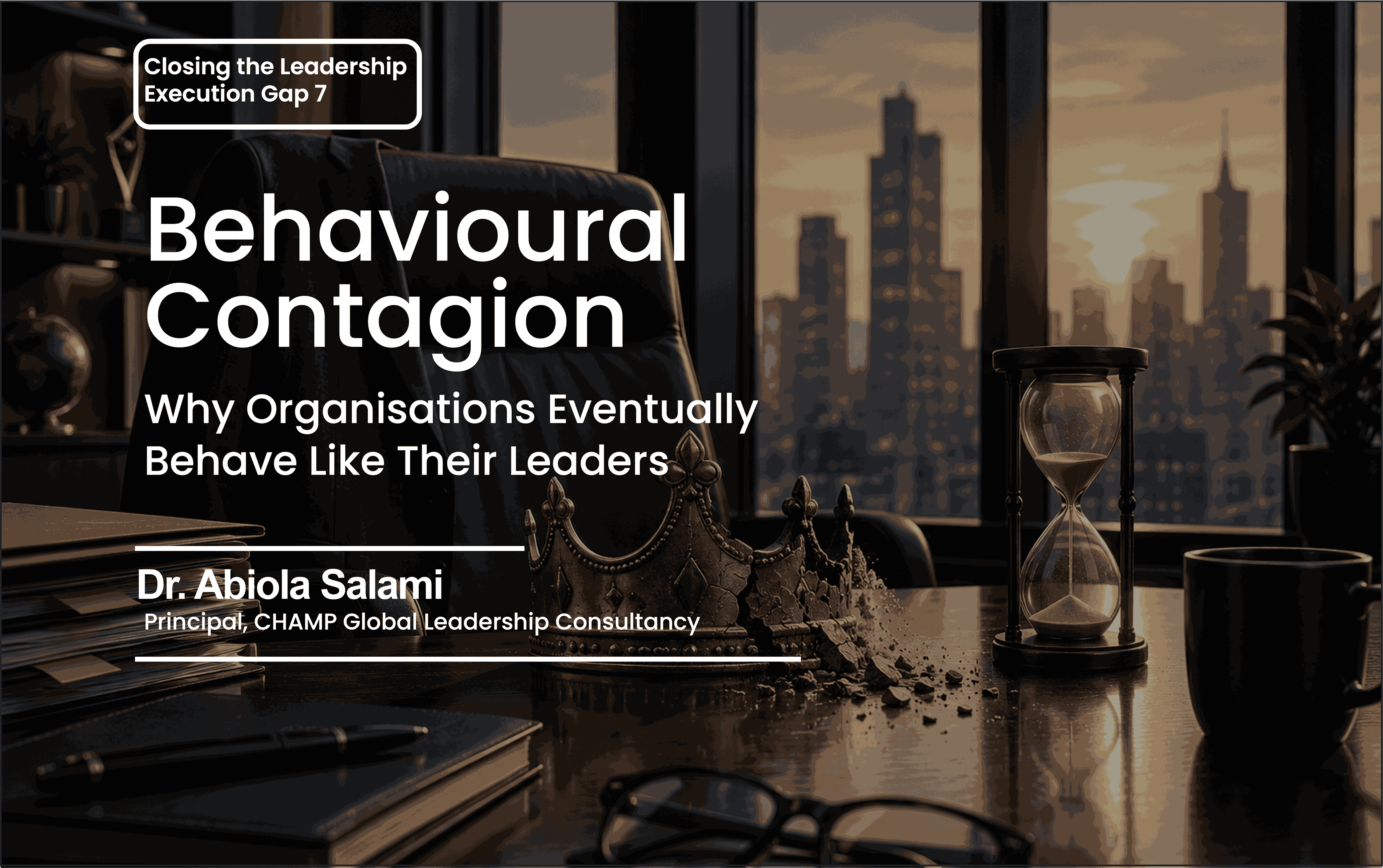
“Leadership is not merely observed. It is absorbed. Long before people replicate strategy, they replicate behaviour.” – Dr. Abiola Salami
Most organisations devote considerable energy to defining what they want people to do.
They create mission statements. They publish values. They design competency frameworks. They write leadership principles. They develop employee handbooks. They run town halls, induction sessions and culture workshops.
All of this matters. But it does not fully explain how behaviour is formed inside organisations.
People rarely behave only according to what an organisation declares. They behave according to what leadership consistently demonstrates, rewards, tolerates and repeats.
This is the difference many organisations miss.
Culture does not spread mainly through posters, policy documents or beautifully designed slide decks. Culture spreads through repeated leadership signals.
Employees watch before they believe. They observe before they imitate. They study what happens when pressure rises. They notice who gets promoted. They notice what behaviour is excused because someone delivers results. They notice what leaders say in public and what they do in private. They notice whether values are protected when protecting them becomes inconvenient.
Over time, these observations become instructions. This is what I describe as Behavioural Contagion.
Behavioural Contagion is the gradual transmission of leadership behaviours, attitudes, emotional responses and performance habits throughout an organisation until they become accepted patterns of collective conduct. It explains why many organisations eventually behave less like their stated values and more like their visible leaders.
The Communication Illusion
Leadership often assumes that clarity of communication creates clarity of behaviour.
This assumption is understandable. When performance declines, organisations usually respond by communicating expectations more loudly. They remind employees of the values. They restate the strategy. They circulate memos. They organise retreats. They repeat the message.
But people are not confused merely because the message is unclear. Many times, people are conflicted because the message and the model are not aligned.
A leader may preach collaboration while rewarding internal competition. A leader may promote accountability while repeatedly excusing favourites. A leader may celebrate innovation while punishing honest failure. A leader may speak about respect while humiliating people in meetings. A leader may ask for openness while becoming defensive when challenged.
Employees do not need a consultant to interpret the contradiction. They understand it quickly. They learn that the spoken value is not always the operating value. This is where the communication illusion begins to collapse. Behaviour is more persuasive than language because behaviour carries consequence. People believe what repeatedly happens.
The organisation may say, “We value courage.” But if courageous people are isolated, everyone receives the real lesson. The organisation may say, “We value excellence.” But if poor execution is tolerated because the person is politically connected, everyone receives the real lesson. The organisation may say, “We value people.” But if exhaustion is consistently glorified, everyone receives the real lesson.
Behaviour does not need official approval to spread. Repetition is enough.
The Organisation Is Always Watching
Many leaders underestimate how closely they are observed.
Employees notice how leaders enter the room. They notice who leaders greet warmly and who they ignore. They notice whether leaders listen or simply wait to speak. They notice whether leaders honour time, keep promises and admit mistakes. They notice whether leaders remain calm when things go wrong. They also notice silence.
When disrespect is ignored, silence teaches. When underperformance is tolerated, silence teaches. When ethical shortcuts are overlooked, silence teaches. When bullying is explained away as “passion,” silence teaches. When leaders avoid difficult conversations, silence teaches.
In organisations, what leaders refuse to confront often becomes permission. This is why Behavioural Contagion does not require formal instruction. It is always operating. Every meeting is a classroom. Every crisis is a classroom. Every promotion is a classroom. Every compromise is a classroom. Every ignored behaviour is a classroom. Leadership is continuously teaching the organisation how to behave.
Behaviour Spreads Faster Than Strategy
Strategy usually moves through planning, communication and execution systems. Behaviour moves faster because behaviour travels through imitation. People imitate what appears safe. They imitate what appears rewarded. They imitate what appears necessary for survival. They imitate what seems to create proximity to power.
If senior leaders interrupt people constantly, managers may begin to interrupt their teams. If executives treat pressure as an excuse for harshness, supervisors may normalise harshness. If leaders avoid accountability conversations, teams may learn avoidance. If leaders hoard information, departments may become territorial. If leaders shift blame upward, downward or sideways, blame becomes a cultural reflex.
No one may formally approve these behaviours. They spread because people conclude, “This is how to succeed here.”
This is why fear spreads faster than trust. Avoidance spreads faster than accountability. Gossip spreads faster than direct conversation. Complacency spreads faster than discipline. Cynicism spreads faster than hope.
Positive behaviours can also spread. Calm spreads. Preparation spreads. Respect spreads. Courage spreads. Ownership spreads. Learning spreads. Accountability spreads.
The issue is not whether behaviour will spread. Behaviour is always spreading. The issue is what kind of behaviour leadership is releasing into the system..
The Hidden Multiplier
Leadership is often described as influence. But influence is too mild a word. Leadership multiplies itself.
One leader’s impatience can become a manager’s communication style. That manager’s style can become a team’s emotional climate. That team’s climate can become a department’s reputation. That department’s reputation can become part of the organisation’s culture.
By the time the behaviour becomes widespread, people may no longer remember where it started. It simply becomes “how we do things here.” This is why Behavioural Contagion matters to execution.
Execution is not powered only by strategy, structure or resources. Execution is powered by repeated behaviour. The quality of follow-through, ownership, communication, problem-solving, accountability and collaboration depends on what people have learned to repeat.
A strategy that requires openness will struggle in a culture where leaders punish disagreement. A strategy that requires innovation will struggle in a culture where leaders embarrass people for mistakes. A strategy that requires speed will struggle in a culture where leaders avoid decisions. A strategy that requires excellence will struggle in a culture where leaders tolerate mediocrity. A strategy that requires teamwork will struggle in a culture where leaders reward personal kingdoms. The execution gap is often a behavioural gap.
The Cost of Invisible Transmission
Behavioural Contagion is costly because it often becomes visible late. Financial reports may show declining performance. Employee surveys may reveal low trust. Customer feedback may expose poor service. Talent data may show rising attrition. Strategy reviews may reveal weak follow-through. But these are usually symptoms, not beginnings.
Before trust declined, people watched leaders mishandle truth. Before accountability weakened, people watched consequences disappear. Before innovation slowed, people watched new ideas get punished. Before collaboration failed, people watched leaders protect silos. Before execution became inconsistent, people watched inconsistency go unchallenged.
The visible problem is often the final expression of behaviours that have been spreading quietly for a long time. This is why culture cannot be fixed only by announcing new values. If leadership behaviour does not change, the old culture continues wearing new language.
The Leadership Mirror
A more honest conversation about culture begins with a different question. This is not, “Do our people understand our values?” But, “What have our leaders taught people to reproduce?”
This question is uncomfortable because it shifts culture from an employee problem to a leadership mirror.
If people are silent, what happened to voice? If people hide mistakes, what happened when truth was exposed? If people avoid ownership, what happened when responsibility was taken? If people play politics, what behaviours made politics useful? If people wait for instruction, what happened to initiative?
These questions do not exist to blame leaders. They exist to reveal the source of repeated behaviour because organisations do not become what they desire. They become what they repeatedly permit, protect and practise.
Interrupting the Contagion
Behavioural Contagion can be redirected, but only when leaders become intentional about what they model. Leaders must ask:
- What behaviour am I normalising under pressure?
- What do people learn from my silence?
- What do I reward without saying so?
- What do I tolerate because confronting it is inconvenient?
- What do people imitate after spending time with me?
- What behaviour must stop with me?
This is where culture begins to change. Not in the slogan. Not in the retreat. Not in the handbook. Culture begins to change when leaders become more conscious of the behaviours they are releasing into the organisation daily.
Closing Reflection
People rarely become the culture an organisation describes. They gradually become the culture leadership demonstrates. Every response to pressure teaches. Every difficult conversation teaches. Every promotion teaches. Every compromise teaches. Every act of courage teaches. Every act of avoidance teaches. Leadership therefore extends beyond influence. It reproduces itself. Whether organisations recognise it or not, behaviour is always spreading. The only remaining question is whether what is spreading strengthens execution or quietly widens the Leadership Execution Gap. That invisible transmission is Behavioural Contagion.
NB
If you are a Supervisor, Manager or Team Lead, Take the Manager’s Execution Scorecard Assessment to see where execution may be breaking in your team.
If you are a Senior Executive, Look into the Invisible Toll Mirror to see the toll of the weight you are carrying.
About Dr. Abiola Salami
Dr. Abiola Salami is the Convener of Dr Abiola Salami International Leadership Bootcamp ; The Peak PerformerTM Festival Made4More Accelerator Program and The New Year Kickoff Summit. He is the Principal Performance Strategist at CHAMP – a full scale professional services firm trusted by high performing business leaders for providing Executive Coaching, Workforce Development & Advisory Services to improve performance. You can reach his team on hello@abiolachamp.com and connect with him @abiolachamp on all social media platforms.
For private coaching, boardroom recalibration, or executive healing strategy, connect email me directly at hello@abiolachamp.com to begin your private Executive Coaching Session.

