
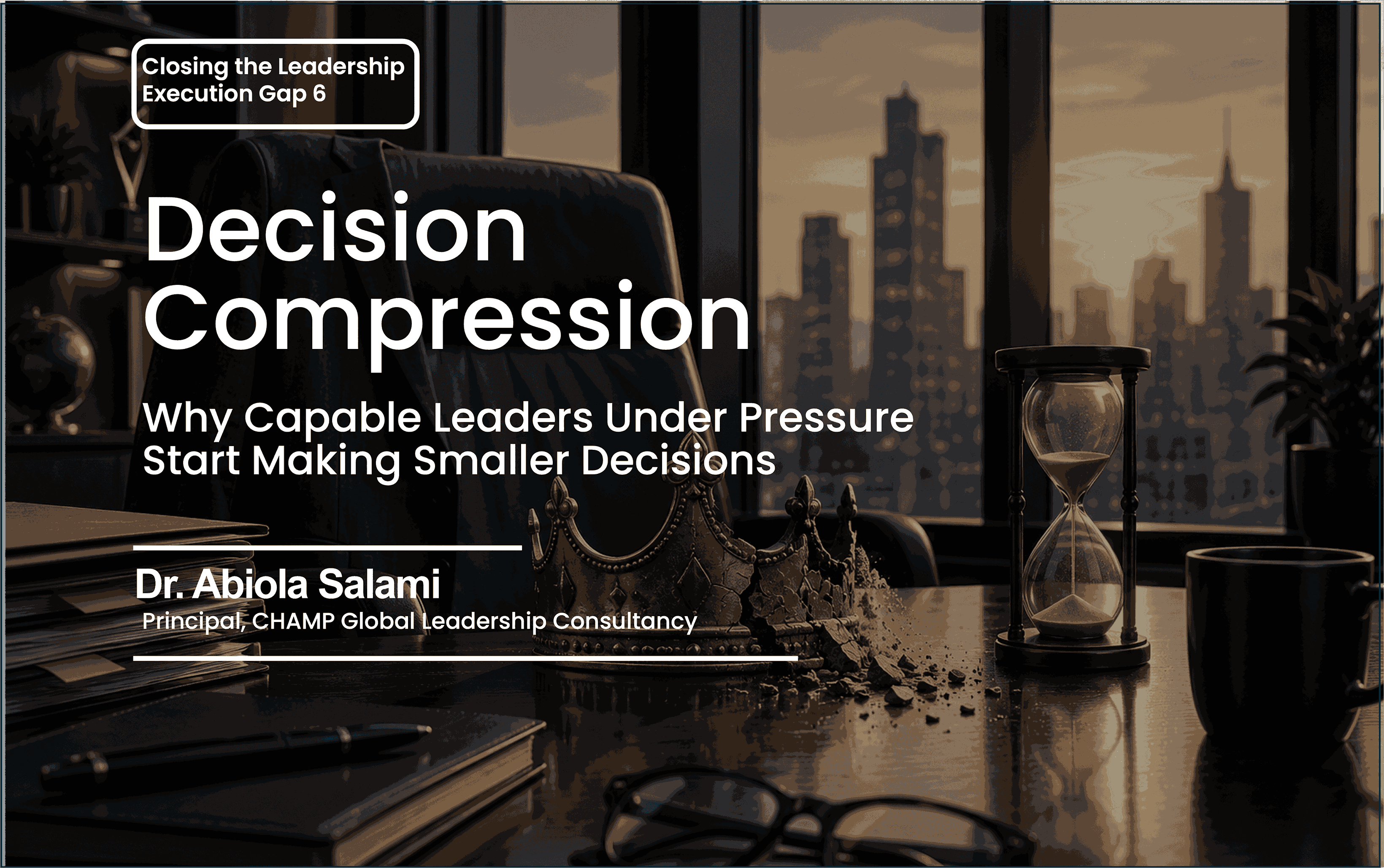
Decision Compression: Why Leaders Under Pressure Start Making Smaller Decisions by Dr. Abiola Salami, Principal, CHAMP Global Leadership Consultancy
“ Leadership does not only test what a person knows. It tests how much space remains inside them to think clearly when everything is demanding an answer.”– Dr. Abiola Salami
Many leaders do not lose effectiveness because they suddenly become incapable. They lose effectiveness because the conditions around their decision-making slowly change.
At the beginning, they still think deeply. They ask questions. They weigh options. They notice patterns. They test assumptions. They listen before responding. Their decisions carry evidence of reflection. Then the role expands.
More people require answers. More meetings demand presence. More stakeholders expect attention. More crises interrupt the day. More problems arrive already labelled urgent. More decisions are required before the leader has recovered from the previous one.
Gradually, the leader’s calendar becomes full, but something more dangerous also happens.
The leader’s mind becomes crowded. This is one of the quietest pressures of leadership. The higher some leaders rise, the more authority they possess, but the less psychological space they may have to use that authority wisely. The organisation sees a leader who is active, present and responsive. The leader may privately feel like a person constantly being pulled from one demand into another.
Every day becomes another decision, another approval, another escalation, another trade-off, another conversation requiring emotional control and another situation where the leader is expected to know what to do.
Over time, leadership can become less like thoughtful navigation and more like continuous reaction. This is what I describe as Decision Compression.
You may be wondering, what is Decision Compression?
Since you are asking, I will tell you. Decision Compression is the gradual reduction in the mental, emotional and reflective space leaders possess to observe, interpret, evaluate and respond wisely as pressure, complexity and responsibility increase.
It does not mean the leader has become unintelligent. It does not mean the leader lacks experience. It does not mean the leader is unserious. It means the space required for wisdom is being squeezed.
The Illusion of Decisiveness
Organisations admire decisive leaders. This admiration is understandable. In uncertain environments, people want direction. Teams want clarity. Markets punish delay. Boards expect movement. Employees become uncomfortable when leadership appears hesitant.
But decisiveness can be misunderstood.
A fast decision is not always a strong decision. A confident decision is not always a wise decision. A leader who answers quickly is not necessarily thinking clearly.
There is a difference between decisiveness and compression. Decisiveness is the ability to move with clarity after sufficient consideration. Compression is the pressure to move before sufficient consideration has occurred.
The two may look similar from outside because they both produce action. They both reduce waiting. And they both create the appearance of control. But internally, they are very different.
A decisive leader has processed enough to act. A compressed leader is acting because there is no space left to process. This is why Decision Compression is dangerous. It often hides behind the appearance of strength. The leader becomes faster, sharper and more direct. Meetings move quickly. Questions are reduced. Long conversations are avoided. The organisation may even describe this leader as more focused.
Yet something important may be disappearing.
Curiosity begins to shrink. Listening becomes shorter. Alternatives receive less attention. Dissent sounds like delay. Reflection feels like luxury. The familiar answer becomes more attractive than the uncomfortable question. When this happens, leadership may still appear confident, but judgment is becoming narrower.
The Architecture of Compression
Decision Compression rarely arrives as a dramatic breakdown. It builds quietly through accumulation.
One extra meeting does not destroy leadership judgment. One difficult client does not compress decision quality. One late night does not remove wisdom. But repetition changes capacity.
A crowded calendar becomes normal. Back-to-back meetings become normal. Decision fatigue becomes normal. Emotional tiredness becomes normal. Responding quickly becomes normal. Thinking later becomes normal. Eventually, “later” never comes.
Many leaders are not failing because they do not know what to do. They are struggling because they no longer have enough uninterrupted space to understand what the situation is really asking of them.
A technical problem may need an answer. A people problem may need listening. A strategic problem may need perspective. A political problem may need timing. A cultural problem may need courage. A performance problem may need diagnosis.
But under compression, many different problems begin to receive the same kind of response.
The leader decides quickly. The leader gives direction. The leader moves on. That response may work for simple issues. It becomes dangerous when complex issues are treated as though they are merely urgent.
When Experience Becomes a Shortcut
Experience is one of the greatest assets of leadership. It allows leaders to detect patterns, anticipate consequences and recognise risks that others may miss. But under Decision Compression, experience can become a shortcut that reduces thinking rather than deepens it.
The leader begins to recognise situations too quickly. “This is just like what happened before.” “We have seen this pattern.” “I know where this is going.” “This kind of person always behaves this way.”
Sometimes the leader is right. But sometimes the current situation only resembles the past. It is not the past.
This is where compression becomes costly. It encourages leaders to rely on previous categories instead of fresh observation. Past success becomes the lens through which present complexity is oversimplified.
The experienced leader may no longer ask, “What is different this time?” The leader may simply ask, “What did I do last time?”
That question may create speed. It may not create wisdom.
In fast-moving environments, yesterday’s correct response can become today’s expensive assumption. The leader who is too compressed to examine the difference may mistake familiarity for understanding.
The Emotional Dimension
Decision Compression is not only cognitive. It is emotional.
Leaders do not make decisions as machines. They make decisions while carrying pressure, frustration, expectation, fatigue, ambition, fear, loyalty, disappointment and sometimes loneliness.
A leader who is emotionally depleted may still speak intelligently. A leader under pressure may still analyse numbers correctly. A leader who is tired may still attend every meeting. But emotional load changes interpretation.
A cautious question may sound like resistance. A delayed response may feel like disrespect. A mistake may appear like carelessness. A challenge may feel like betrayal. A request for clarity may sound like incompetence.
When emotional space is reduced, leaders may respond not only to what happened, but to what the pressure inside them says it means.
This is why some leaders become more reactive as responsibility increases. They are not reacting only to people. They are reacting from accumulated internal load.
The Organisational Consequences
Decision Compression never remains private for long. Teams begin to feel it. Meetings become shorter, but not always better. Decisions become faster, but not always clearer. Questions become fewer, but not always because people understand. Updates become more transactional.
People learn to bring only what can be approved quickly. Complex issues are simplified before they reach the leader. Bad news is polished. Disagreement is delayed. Strategic conversations become crowded out by operational urgency.
Over time, the organisation adapts to the leader’s compression. People stop presenting nuance because nuance appears unwelcome. They stop raising early warnings because warnings slow things down. They stop offering alternative views because the decision already seems made. They stop thinking with the leader and start waiting for instruction from the leader.
The organisation may still be busy. It may still be executing. It may still be producing reports, attending meetings and meeting deadlines. But its thinking is becoming thinner.
That is one of the most damaging consequences of Decision Compression. It does not only reduce the quality of the leader’s decisions. It reduces the quality of collective thinking around the leader.
.
Preserving Decision Space
The answer is not for leaders to become slow. In many environments, speed is necessary. The real work is to distinguish between decisions that require speed and decisions that require space.
Not every issue deserves deep reflection. Some decisions should be made quickly. But leaders must know which decisions are too consequential, too complex or too human to be handled from a compressed state.
So, before major decisions, leaders may need to ask the following 6 six questions:
- Am I reacting to the issue or to the pressure around the issue?
- Have I heard enough perspectives?
- What assumption am I treating as fact?
- What would I notice if I were not rushing?
- What is the cost of being wrong?
- Is this truly urgent, or has urgency become our culture?
These questions do not weaken leadership. They protect it. Because wisdom requires room.
Closing Reflection
Leadership is often measured by the decisions people make. But perhaps it should also be measured by the conditions leaders protect before making those decisions. The greatest threat to judgment is not always ignorance. Sometimes it is accumulated urgency. Sometimes it is emotional depletion. Sometimes it is the quiet disappearance of reflection.
Many organisations ask leaders to decide faster. Fewer organisations protect leaders well enough to think better. Yet the future may belong to organisations that understand this difference. Because when leaders lose the space to think deeply, even brilliant people can begin producing ordinary decisions. That invisible narrowing is Decision Compression.
About Dr. Abiola Salami
Dr. Abiola Salami is the Principal Performance Strategist at CHAMP – a full scale professional services firm trusted by high performing business leaders for providing Executive Coaching, Workforce Development & Advisory Services to improve performance. He is the Convener of Dr Abiola Salami International Leadership Bootcamp ; The Peak PerformerTM Festival Made4More Accelerator Program and The New Year Kickoff Summit. You can reach his team on hello@abiolachamp.com and connect with him @abiolachamp on all social media platforms.
NB
If you are a Supervisor, Manager or Team Lead, Take the Manager’s Execution Scorecard Assessment to see where execution may be breaking in your team.
If you are a Senior Executive, Look into the Invisible Toll Mirror to see the toll of the weight you are carrying.
About Dr. Abiola Salami
Dr. Abiola Salami is the Principal Performance Strategist at CHAMP – a full scale professional services firm trusted by high performing business leaders for providing Executive Coaching, Workforce Development & Advisory Services to improve performance. He is the Convener of Dr Abiola Salami International Leadership Bootcamp ; The Peak PerformerTM Festival Made4More Accelerator Program and The New Year Kickoff Summit. You can reach his team on hello@abiolachamp.com and connect with him @abiolachamp on all social media platforms..
For private coaching, boardroom recalibration, or executive healing strategy, connect email me directly at hello@abiolachamp.com to begin your private Executive Coaching Session.

