
The Leadership Identity Lag: Why Promotion Rarely Produces Leaders by Dr. Abiola Salami, Principal, CHAMP Global Leadership Consultancy
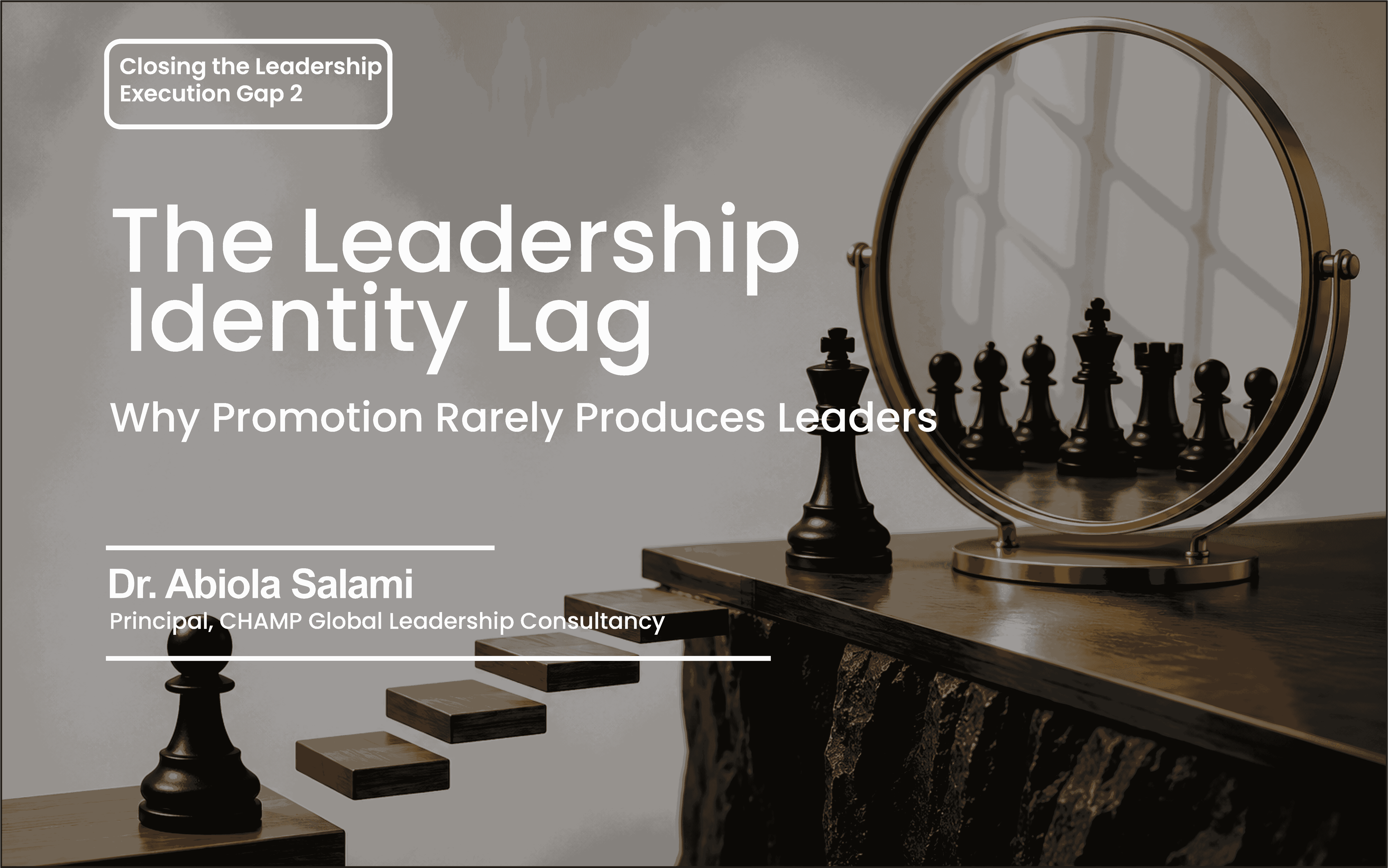
“Promotion changes authority immediately. Leadership identity changes much more slowly. Between those two moments lies one of the greatest hidden risks to organisational performance.” – Dr. Abiola Salami
Organisations celebrate promotion as evidence of progress. Employees see it as recognition. Executives see it as succession. Human Resources sees it as talent development. The individual sees it as achievement. Yet promotion often creates an illusion that organisations rarely question.
The assumption is that once someone becomes a manager, they have become a leader.
Nothing could be further from the truth.
A new title changes reporting lines. It changes authority. It changes expectations. It changes accountability. But it does not automatically change how a person thinks, decides, communicates or influences others.
Leadership identity evolves far more slowly than organisational structure.
Between promotion and genuine leadership lies a period I describe as Leadership Identity Lag. It is one of the least recognised, yet most expensive, leadership realities in modern organisations. It quietly widens the Leadership Execution Gap, undermines execution, frustrates teams and leaves organisations wondering why capable people suddenly struggle after promotion. The problem is rarely competence. The problem is identity.
The Promotion Illusion
Most organisations promote people because they have demonstrated exceptional performance in their current role. So, the best engineer becomes Engineering Manager. The highest-performing salesperson becomes Sales Manager. The strongest analyst becomes Team Lead. The dependable supervisor becomes Head of Department.
On the surface, the logic appears sound. Reward excellence. Retain talent. Create career progression.
But hidden beneath this logic is an assumption that deserves greater scrutiny. It assumes that excellence in producing results naturally translates into excellence in producing results through other people. These are fundamentally different capabilities. One depends primarily on personal competence. The other depends on leadership.
Promotion therefore rewards yesterday’s performance while simultaneously demanding tomorrow’s capabilities. Unfortunately, organisations often celebrate the promotion without recognising the transformation it requires.
Understanding Leadership Identity Lag
Leadership Identity Lag is the period during which an individual continues to think, behave and make decisions as the person they used to be, despite occupying a leadership position that requires fundamentally different capabilities.
The promotion is visible. The identity transition is invisible. Titles change overnight. Identity rarely does.
Many newly promoted managers continue measuring their own value through personal output rather than collective performance. They remain the chief problem-solver. The fastest responder. The technical expert. The busiest individual in the room.
They struggle to delegate because they still derive confidence from doing. They struggle to coach because solving feels more productive than developing. They struggle to hold difficult conversations because technical expertise never required emotional courage. They continue succeeding as outstanding contributors while quietly failing as leaders. This is not because they lack intelligence but because they are still leading from yesterday’s identity.
When Yesterday’s Success Becomes Tomorrow’s Constraint
One of the great paradoxes of leadership is that the behaviours responsible for earning promotion often become insufficient or even counterproductive after promotion.
The habits that once accelerated performance begin to limit it. Working harder no longer solves every problem. Knowing the answer no longer creates organisational capability. Being the smartest person in the room no longer guarantees the best outcome. Responding to every issue personally gradually weakens the initiative of others.
The leader continues performing. The team stops growing. This creates an invisible organisational bottleneck. People wait. Decisions accumulate. Initiative declines. Ownership weakens. Execution slows. Ironically, the leader appears more exhausted than ever. Not because leadership requires more work but because they continue approaching leadership as work only they can perform.
The Identity Organisations Never Assess
Most promotion decisions evaluate competence. Few evaluate identity. Organisations assess experience, qualifications, technical knowledge, performance ratings, delivery history and potential.
These assessments matter. But they rarely answer these six more important questions:
- Has this individual begun thinking beyond personal achievement?
- Can they create clarity without controlling everything?
- Can they influence behaviour rather than merely complete tasks?
- Can they remain emotionally steady under pressure?
- Can they derive satisfaction from other people’s success instead of personal visibility?
- Can they build capability rather than dependency?
These questions concern identity rather than competence.
Unfortunately, identity remains largely absent from promotion conversations. Organisations therefore continue promoting people into leadership while hoping leadership somehow emerges afterwards. Hope, however, has never been a leadership development strategy.
Why This Matters More Than Organisations Realise
Leadership Identity Lag rarely affects one individual alone. It reshapes entire teams. When leaders continue behaving as individual contributors, teams gradually adapt. People stop taking initiative because every important decision returns to the manager.
Creativity diminishes because the leader remains the primary source of answers. Ownership declines because responsibility quietly shifts upward. Collaboration weakens because influence gives way to instruction. Eventually, organisations conclude that employees lack accountability.
In many cases, accountability was not lost. It was unintentionally displaced by leadership that never completed its own identity transition. This is why Leadership Identity Lag deserves recognition as an organisational reality rather than an individual weakness. It reproduces itself through teams, departments and eventually organisational culture.
Beyond Promotion
Although the reality often begins with promotion, Leadership Identity Lag is not limited to first-time managers. Executives experience it after entering larger organisations. Entrepreneurs experience it as businesses scale. Founders experience it when organisations outgrow their personal capacity. Public sector leaders experience it after major appointments. Board members experience it after moving from operational leadership to governance.
Whenever responsibilities evolve faster than leadership identity, the lag reappears. This makes Leadership Identity Lag not merely a promotion issue. It is a recurring feature of leadership itself.
Towards a Different Conversation
Leadership development has traditionally focused on acquiring new skills. No doubt, skills remain important; but skills alone cannot fully explain why experienced professionals sometimes struggle after assuming greater responsibility. The deeper challenge concerns identity.
Leadership is not simply a collection of competencies. It is a gradual reconstruction of how individuals understand their role, define success and create value through other people. Until organisations recognise Leadership Identity Lag as a predictable stage in leadership transition, they will continue mistaking promotion for preparation and authority for readiness. The consequences will continue appearing where they matter most i.e. in execution, in culture, in performance; and ultimately, in organisational results.
Closing Reflection
Promotion is one of the easiest decisions organisations make. Leadership transformation is one of the hardest. The distance between those two realities explains why so many capable professionals struggle after promotion not because they were promoted too early, but because their identity has not yet caught up with their responsibility. Every promotion changes a title. Only a few change the leader. That invisible delay is what I call Leadership Identity Lag.
NB
If you are a Supervisor, Manager or Team Lead, Take the Manager’s Execution Scorecard Assessment to see where execution may be breaking in your team.
If you are a Senior Executive, Look into the Invisible Toll Mirror to see the toll of the weight you are carrying.
About Dr. Abiola Salami
Dr. Abiola Salami is the Principal Performance Strategist at CHAMP – a full scale professional services firm trusted by high performing business leaders for providing Executive Coaching, Workforce Development & Advisory Services to improve performance. He is the Convener of Dr Abiola Salami International Leadership Bootcamp ; The Peak PerformerTM Festival Made4More Accelerator Program and The New Year Kickoff Summit. You can reach his team on hello@abiolachamp.com and connect with him @abiolachamp on all social media platforms..
For private coaching, boardroom recalibration, or executive healing strategy, connect email me directly at hello@abiolachamp.com to begin your private Executive Coaching Session.

