
The 5 Invisible Tolls Quietly Undermining Strategy Execution
By Dr. Abiola Salami, Worldclass Performance Strategist
The 5 Invisible Tolls Quietly Undermining Strategy Execution
Across many boardrooms in West Africa, something is not adding up. Organizations are clearer than ever. Strategies are sharper than ever. Leaders are more exposed, more trained, more experienced.
Yet execution? Is still inconsistent, still fragile and still unpredictable.
Deadlines slip. Teams stall. Momentum fades halfway through the year. And instead of confronting the real issue, many organizations recycle the same excuse i.e. “We need a better strategy.”
But what if the strategy is not the problem? What if the real issue is far more uncomfortable? What if leadership itself is quietly breaking under pressure and taking execution down with it?
The Silent Breakdown Behind Strategic Failure
Let’s be honest. Leadership today is not just about thinking. It is about sustaining performance under constant pressure. And most leaders were never trained for that.
Leaders were trained to analyze, decide and plan. But not to manage internal pressure, regulate emotional energy and lead consistently through human complexity.
So what happens? The strategy remains intact but the leader executing it begins to fracture slowly, quietly and invisibly.
The 5 Invisible Tolls of Leadership
These are not theoretical ideas. They are lived realities I have documented in my book Taming the Invisible Toll of Leadership Expectations. These realities don’t show up in reports but they show up in results.
1. Physical Fatigue — When Leaders Are There, But Not Fully There
Many leaders are operating tired. They are not visibly exhausted but they are internally depleted. Fatigue changes everything because thinking becomes slower, decisions become delayed and patience becomes thinner. Execution does not collapse overnight. It weakens through reduced leadership energy. Because no matter how strong the strategy is xecution flows at the speed of the leader’s energy.
2. Emotional Drain — When Pressure Replaces Clarity
Leadership is emotional labor. It involves managing people, handling expectations and absorbing pressure from all directions. Over time, this drains leaders; and drained leaders have three common traits (a) react instead of respond (b) avoid instead of engage and (c) withdraw instead of lead. The organization feels it immediately, because leadership emotion is not private; it is contagious.
3. Relationship Strain — When Influence Becomes Isolation
The higher leaders rise, the fewer honest conversations they have. People become careful. Feedback becomes filtered. Truth becomes selective. And gradually, leadership becomes isolated.
This is not just a relationship problem. It is an execution problem, because when leaders stop hearing the truth three things happen (a) problems surface late (b) risks are underestimated and (c) decisions lose accuracy. Execution suffers where honesty disappears.
4. Cognitive Overload — When Leaders Become the Bottleneck
Too many decisions. Too many priorities. Too many demands. And eventually, leaders become overwhelmed. When that happens decision speed drops, teams start waiting and execution slows across the system. The organization becomes dependent on one overloaded mind. And that is dangerous.
Because no organization scales execution through mental congestion at the top.
5. Identity Fracture — When Leaders Stop Leading and Start Protecting
This is the most dangerous toll. When leadership becomes tied to identity e.g. “I must always perform” or “I cannot be wrong” or “I must not fail”. The leader changes. They become cautious, defensive and controlled. This is not because they lack competence but because they are protecting an image, and when leaders start protecting themselves. they stop leading confidently. With this, execution becomes safe, and safe execution rarely produces excellent results.
(You can access the full invisible tolls from my book Taming the invisible Toll of Leadership Expectation on www.tppafrica.com/books)
So What Do High-Performing Organizations Do Differently?
They stop treating leadership as a role and start treating it as a system that must be strengthened intentionally. This is because strategy does not fail in planning. It fails in human environments under pressure.
The TPP FEST Framework™ — Executing Strategy in Human Environments
To move from motion to measurable progress, leadership must evolve. Not just in thinking but in how it performs under pressure, through people, and across systems. The TPP FEST Framework™ defines the 7 execution levers that separate organizations that plan from those that deliver.
T — Timely & Decisive Leadership
Execution slows where leaders hesitate. In many organizations, delay is disguised as “careful thinking”
but in reality, it is costing speed, momentum, and opportunity. Great leaders understand delayed decisions kill execution, over-analysis creates stagnation and clarity must come before comfort They prioritize speed over perfection, direction over indecision and movement over meetings. Because in execution, clarity is not just communication, it is acceleration.
P — People-Centered Execution
Strategy is executed by people not PowerPoint; and people do not give their best in environments where they feel unsafe, ignored and intimidated. Execution improves when leaders build trust, psychological safety and open communication. Because the truth is simple, people don’t execute what they are told, they execute what they feel safe to act on.
P — Performance Accountability Without Fear
Fear is one of the most expensive leadership tools ever created. It creates silence, delayed reporting and surface-level compliance; but it never creates excellence. High-performing organizations create environments where problems are raised early, ownership is shared and mistakes become learning loops. This is because silence is the real enemy of execution.
F — Focus & Energy Discipline
Execution does not fail because people are busy. It fails because energy is scattered. Leaders must learn to manage attention, priorities and personal energy. This is because tired leaders think slower, decide poorly and react emotionally. Great execution requires focused leaders, disciplined priorities and sustainable energy because execution flows at the speed of leadership energy.
E — Emotional Intelligence Under Pressure
Pressure is not the problem, unmanaged pressure is. Leadership emotion shapes team confidence, communication patterns and risk-taking behavior. Great leaders do not eliminate pressure, they master their response to it. They learn to regulate emotion, respond instead of react and lead with composure under stress. This is because in every organization, the emotional tone of the leader becomes the emotional tone of execution.
S — Scalable Systems Over Hero Leadership
Many organizations depend too much on individuals e.g. one strong leader, one reliable performer and one decision-maker. That is not strategy execution. That is dependency. Sustainable organizations build systems, processes and structures that outlast individuals, scale performance and reduce bottlenecks. This is because if everything depends on you, execution will always slow down.
T — Total Leadership Alignment
Execution breaks when leadership is not aligned. Different priorities, conflicting signals and mixed messages to teams. And the result? Confusion, delays and fragmented performance. Aligned leadership ensures clear direction across levels, consistent messaging and unified execution focus. This is because organizations don’t execute what leaders say. They execute what leaders consistently reinforce.
The Core Message of TPPFEST Framework™
Execution excellence is not an accident. It is the result of leaders who understand three things (a) Strategy is logical (b) Execution is human (c) Performance is emotional. And until leadership is built to manage all three, organizations will continue moving without progressing.
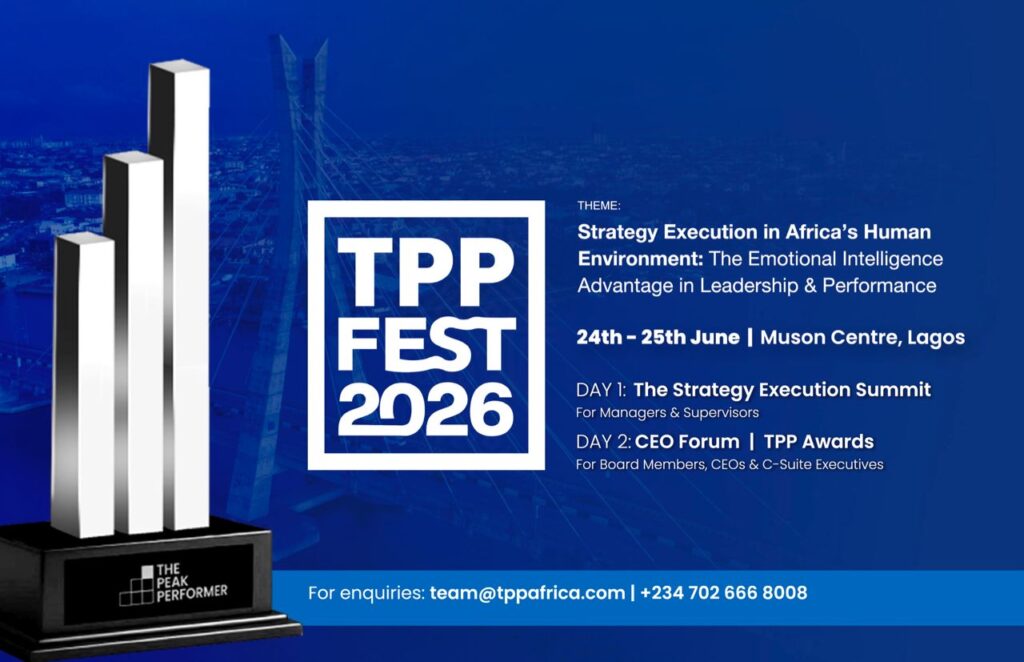
This entire conversation is about a shift. A new way of thinking about performance. The conversation comes alive TPP Fest 2026 on 24th – 25th June with the theme Strategy Execution in Human Environments:The Emotional Intelligence Advantage in Leadership & Performance to serve two clear verticals – (i) Strategy Executors (i.e. Managers & Supervisors) will be exposed to our proprietary framework on The Magic of Emotional Intelligence for Daily Execution with a focus on Behavior, Communication, Team Climate (ii) Strategy Leaders (i.e. Senior leaders, C-Suite Executives, Company Directors etc) will be exposed to our proprietary framework on Taming the Invisible Toll of Leadership ExpectationsTM with a focus on Decision Quality, Pressure Management and Organizational Energy.
Strategy does not fail because it is unclear. It fails because people are inconsistent. And in every high-performing organization, there is an unspoken standard. Not just to plan or decide, but to execute consistently, deliberately, and under pressure. Because in the end, execution is not about intelligence. It is about discipline. And discipline has a simple expression: We show up.
Final Question
So before your next strategy meeting, ask yourself: Are we strengthening the plan or strengthening the leaders expected to deliver it? Because until leaders learn to carry the weight of leadership without breaking, execution will always remain inconsistent.
About Dr. Abiola Salami
Dr. Abiola Salami is the Convener of Dr Abiola Salami International Leadership Bootcamp ; The Peak PerformerTM Festival Made4More Accelerator Program and The New Year Kickoff Summit. He is the Principal Performance Strategist at CHAMP – a full scale professional services firm trusted by high performing business leaders for providing Executive Coaching, Workforce Development & Advisory Services to improve performance. You can reach his team on hello@abiolachamp.com and connect with him @abiolachamp on all social media platforms.
For private coaching, boardroom recalibration, or executive healing strategy, connect email me directly at hello@abiolachamp.com to begin your private Executive Coaching Session.

