
By Dr. Abiola Salami, Worldclass Performance Strategist
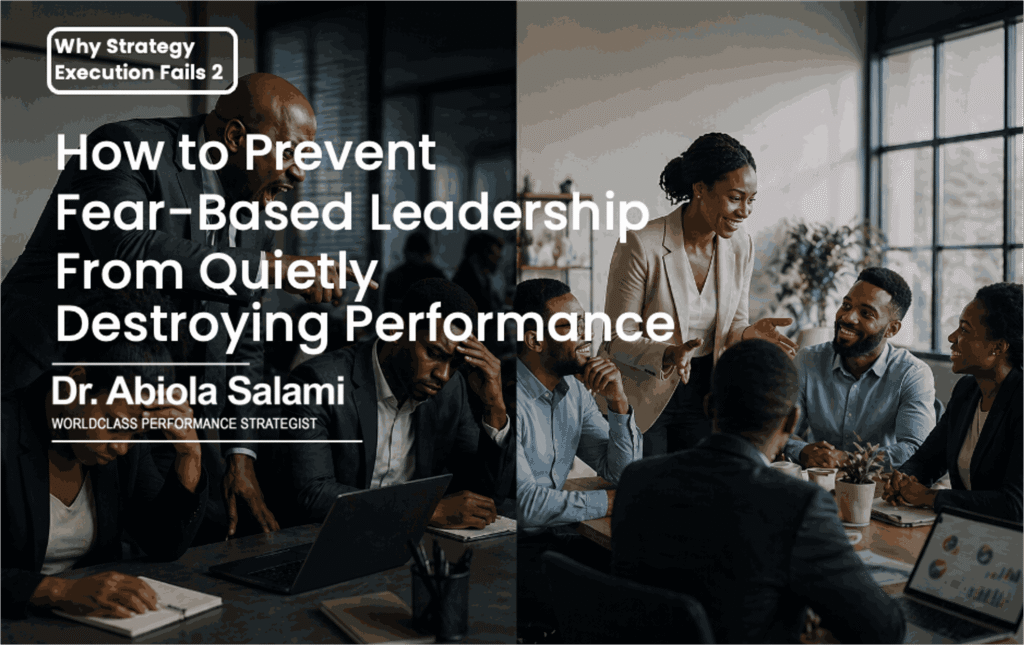
How to Prevent Fear-Based Leadership from Quietly Destroying Performance
One frustrating pattern keeps repeating itself in the marketplace. Strategies are well designed. Targets are clearly defined. Teams are capable. Yet execution keeps breaking down. Deadlines slip. Problems escalate late. Teams disengage quietly. And the usual response? “We need better planning.” “We need tighter supervision.” But what if the real problem is something far more uncomfortable? What if strategy execution is failing because of how managers behave under pressure?
Anger Trap Is The Hidden Execution Killer
Most managers don’t fail because they lack competence. They fail because they unknowingly create fear-based execution environments. And fear is expensive, not visibly or immediately but operationally. Anger in leadership is not just emotional; it is structural. It affects information flow, decision speed, team initiative and innovation capacity. Which leads to this powerful truth – an angry manager does not build a disciplined team; they build a slow organization.
What Really Happens Inside Fear-Based Teams
No one says it out loud but the pattern is consistent. Problems are hidden, communication becomes filtered, initiative drops and people do the minimum required. This is not because people are incompetent but because they are protecting themselves. And once a team shifts from performance to protection, execution begins to collapse silently.
1. Delayed Information = Delayed Execution
When managers react emotionally, teams learn quickly that bad news is dangerous. So they delay it in one of three ways (a) Issues are reported late (b) Risks are hidden and (c) Escalation happens only when necessary. By the time leadership responds, the problem has already grown and here is the irony;
Managers blame teams for poor communication when it is actually the environment that made communication unsafe.
Execution Shift
Replace reaction with inquiry. Instead of “Why did this happen?” Say “Help me understand what happened early so we can fix it faster.” That shift alone can restore speed, transparency and trust.
2. Fear Kills Ownership
Fear does not create high performance. It creates compliance, silence and emotional withdrawal. People stop thinking critically, stop suggesting improvements and stop taking initiative because initiative becomes risky. And when initiative disappears, execution becomes mechanical, not meaningful. You cannot scale performance with people who are afraid to contribute.
Execution Shift
Move from fear to ownership by rewarding early reporting, normalizing intelligent mistakes and celebrating transparency. This is because ownership thrives in environments where people feel safe to act.
3. Creativity Dies Where Tension Lives
Innovation is not just about talent. It is about environment. People need psychological safety, freedom to experiment and permission to fail. Anger removes all three. And when that happens, ideas dry up, inefficiencies repeat and growth stagnates. The organization becomes active but not effective.
4. The Most Dangerous Illusion: Silence as Alignment
This is where many managers misread their teams. Meetings are quiet. No one challenges ideas.
Everyone agrees quickly. It looks like alignment, but it is not. It is emotional withdrawal. Quiet teams are often disengaged, cautious and unwilling to contribute. They are not aligned. They are just adapting.
In fear-based environments, people don’t stop working. They stop showing up fully. They show up carefully. They show up defensively. They show up strategically silent. And when people stop showing up with their full thinking, their full voice, and their full ownership; execution slows. Because great organizations are not built by people who are present. They are built by people who are fully engaged. Who are willing to speak, contribute, and act. In other words, People who show up.
Execution Shift
Create structured voice by asking: “What are we missing?”; invite dissent and call on quieter voices. This is because strong execution depends on open thinking not silent agreement.
The Bigger Picture: Strategy Execution in Human Environments
Execution is not just a process. It is a human system under pressure. And human systems don’t just instructions, they respond to three things i.e. Emotional safety, Leadership behavior and Communication patterns.
This is why many organizations struggle. They optimize strategy but ignore the human environment required to execute it.
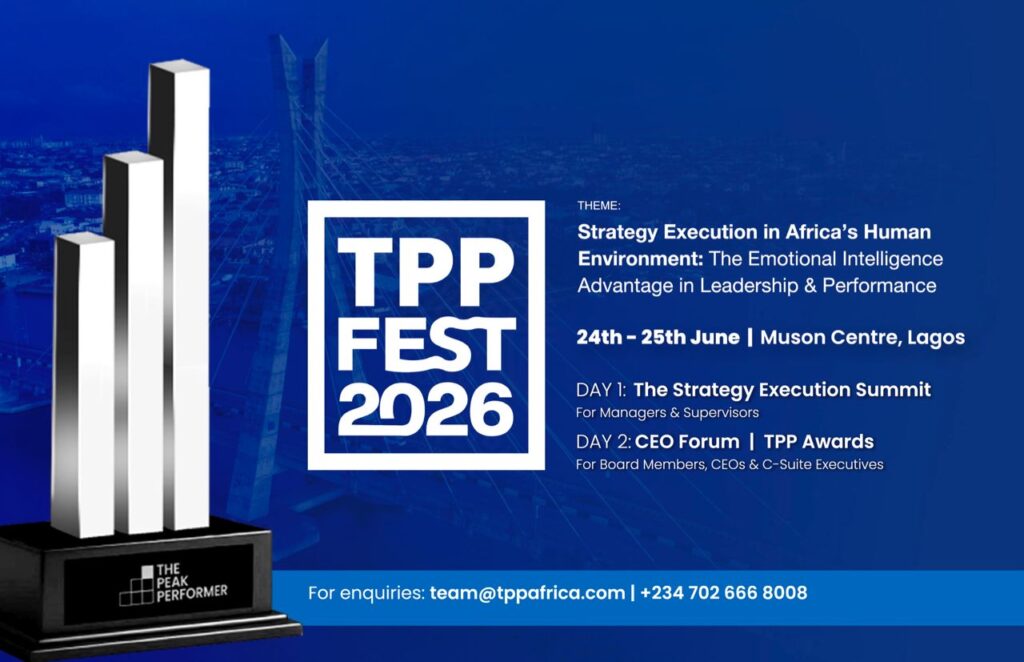
he TPPFEST Framework™ — Executing Strategy Through People Under Pressure
As we build toward TPP Fest 2026, one thing is becoming clear, execution excellence requires more than planning. It requires leadership transformation. The TPPFEST Framework™ provides a practical structure.
T — Timely & Decisive Leadership
Execution slows where leaders hesitate. Managers must decide faster, communicate clearly and reduce ambiguity because clarity drives action.
P — People-Centered Execution
People do not execute what they are told. They execute what they feel safe to act on. Managers must build trust, promote psychological safety and ensure open communication.
P — Performance Accountability Without Fear
Fear creates silence. Silence delays execution. Build environments where problems come early, ownership is shared and learning is continuous
F — Focus & Energy Discipline
Execution requires energy. Tired managers react emotionally, think slower and lead inconsistently. Protect focus. Manage energy. Prioritize what matters.
E — Emotional Intelligence Under Pressure
This is the defining leadership skill. Leaders must learn to pause before reacting, regulate emotions and respond intentionally because emotional control shapes execution quality.
S — Scalable Systems Over Personality
Execution should not depend on one manager. Build systems that reduce bottlenecks, enable teams and sustain performance.
T — Total Leadership Alignment
Confusion kills execution. Ensure clear direction, consistent messaging and unified priorities; because teams execute what leaders consistently reinforce.
Looking Ahead: TPP Fest 2026
This entire conversation is about a shift. A new way of thinking about performance. The conversation comes alive TPP Fest 2026 on 24th – 25th June with the theme Strategy Execution in Human Environments:The Emotional Intelligence Advantage in Leadership & Performance to serve two clear verticals – (i) Strategy Executors (i.e. Managers & Supervisors) will be exposed to our proprietary framework on The Magic of Emotional IntelligenceTM for Daily Execution with a focus on Behavior, Communication, Team Climate (ii) Strategy Leaders (i.e. Senior leaders, C-Suite Executives, Company Directors etc) will be exposed to our proprietary framework on Taming the Invisible Toll of Leadership ExpectationsTM with a focus on Decision Quality, Pressure Management and Organizational Energy.
We must remember that the future of leadership will not be defined by authority. It will be defined by Emotional intelligence applied to execution. Because the managers who will win are not the loudest. They are the ones who create environments where people can perform without fear and execute with excellence.
A Simple Habit That Changes Everything
Apply the 3-Step Pause Rule:
- Pause (3 seconds)
- Ask one question
- Then respond
This small shift improves communication speed, team trust and execution quality
Manager Reflection
Ask yourself: When something goes wrong, do people come to you early OR do they wait? Because that answer reveals your leadership impact on execution.
Final Thought
Managers often believe they drive results through pressure but they actually don’t. They drive results through emotional climate. Because in the end people don’t execute strategy based on instructions. They execute based on how safe they feel to think, speak, and act.
You don’t build execution through fear. You build it through environments where people feel safe to think, safe to speak, and safe to act. Because in the end, strategy is only as strong as the people executing it. And people only perform at their best when they show up.
About Dr. Abiola Salami
Dr. Abiola Salami is the Convener of Dr Abiola Salami International Leadership Bootcamp ; The Peak PerformerTM Festival Made4More Accelerator Program and The New Year Kickoff Summit. He is the Principal Performance Strategist at CHAMP – a full scale professional services firm trusted by high performing business leaders for providing Executive Coaching, Workforce Development & Advisory Services to improve performance. You can reach his team on hello@abiolachamp.com and connect with him @abiolachamp on all social media platforms.
For private coaching, boardroom recalibration, or executive healing strategy, connect email me directly at hello@abiolachamp.com to begin your private Executive Coaching Session.

