
By Dr. Abiola Salami, Worldclass Performance Strategist This article is the final in a five-part series exploring the how women shrink, inspired by my book NO MORE SHRINKING (A Performance Tool for Women Who Are Done Playing Small).
Let me start with a hard truth today.
In many organizations, the most important meeting is not the one inside the conference room. It is the one in the corridor after everyone leaves.
If you have worked in any serious organization long enough, you know exactly what I’m talking about.
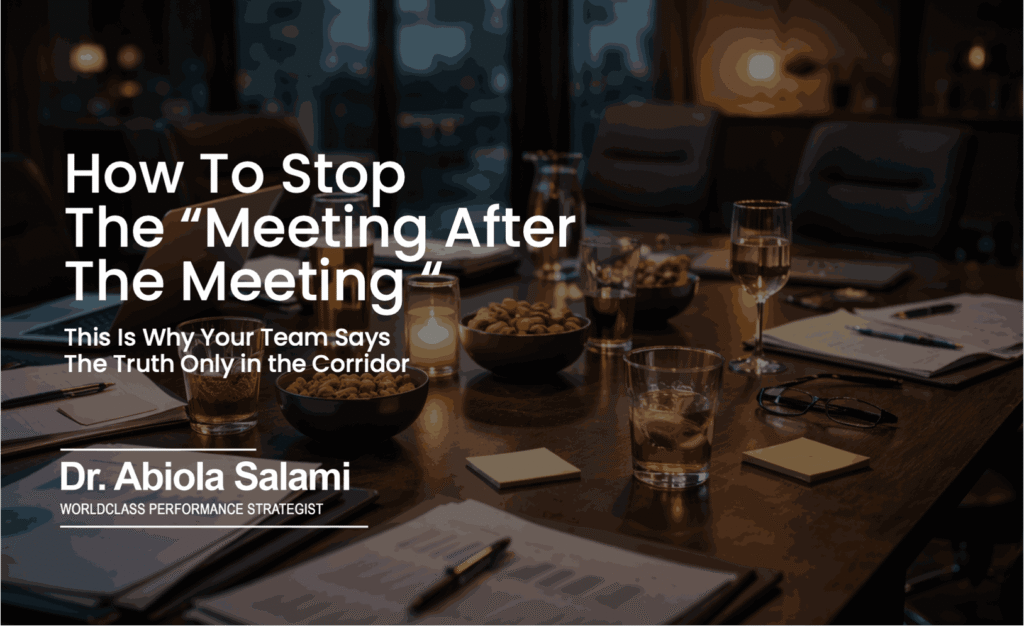
Inside the meeting room, everything looks professional. PowerPoint slides are presented. Charts are displayed. Someone adjusts their glasses and nods thoughtfully. A few polite questions are asked. The boss speaks. Everyone agrees. The meeting ends.
And it appears, at least on the surface, that progress has been made.
But then something interesting happens.
As people walk out of the room and gather in smaller groups, the real conversation begins. Suddenly the courage that was missing inside the room appears in the corridor.
Someone whispers: “Honestly, I don’t think this strategy will work.” Another person responds: “Yes. The assumptions are unrealistic.”A third person adds: “We ignored the risk completely.”
And just like that, the atmosphere changes.
The same people who were careful and diplomatic inside the meeting room are now speaking with clarity, confidence, and sometimes even frustration.
It is almost as if the truth had been waiting outside the door.
The Story That Should Disturb Every Leader
A senior executive once shared something deeply disturbing with me after a strategy meeting.
He said, “Dr. Salami, today’s meeting looked successful.” The strategy presentation was smooth. The slides were polished. The CEO seemed satisfied. Nobody openly disagreed. The plan was approved. The meeting ended with polite smiles.
But the moment the meeting ended and people stepped outside, the entire tone changed.
In the hallway, different executives began expressing concerns. One person said the timeline was impossible. Another said the financial projections were unrealistic. Another said the market conditions had been misunderstood. Another quietly said the operational team had not even been consulted.
Then the executive looked at me and said something painful.
“Dr. Salami, the strange thing is that everybody knew the plan had serious problems but nobody said it inside the room.”
Six months later, the project collapsed. Budgets were exceeded. Deadlines were missed. Customers were disappointed. Executives began asking hard questions. And suddenly everyone began repeating the same sentence: “We knew this would happen.”
Now let me ask you a question that every organization must confront honestly.
If everyone knew the strategy was flawed, why didn’t anyone say something when it mattered?

The Culture of Polite Dysfunction
The answer is something I call Polite Dysfunction.
Polite Dysfunction is one of the most dangerous silent cultures inside organizations. It happens when intelligent, capable professionals decide that protecting comfort in the room is more important than protecting results.
Nobody wants to appear confrontational. Nobody wants to challenge authority. Nobody wants to be the person who disrupts the atmosphere. Nobody wants to be labeled difficult. Nobody wants to embarrass the boss.
So people do what polite professionals often do – they smile, nod, remain silent and the organization quietly pays the price.
Why Intelligent People Stay Quiet
Silence in meetings is rarely about incompetence.
Most of the time, the people in the room are intelligent, experienced professionals. They see the risks. They see the gaps. They see the flawed assumptions.
But they are performing a quiet calculation in their minds. A calculation that sounds something like this:
- Will speaking up make me look negative?
- Will the boss interpret this as resistance?
- Will this damage my reputation?
- Will I be labeled difficult to work with?
- Is this worth the political risk?
And in that moment, many people choose the safer option. They remain silent. Not because they lack intelligence but because they lack psychological safety.
The Dangerous Cost of Silence
Let me say something that might make some leaders uncomfortable: Many organizations do not fail because of bad ideas. They fail because good people refuse to challenge bad ideas. Let that sink in!
The silence of intelligent professionals can be more dangerous than the mistakes of incompetent ones.
Because when incompetent people make mistakes, those mistakes are visible. But when competent people see problems and remain silent, failure becomes predictable and preventable at the same time. And that is a dangerous combination.
It means the organization is not failing because it lacks talent. It is failing because it lacks truth.
The Corridor Becomes the Truth Zone
In many organizations, the corridor has become the truth zone.
Inside the meeting room, people manage impressions. Outside the meeting room, people speak honestly. Inside the room, people protect relationships. Outside the room, people analyze reality. Inside the room, people maintain harmony. Outside the room, people confront truth.
But here is the problem.
Truth that appears after the decision has been made is almost useless. Because by the time the corridor conversation begins:
- The strategy has already been approved
- The budget has already been allocated
- The direction has already been set
And the organization begins moving forward confidently toward a problem that many people privately predicted.
The Courage Organizations Need
This conversation is not about encouraging disrespect. It is not about creating conflict. It is not about arguing for the sake of argument. It is about intellectual courage.
Organizations improve when people are willing to raise difficult questions early. Because problems raised early can be solved but problems hidden by silence usually grow.
A weak assumption exposed early can be corrected. A flawed strategy challenged early can be refined. But when silence dominates the room, small weaknesses quietly grow into expensive failures.
A Simple Leadership Practice That Changes Everything
If you lead meetings in your organization, there is a simple practice that can transform the culture of your discussions.
Before ending the meeting, ask this question clearly: “What are we not saying that needs to be said?”
Then pause and wait. Do not rush to fill the silence. Do not soften the question.
Let the room feel the weight of the moment. Because sometimes the most valuable insight in a meeting appears after an uncomfortable pause.
That pause is where courage begins. And when someone finally speaks honestly, something powerful happens. The room becomes real.
If You Are Not the Leader in the Room
You may not be the CEO of the chair of the meeting but you still have influence.
Professional courage does not always mean speaking loudly. Sometimes it simply means raising a thoughtful question. A question like:
- “What risk might we be underestimating here?”
- “What assumption are we making that could be wrong?”
- “How will this strategy hold if the market shifts?”
One thoughtful question can open the door for deeper thinking. And sometimes one courageous voice can prevent months of organizational damage.
The Real Purpose of Meetings
Let me leave you with a reflection.
Many organizations misunderstand the purpose of meetings. They believe meetings exist to create agreement. They do not. The purpose of meetings is clarity. Clarity about strategy.
Clarity about risks. Clarity about assumptions. Clarity about what could go wrong. And clarity only appears when truth is allowed into the room.
Without truth, meetings become performances. With truth, meetings become progress.
A Final Thought
The Meeting After the Meeting is not just a harmless workplace habit. It is a signal.
A signal that something important is missing inside the room.
Because when people feel safer telling the truth in the corridor than in the conference room, the organization has a culture problem. And culture problems eventually become performance problems.
So the next time you walk out of a meeting and hear the real conversation begin in the hallway, pause for a moment.
And ask yourself one uncomfortable question: Why didn’t we say this inside the room?
Because the future of your organization may depend on your answer.
And remember this: Silence in the meeting room often becomes crisis in the boardroom.ns next.
About Dr. Abiola Salami
Dr. Abiola Salami is the Convener of Dr Abiola Salami International Leadership Bootcamp ; The Peak PerformerTM Festival Made4More Accelerator Program and The New Year Kickoff Summit. He is the Principal Performance Strategist at CHAMP – a full scale professional services firm trusted by high performing business leaders for providing Executive Coaching, Workforce Development & Advisory Services to improve performance. You can reach his team on hello@abiolachamp.com and connect with him @abiolachamp on all social media platforms.
For private coaching, boardroom recalibration, or executive healing strategy, connect email me directly at hello@abiolachamp.com to begin your private Executive Coaching Session.

