
By Dr. Abiola Salami, Author of TITLE: Taming the Invisible Toll of Leadership Expectations
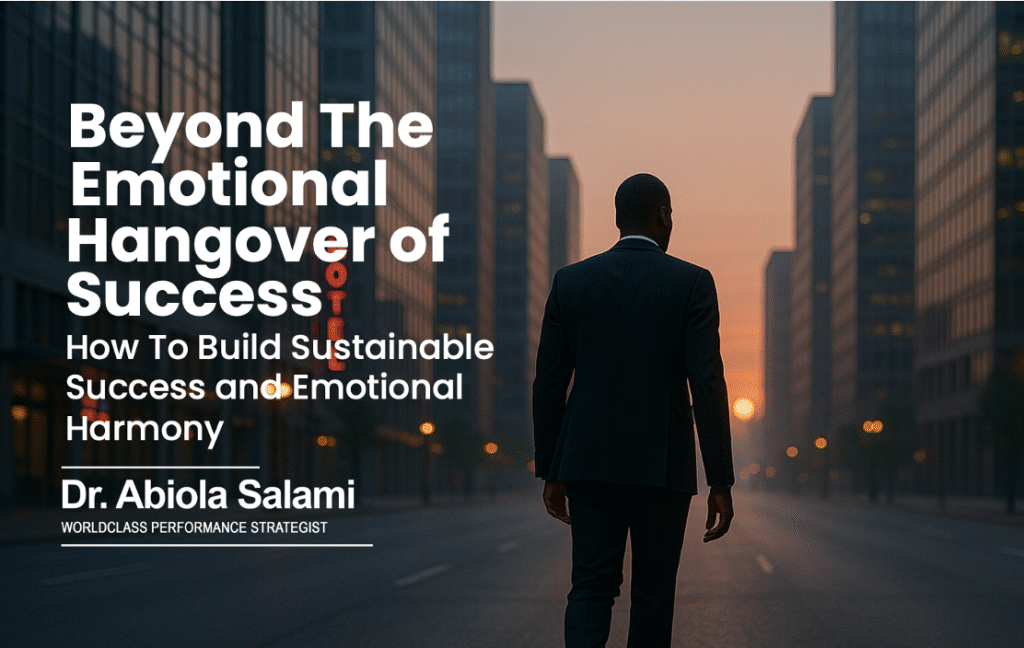
Today, we conclude our month long conversation on Taming the Emotional Hangover of Achievement.
Introduction
There is a moment in every leader’s journey when success stops being about speed and starts being about sustainability. You no longer want to win fast, you want to win forever.
That shift marks the graduation from achievement to alignment. It’s the space where ambition meets emotional intelligence and where impact no longer costs you your inner peace.
After exploring the why of emotional fatigue and the how of the A.L.I.G.N Framework, this final part focuses on the after where we discuss how to build a rhythm of life and leadership that keeps you whole even while the world keeps demanding more.
1. Redefine success as sustainability
In traditional business culture, success is measured in quarterly returns, market share, or public perception. But modern leadership demands a deeper metric I will call emotional sustainability.
Ask yourself:
- Can I still feel joy in what I’m building?
- Can my team grow without breaking?
- Can my body, mind, and relationships survive the next decade of this pace?
When sustainability becomes your definition of success, your strategy changes. You delegate more intelligently. You choose battles wisely. You start saying no, not because you are weak, but because you are wise.
As I wrote in TITLE, “A leader’s greatest victory is not staying on top of the world; it’s staying in touch with their soul while they’re there.”
2. Practice the rhythm of recovery
Human beings are cyclical creatures. Seasons of performance must be followed by seasons of replenishment. High-achieving leaders often violate this law of rhythm. They sprint through life as if the universe rewards exhaustion.
Recovery is not an act of laziness; it’s an act of intelligence.
Schedule restoration as seriously as you schedule results. That includes:
- Quiet reflection: daily solitude for mental reset.
- Emotional decluttering: regular conversations with a coach or confidant.
- Physical renewal: sleep, nutrition, exercise not as vanity but as vitality.
- Spiritual anchoring: moments that remind you of purpose beyond performance.
- Social Reconnection: This is about restoring energy through human presence with family, genuine friends, mentors, or community.
When recovery becomes ritual, resilience becomes reflex.
3. Lead with Emotional Intelligence as strategy
Emotional Intelligence (EI) is not soft skill; it is strategic infrastructure. EI helps you notice when your ambition is outrunning your awareness. It helps you interpret your team’s silence, your spouse’s sigh, your body’s fatigue. It turns blind pursuit into conscious leadership.
Leaders with high EI create psychologically safe environments where teams can thrive without fear. They know that pressure should stretch people, not strangle them.
Business strategy without emotional intelligence leads to self destruction.
4. Build a legacy of balance
Sustainable leadership is not about leaving monuments; it’s about leaving methods that are replicable as humane ways of achieving greatness.
Mentor your next generation of leaders to work smart and live whole. Let them see you take rest without guilt, delegate without ego, and apologize without losing authority. Legacy is not just what they remember about your achievements; it’s what they imitate about your character.
When your organization learns that wellbeing and performance can coexist, you’ve created culture not chaos.
5. Design systems that protect peace
Emotionally intelligent leaders institutionalize balance. They build systems that make renewal unavoidable:
- Annual executive retreats that blend strategy with reflection.
- Leadership scorecards that track wellbeing alongside KPIs.
- Cultures that celebrate rest, not just resilience.
In neuroscience, this is called embedding safety cues. Your brain relaxes when renewal becomes predictable. So does your team’s. Peace stops being an accident; it becomes architecture.
6. Develop Courage
Courage is the quiet strength behind sustainability. It takes courage to slow down when the world applauds speed. It takes courage to tell your board that burnout is not a badge of honor. It takes courage to say, “I choose wholeness over hype.”
That courage is the new frontier of leadership.
As I remind leaders everywhere: “The greatest disruption in business today is not technological; it is emotional. The future will belong to those who can manage both technology and humanity.”
7. Integrate Humanity Into Every Metric
The final frontier of sustainable leadership is humanity. Unlocking humanity is the decision to measure what truly matters.
What if your KPIs included kindness? What if quarterly reviews considered joy, empathy, or trust? What if the success of your next product was evaluated not only by sales, but by the wellbeing of the people who built it?
When you integrate humanity into your leadership metrics, you don’t just grow profits, you grow people. And people who are valued, seen, and supported will always outperform those who are merely managed.
Leadership, at its core, is not the art of driving results. It’s the discipline of preserving humanity while producing excellence.
Peak performance is not a constant summit; it’s a disciplined dance between effort and ease. It’s not about avoiding pressure. It’s about processing it intelligently.
When you master that dance, achievement stops being a high you chase and becomes a harmony you sustain. You no longer fear the silence after success; you start to savor it.
An invitation to the CEO Forum — Where renewal meets strategy
If this series has stirred within you a desire to lead powerfully yet peacefully, I invite you to join us at the CEO Forum during The Peak Performer Festival (TPP Fest 2025).
This gathering convenes Africa’s top executives, founders, and public leaders under the theme: “TITLE: Taming the Emotional Cost of Leadership Expectations.”
This year’s Forum will feature thought-provoking insights from Mr. Kunle Elebute, Former Chairman, KPMG Africa, Otunba Bimbo Ashiru, Mr. Udeme Ufot and other captains of industries.
Together, we will explore how to:
✅ Build emotionally sustainable organizations.
✅ Redefine performance through purpose and presence.
✅ Lead with authenticity in an age of relentless expectation.
The CEO Forum is not another panel marathon; it is a closed-door conversation. It is a sanctuary for reflection, reconnection, and recalibration.
To request your exclusive invitation, email team@tppafrica.com with the subject line “CEO Forum Invitation – TPP Fest 2025.” Spaces are limited, because genuine renewal requires intimacy, not crowding.
Join us, and let’s rewrite what it means to win together.
Closing Reflection
If the first half of your career was about achievement, let the next half be about alignment. Because true greatness is not measured by how much you conquer, but by how much of yourself remains intact after every conquest.
Leadership should not empty you. It should expand you. And when peace becomes your power, success finally feels like success.
About Dr. Abiola Salami
Dr. Abiola Salami is the Convener of Dr Abiola Salami International Leadership Bootcamp ; The Peak PerformerTM Festival Made4More Accelerator Program and The New Year Kickoff Summit. He is the Principal Performance Strategist at CHAMP – a full scale professional services firm trusted by high performing business leaders for providing Executive Coaching, Workforce Development & Advisory Services to improve performance. You can reach his team on hello@abiolachamp.com and connect with him @abiolachamp on all social media platforms.
For private coaching, boardroom recalibration, or executive healing strategy, connect email me directly at hello@abiolachamp.com to begin your private Executive Coaching Session.

