
How to Prevent Strategy Execution Failure 8: What High Performing Organizations Do Differently by Dr. Abiola Salami, Worldclass Performance Strategist
How to Prevent Strategy Execution Failure 8: What High Performing Organizations Do Differently by Dr. Abiola Salami, Worldclass Performance Strategist
By now, one truth should be clear. Strategy is not the problem. Across organizations, strategies are increasingly sophisticated. Leaders are informed. Teams are capable. Resources are available. Yet execution continues to fail. Deadlines slip. Priorities shift. Momentum fades. And despite multiple interventions, the same pattern repeats. Which raises a critical question What are high-performing organizations doing differently?
The Execution Divide
Having observed organizations closely, I have noticed a clear divide. On one side are organizations that plan well but struggle to execute with teams that are busy but not productive and leaders who are involved but overwhelmed. On the other side are organizations that execute consistently with teams that move with clarity and speed and leaders who sustain performance under pressure.
The difference is not intelligence. It is not resources. It is not even strategy. It is structure. More specifically, how execution is designed within human environments.
Execution is not an outcome, it is a system. Most organizations treat execution as an outcome, as something that should happen after planning. But high-performing organizations treat execution differently; they treat it as a system.
A system built on leadership behavior, team dynamics, decision flow and emotional intelligence. Because they understand something fundamental i.e. Execution is not what you do after strategy. Execution is how strategy comes alive through people.
Often, the missing link is emotional intelligence in execution. For years, emotional intelligence has been discussed as a “soft skill.” But in reality, it is one of the most critical drivers of execution because execution depends on how leaders respond under pressure, how teams communicate under stress, how quickly problems are surfaced and how confidently decisions are made.
These are not technical issues. They are human issues. And human issues require emotional intelligence.
To bridge the gap between strategy and execution, high-performing organizations rely on structured leadership systems. This is where the TPPFEST Framework™ comes in. It is not a theory. It is a practical model for executing strategy in real-world, high-pressure environments.
The TPPFEST Framework™ — Executing Strategy in Human Environments
T — Timely & Decisive Leadership
Execution slows where leaders hesitate. Indecision creates delays, confusion and loss of momentum
High-performing leaders understand that clarity drives speed. They prioritize fast decision-making, clear direction and action over over-analysis. Because in execution, waiting is costly.
P — People-Centered Execution
Strategy is executed by people not processes. And people perform best in environments where they feel safe, heard and valued. High-performing organizations build trust, psychological safety and open communication. Because people don’t execute what they are told. They execute what they feel safe to act on.
P — Performance Accountability Without Fear
Fear delays information. And delayed information kills execution. Organizations that execute well create environments where problems are raised early, mistakes are discussed openly and ownership is shared because silence is the real enemy of execution.
F — Focus & Energy Discipline
Execution is not a time problem. It is an energy problem. Leaders and teams often fail not because they lack time but because their energy is scattered. High-performing organizations prioritize ruthlessly, eliminate unnecessary complexity and protect focus because tired teams don’t execute well.
E — Emotional Intelligence Under Pressure
Pressure is inevitable but poor emotional response is optional. High-performing leaders regulate emotions, stay composed and respond intentionally because emotional instability creates confusion and confusion slows execution.
S — Scalable Systems Over Personality
Many organizations depend too heavily on individuals. One strong leader. One reliable performer. But that model does not scale. High-performing organizations build systems that distribute responsibility, enable faster decisions and sustain performance. Because if everything depends on one person, execution will always slow down.
T — Total Leadership Alignment
Execution breaks when leadership is not aligned with conflicting priorities, mixed signals and unclear direction. High-performing organizations ensure unified leadership, clear communication and consistent reinforcement. Because organizations don’t execute what leaders say. They execute what leaders consistently reinforce.
The TPPFEST Framework™ does three critical things, it moves organizations from planning to execution, activity to results and from motion to measurable progress. Because execution is not about doing more.
It is about doing the right things consistently and effectively.
Why This Matters Now
The business environment is changing. Speed is increasing. Complexity is rising. Expectations are higher than ever. Organizations can no longer afford execution gaps. Because in today’s world slow decisions lose opportunities, poor communication creates risk and weak leadership environments reduce performance. Execution is no longer optional. It is the defining capability of leadership.
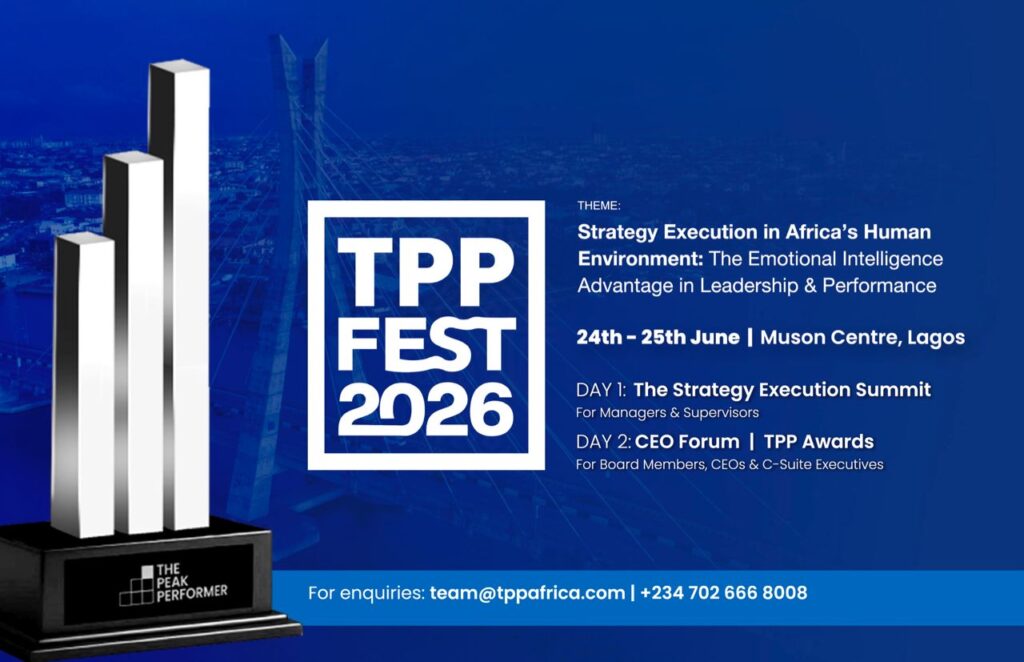
This entire conversation is about a shift. A new way of thinking about performance. The conversation comes alive at TPP Fest 2026 on 24th – 25th June with the theme Strategy Execution in Human Environments: The Emotional Intelligence Advantage in Leadership & Performance.
This platform is designed to serve two clear verticals:
1. Strategy Executors: These are Managers & Supervisors who will be exposed to our proprietary framework The Magic of Emotional Intelligence for daily execution with a focus on behavior, communication and team climate.
2. Strategy Leaders: These are Senior Leaders, C-Suite Executives, Company Directors who will engage with our proprietary framework Taming the Invisible Toll of Leadership Expectations™ with a focus on decision quality, pressure management and organizational energy.
Because the future of leadership will not be defined by how much leaders know. It will be defined by how well they can execute through people and under pressure without losing the people or breaking down.
An Important Reflection
Ask yourself Is your organization designed for execution Or are you relying on effort and hope? Because strategy alone is not enough. Execution requires structure and structure requires intentional leadership.
Final Thought
Execution excellence is not talent. It is not luck. It is not even strategy. It is discipline. It is structure. It is leadership applied consistently under pressure. Because in the end, the organizations that win are not the ones that plan the best. They are the ones that execute the best; nnd execution belongs to leaders and teams who Show up.
About Dr. Abiola Salami
Dr. Abiola Salami is the Convener of Dr Abiola Salami International Leadership Bootcamp ; The Peak PerformerTM Festival Made4More Accelerator Program and The New Year Kickoff Summit. He is the Principal Performance Strategist at CHAMP – a full scale professional services firm trusted by high performing business leaders for providing Executive Coaching, Workforce Development & Advisory Services to improve performance. You can reach his team on hello@abiolachamp.com and connect with him @abiolachamp on all social media platforms.
For private coaching, boardroom recalibration, or executive healing strategy, connect email me directly at hello@abiolachamp.com to begin your private Executive Coaching Session.

